100-101 Exam Details
-
Exam Code
:100-101 -
Exam Name
:CCNA Interconnecting Cisco Networking Devices 1 (ICND1) -
Certification
:Cisco Certifications -
Vendor
:Cisco -
Total Questions
:202 Q&As -
Last Updated
:Dec 07, 2021
Cisco 100-101 Online Questions & Answers
-
Question 51:
Which two of these statements are true of IPv6 address representation? (Choose two.)
A. There are four types of IPv6 addresses: unicast, multicast, anycast, and broadcast.
B. A single interface may be assigned multiple IPv6 addresses of any type.
C. Every IPv6 interface contains at least one loopback address.
D. The first 64 bits represent the dynamically created interface ID.
E. Leading zeros in an IPv6 16 bit hexadecimal field are mandatory. -
Question 52:
Refer to the output of the corporate router routing table shown in the graphic.
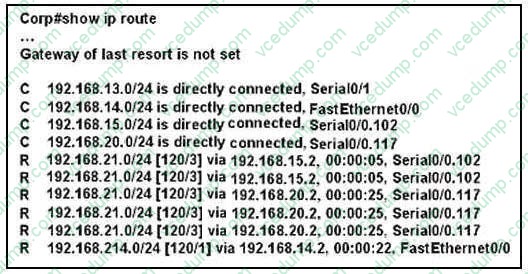
The corporate router receives an IP packet with a source IP address of 192.168.214.20 and a destination address of 192.168.22.3.
What will the router do with this packet?
A. It will encapsulate the packet as Frame Relay and forward it out interface Serial 0/0.117.
B. It will discard the packet and send an ICMP Destination Unreachable message out interface FastEthernet 0/0.
C. It will forward the packet out interface Serial 0/1 and send an ICMP Echo Reply message out interface serial 0/0.102.
D. It will change the IP packet to an ARP frame and forward it out FastEthernet 0/0. -
Question 53:
Refer to the exhibit.

Why are two OSPF designated routers identified on Core-Router?
A. Core-Router is connected to more than one multi-access network.
B. The router at 208.149.23.130 is a secondary DR in case the primary fails.
C. Two router IDs have the same OSPF priority and are therefore tied for DR election
D. The DR election is still underway and there are two contenders for the role. -
Question 54:
Scenario
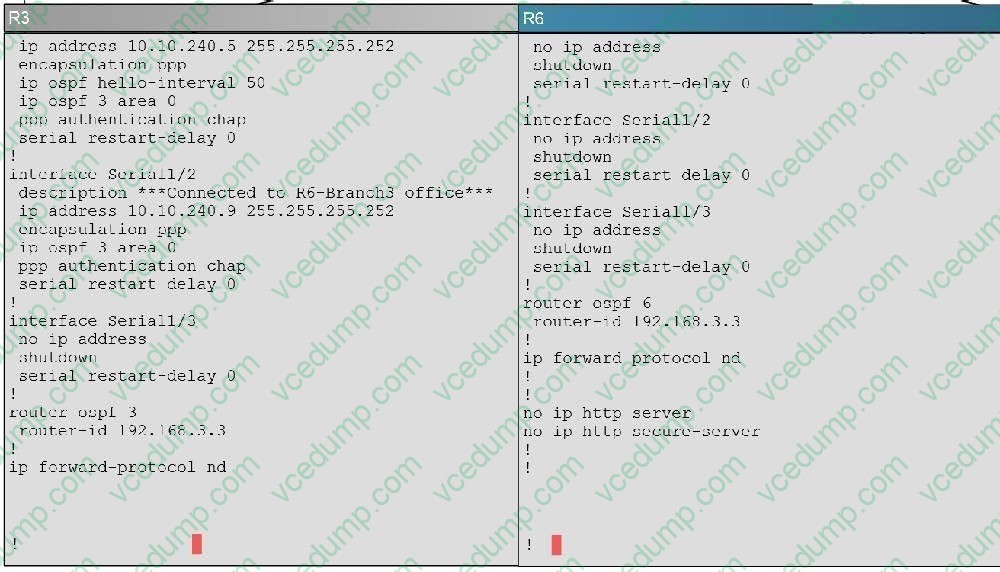
Refer to the topology. Your company has decided to connect the main office with three other remote branch offices using point-to-point serial links. You are required to troubleshoot and resolve OSPF neighbor adjacency issues between the main office and the routers located in the remote branch offices.
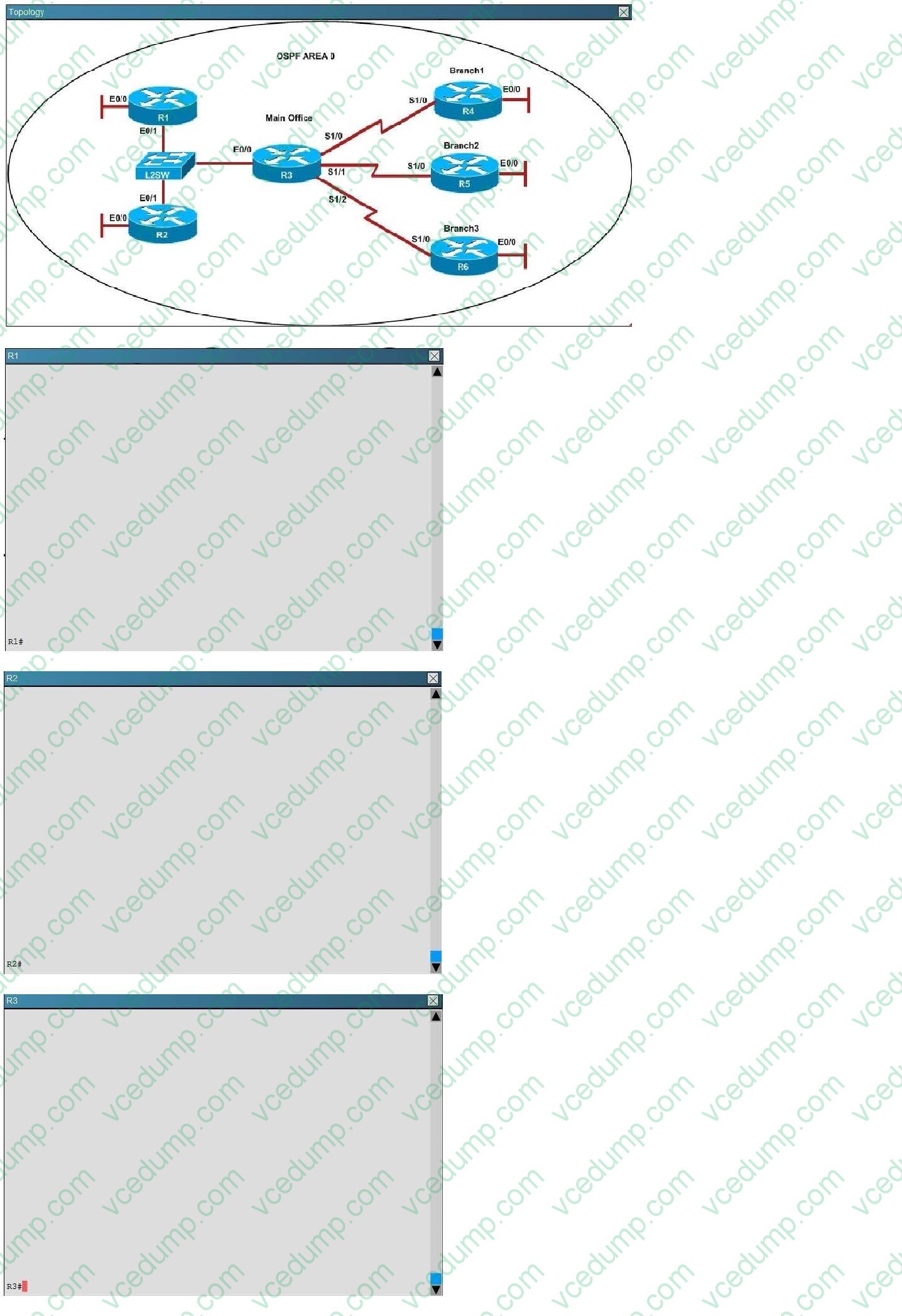
An OSPF neighbor adjacency is not formed between R3 in the main office and R6 in the Branch3 office. What is causing the problem?
A. There is an area ID mismatch.
B. There is a PPP authentication issue; the username is not configured on R3 and R6.
C. There is an OSPF hello and dead interval mismatch.
D. The R3 router ID is configured on R6. -
Question 55:
SIMULATION
There are three locations in a school district of a large city: ROUTER -M, ROUTER -W and ROUTER -U. The network connection between two of these locations has already functioned.
Configure the ROUTER -M router IP addresses on the E0 and S0 interfaces so that the E0 receives the first usable subnet while the S0 receives the second usable subnet from the network 192.168.160.0/28. Both interfaces would receive the
last available ip address on the proper subnet.
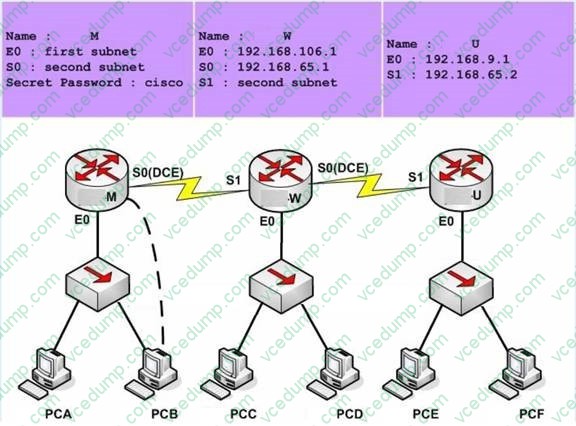
Note. The OSPF process must be configured to allow interfaces in specific subnets to participate in the routing process.
Correct Answer. ROUTER-M> enable -
Question 56:
When configuring NAT, the Internet interface is considered to be what?
A. local
B. inside
C. global
D. outside -
Question 57:
What is the OSPF default frequency, in seconds, at which a Cisco router sends hello packets on a multi- access network?
A. 10
B. 40
C. 30
D. 20 -
Question 58:
Refer to the exhibit.
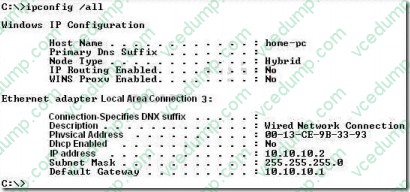
A user cannot reach any web sites on the Internet, but others in the department are not having a problem. What is the most likely cause of the problem?
A. IP routing is not enabled.
B. The default gateway is not in the same subnet.
C. A DNS server address is not reachable by the PC.
D. A DHCP server address is not reachable by the PC.
E. NAT has not been configured on the router that connects to the Internet. -
Question 59:
The network administrator has found the following problem.
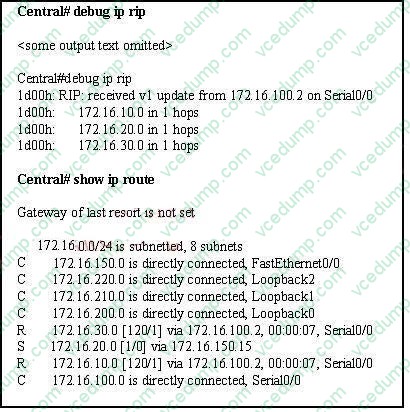
The remote networks 172.16.10.0, 172.16.20.0, and 172.16.30.0 are accessed through the Central router's serial 0/0 interface. No users are able to access 172.16.20.0. After reviewing the command output shown in the graphic, what is the most likely cause of the problem?
A. no gateway of last resort on Central
B. Central router's not receiving 172.16.20.0 update
C. incorrect static route for 172.16.20.0
D. 172.16.20.0 not located in Central's routing table -
Question 60:
Which address type does a switch use to make selective forwarding decisions?
A. Source IP address
B. Destination IP address
C. Source and destination IP address
D. Source MAC address
E. Destination MAC address
Related Exams:
-
300-745
Designing Cisco Security Infrastructure (300-745 SDSI) v1.0 -
350-101
Implementing and Operating Cisco Wireless Core Technologies (350-101 WLCOR)v1.0 -
352-011
Cisco Certified Design Expert Practical -
500-052
Cisco Unified Contact Center Express -
500-173
Designing the FlexPod Solution (FPDESIGN) -
500-201
Deploying Cisco Service Provider Mobile Backhaul Solutions -
500-210
SP Optical Technology Field Engineer Representative -
500-220
Engineering Cisco Meraki Solutions (ECMS) v2.2 -
500-230
Cisco Service Provider Routing Field Engineer -
500-240
Cisco Mobile Backhaul for Field Engineers
Tips on How to Prepare for the Exams
Nowadays, the certification exams become more and more important and required by more and more enterprises when applying for a job. But how to prepare for the exam effectively? How to prepare for the exam in a short time with less efforts? How to get a ideal result and how to find the most reliable resources? Here on Vcedump.com, you will find all the answers. Vcedump.com provide not only Cisco exam questions, answers and explanations but also complete assistance on your exam preparation and certification application. If you are confused on your 100-101 exam preparations and Cisco certification application, do not hesitate to visit our Vcedump.com to find your solutions here.