100-101 Exam Details
-
Exam Code
:100-101 -
Exam Name
:CCNA Interconnecting Cisco Networking Devices 1 (ICND1) -
Certification
:Cisco Certifications -
Vendor
:Cisco -
Total Questions
:202 Q&As -
Last Updated
:Dec 07, 2021
Cisco 100-101 Online Questions & Answers
-
Question 181:
ROUTER# show ip route 192.168.12.0/24 is variably subnetted, 9 subnets, 3 masks C 192.168.12.64 /28 is directly connected, Loopback1 C 192.168.12.32 /28 is directly connected, Ethernet0 C 192.168.12.48 /28 is directly connected, Loopback0 O
192.168.12.236 /30 [110/128] via 192.168.12.233, 00:35:36, Serial0 C 192.168.12.232 /30 is directly connected, Serial0 O 192.168.12.245 /30 [110/782] via 192.168.12.233, 00:35:36, Serial0 O 192.168.12.240 /30 [110/128] via 192.168.12.233, 00:35:36, Serial0 O 192.168.12.253 /30 [110/782] via 192.168.12.233, 00:35:37, Serial0 O 192.168.12.249 /30 [110/782] via 192.168.12.233, 00:35:37, Serial0 O 192.168.12.240/30 [110/128] via 192.168.12.233, 00:35:36, Serial 0
To what does the 128 refer to in the router output above?
A. OSPF cost
B. OSPF priority
C. OSPF hop count
D. OSPF ID number
E. OSPF administrative distance -
Question 182:
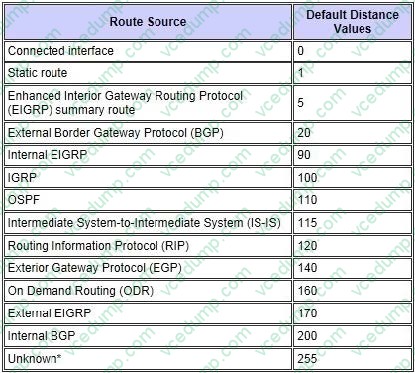
What is the default administrative distance of the OSPF routing protocol?
A. 90
B. 100
C. 110
D. 120
E. 130
F. 170 -
Question 183:
What is the purpose of the switchport command?
Switch(config-if)# switchport port-security maximum 1 Switch(config-if)# switchport port-security mac- address 0018.DE8B.4BF8
A. It ensures that only the device with the MAC address 0018.DE8B.4BF8 will be able to connect to the port that is being configured.
B. It informs the switch that traffic destined for MAC address 0018.DE8B.4BF8 should only be sent to the port that is being configured.
C. It will act like an access list and the port will filter packets that have a source or destination MAC of 0018.DE8B.4BF8.
D. The switch will shut down the port of any traffic with source MAC address of 0018.DE8B.4BF8. -
Question 184:
On a Cisco switch, which protocol determines if an attached VoIP phone is from Cisco or from another vendor?
A. RTP
B. TCP
C. CDP
D. UDP -
Question 185:
Refer to the exhibit.
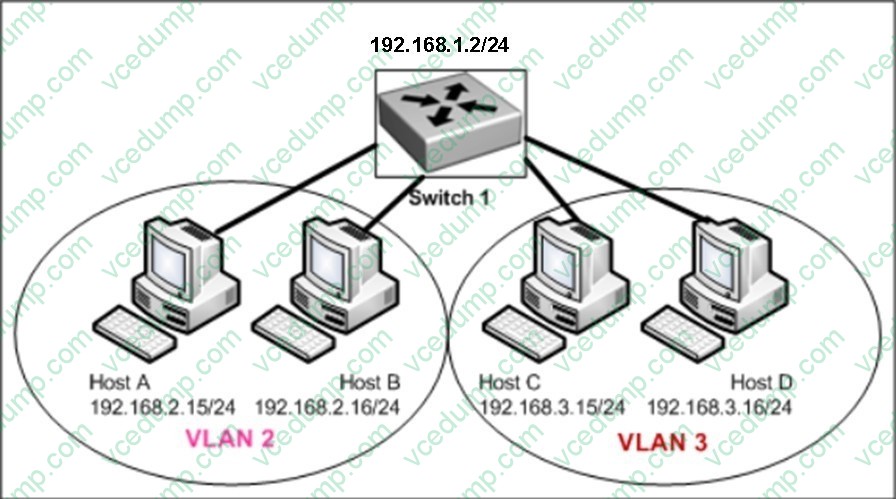
Host A can communicate with Host B but not with Hosts C or D. How can the network administrator solve this problem?
A. Configure Hosts C and D with IP addresses in the 192.168.2.0 network.
B. Install a router and configure a route to route between VLANs 2 and 3.
C. Install a second switch and put Hosts C and D on that switch while Hosts A and B remain on the original switch.
D. Enable the VLAN trunking protocol on the switch. -
Question 186:
Refer to the exhibit.
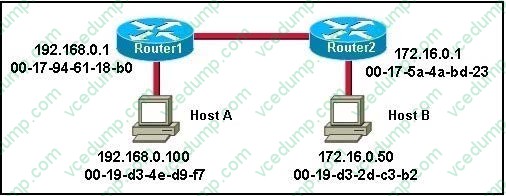
Host A is sending a packet to Host B for the first time. What destination MAC address will Host A use in the ARP request?
A. 192.168.0.1
B. 172.16.0.50
C. 00-17-94-61-18-b0
D. 00-19-d3-2d-c3-b2
E. ff-ff-ff-ff-ff-ff
F. 255.255.255.255 -
Question 187:
Refer to the exhibit.
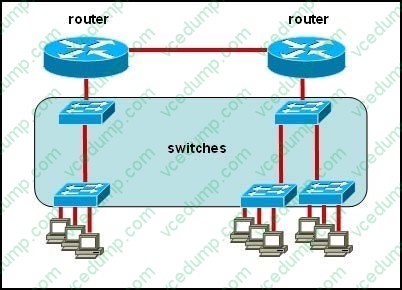
All devices attached to the network are shown. How many collision domains are present in this network?
A. 2
B. 3
C. 6
D. 9
E. 15 -
Question 188:
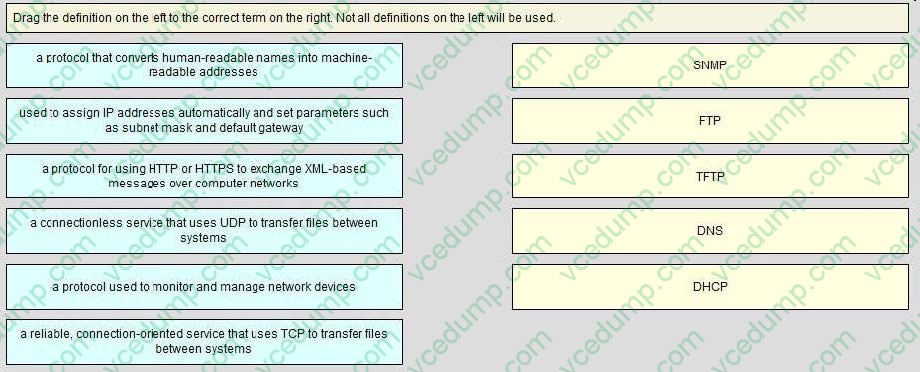
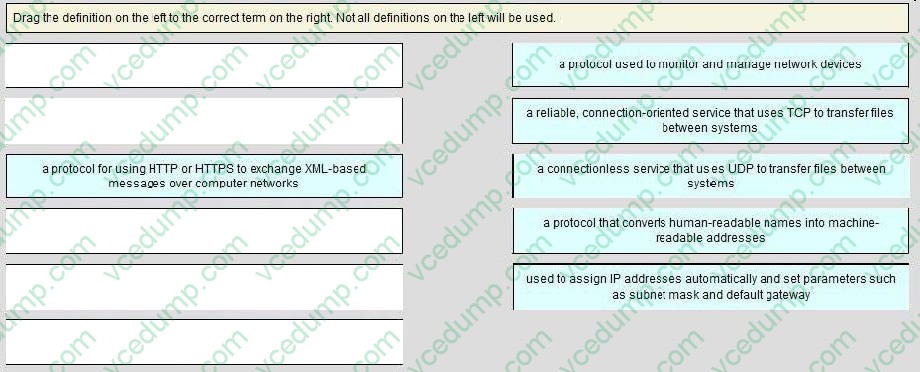
Select and Place:
Select and Place:
-
Question 189:
How many addresses will be available for dynamic NAT translation when a router is configured with the following commands?
Router(config)#ip nat pool TAME 209.165.201.23 209.165.201.30 netmask 255.255.255.224 Router (config)#ip nat inside source list 9 pool TAME
A. 7
B. 8
C. 9
D. 10
E. 24
F. 32 -
Question 190:
Refer to the exhibit.
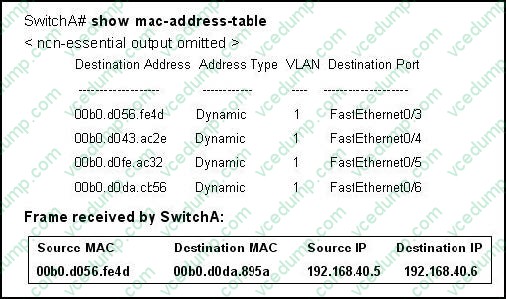
SwitchA receives the frame with the addressing shown in the exhibit. According to the command output also shown in the exhibit, how will SwitchA handle this frame?
A. It will drop the frame.
B. It will forward the frame out port Fa0/6 only.
C. It will forward the frame out port Fa0/3 only.
D. It will flood the frame out all ports.
E. It will flood the frame out all ports except Fa0/3.
Related Exams:
-
300-745
Designing Cisco Security Infrastructure (300-745 SDSI) v1.0 -
350-101
Implementing and Operating Cisco Wireless Core Technologies (350-101 WLCOR)v1.0 -
352-011
Cisco Certified Design Expert Practical -
500-052
Cisco Unified Contact Center Express -
500-173
Designing the FlexPod Solution (FPDESIGN) -
500-201
Deploying Cisco Service Provider Mobile Backhaul Solutions -
500-210
SP Optical Technology Field Engineer Representative -
500-220
Engineering Cisco Meraki Solutions (ECMS) v2.2 -
500-230
Cisco Service Provider Routing Field Engineer -
500-240
Cisco Mobile Backhaul for Field Engineers
Tips on How to Prepare for the Exams
Nowadays, the certification exams become more and more important and required by more and more enterprises when applying for a job. But how to prepare for the exam effectively? How to prepare for the exam in a short time with less efforts? How to get a ideal result and how to find the most reliable resources? Here on Vcedump.com, you will find all the answers. Vcedump.com provide not only Cisco exam questions, answers and explanations but also complete assistance on your exam preparation and certification application. If you are confused on your 100-101 exam preparations and Cisco certification application, do not hesitate to visit our Vcedump.com to find your solutions here.