100-101 Exam Details
-
Exam Code
:100-101 -
Exam Name
:CCNA Interconnecting Cisco Networking Devices 1 (ICND1) -
Certification
:Cisco Certifications -
Vendor
:Cisco -
Total Questions
:202 Q&As -
Last Updated
:Dec 07, 2021
Cisco 100-101 Online Questions & Answers
-
Question 171:
An administrator is working with the 192.168.4.0 network, which has been subnetted with a /26 mask. Which two addresses can be assigned to hosts within the same subnet? (Choose two.)
A. 192.168.4.61
B. 192.168.4.63
C. 192.168.4.67
D. 192.168.4.125
E. 192.168.4.128
F. 192.168.4.132 -
Question 172:
Refer to the exhibit.
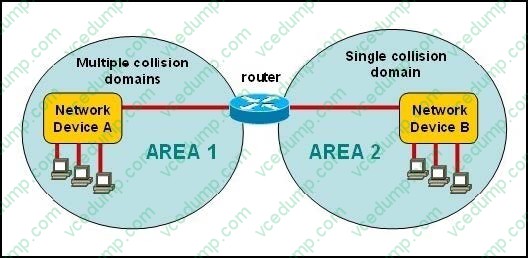
A network has been planned as shown. Which three statements accurately describe the areas and devices in the network plan? (Choose three.)
A. Network Device A is a switch.
B. Network Device B is a switch.
C. Network Device A is a hub.
D. Network Device B is a hub.
E. Area 1 contains a Layer 2 device.
F. Area 2 contains a Layer 2 device. -
Question 173:
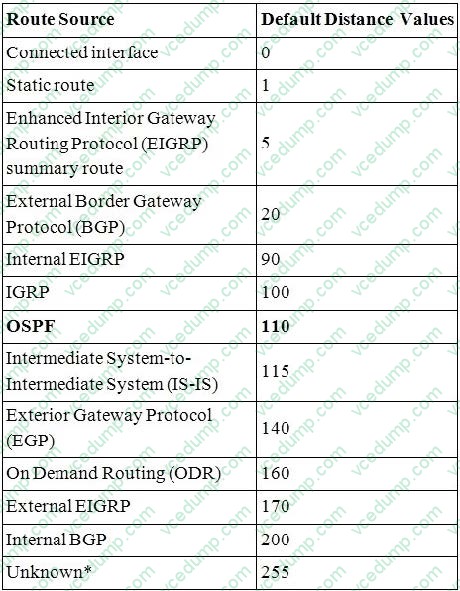
What is the default administrative distance of OSPF?
A. 90
B. 100
C. 110
D. 120 -
Question 174:
Refer to the exhibit.
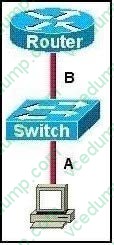
The two connected ports on the switch are not turning orange or green. What would be the most effective steps to troubleshoot this physical layer problem? (Choose three.)
A. Ensure that the Ethernet encapsulations match on the interconnected router and switch ports.
B. Ensure that cables A and B are straight-through cables.
C. Ensure cable A is plugged into a trunk port.
D. Ensure the switch has power.
E. Reboot all of the devices.
F. Reseat all cables. -
Question 175:
Refer to the exhibit.
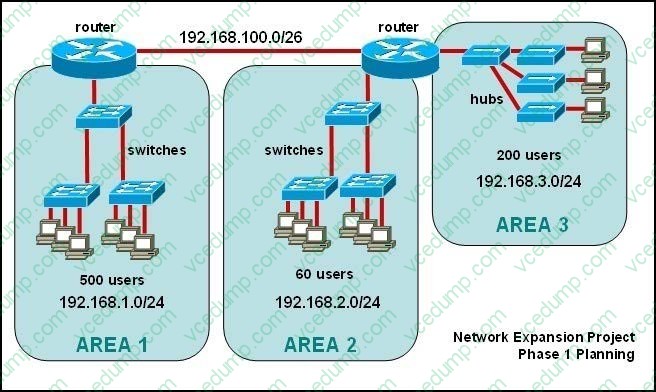
The junior network support staff provided the diagram as a recommended configuration for the first phase of a four-phase network expansion project. The entire network expansion will have over 1000 users on 14 network segments and has been allocated this IP address space.
192.168.1.1 through 192.168.5.255
192.168.100.1 through 192.168.100.255
What are three problems with this design? (Choose three.)
A. The AREA 1 IP address space is inadequate for the number of users.
B. The AREA 3 IP address space is inadequate for the number of users.
C. AREA 2 could use a mask of /25 to conserve IP address space.
D. The network address space that is provided requires a single network-wide mask.
E. The router-to-router connection is wasting address space.
F. The broadcast domain in AREA 1 is too large for IP to function. -
Question 176:
Refer to the exhibit.
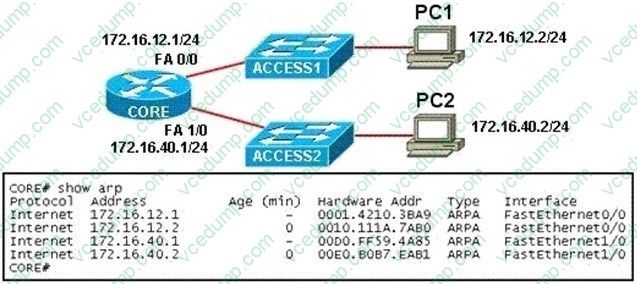
PC1 pings PC2. What three things will CORE router do with the data that is received from PC1? (Choose three.)
A. The data frames will be forwarded out interface FastEthernet0/1 of CORE router.
B. The data frames will be forwarded out interface FastEthernet1/0 of CORE router.
C. CORE router will replace the destination IP address of the packets with the IP address of PC2.
D. CORE router will replace the MAC address of PC2 in the destination MAC address of the frames.
E. CORE router will put the IP address of the forwarding FastEthernet interface in the place of the source IP address in the packets.
F. CORE router will put the MAC address of the forwarding FastEthernet interface in the place of the source MAC address. -
Question 177:
Refer to the exhibit.
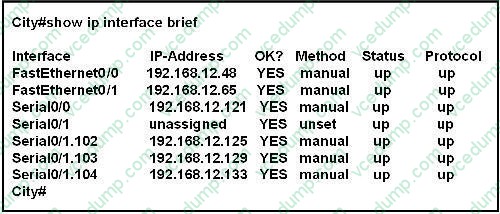
A network associate has configured OSPF with the command:
City(config-router)# network 192.168.12.64 0.0.0.63 area 0
After completing the configuration, the associate discovers that not all the interfaces are participating in OSPF. Which three of the interfaces shown in the exhibit will participate in OSPF according to this configuration statement? (Choose three.)
A. FastEthernet0 /0
B. FastEthernet0 /1
C. Serial0/0
D. Serial0/1.102
E. Serial0/1.103
F. Serial0/1.104 -
Question 178:
What is the network address for the host with IP address 192.168.23.61/28?
A. 192.168.23.0
B. 192.168.23.32
C. 192.168.23.48
D. 192.168.23.56
E. 192.168.23.60 -
Question 179:
What is the subnet address for the IP address 172.19.20.23/28?
A. 172.19.20.0
B. 172.19.20.15
C. 172.19.20.16
D. 172.19.20.20
E. 172.19.20.32 -
Question 180:
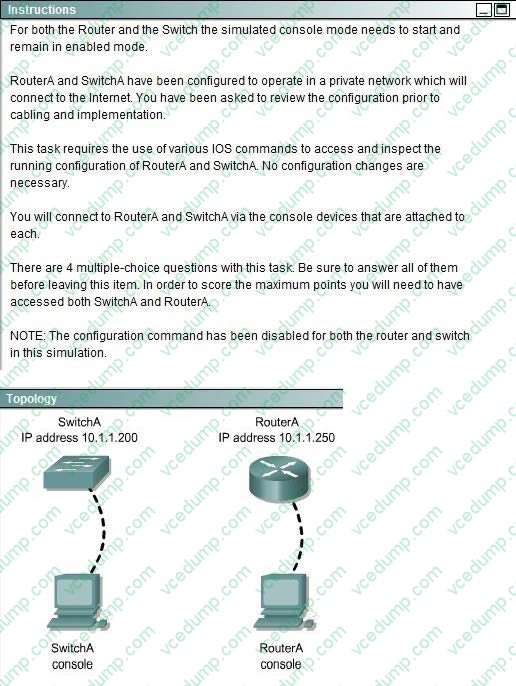
Select two options which are security Issues which need to be modified before RouterA is used? (Choose two.)
A. unencrypted weak password is configured to protect privilege mode
B. inappropriate wording in banner message
C. the virtual terminal lines have a weak password configured
D. virtual terminal lines have a password, but it will not be used
E. configuration supports un-secure web server access
Related Exams:
-
300-745
Designing Cisco Security Infrastructure (300-745 SDSI) v1.0 -
350-101
Implementing and Operating Cisco Wireless Core Technologies (350-101 WLCOR)v1.0 -
352-011
Cisco Certified Design Expert Practical -
500-052
Cisco Unified Contact Center Express -
500-173
Designing the FlexPod Solution (FPDESIGN) -
500-201
Deploying Cisco Service Provider Mobile Backhaul Solutions -
500-210
SP Optical Technology Field Engineer Representative -
500-220
Engineering Cisco Meraki Solutions (ECMS) v2.2 -
500-230
Cisco Service Provider Routing Field Engineer -
500-240
Cisco Mobile Backhaul for Field Engineers
Tips on How to Prepare for the Exams
Nowadays, the certification exams become more and more important and required by more and more enterprises when applying for a job. But how to prepare for the exam effectively? How to prepare for the exam in a short time with less efforts? How to get a ideal result and how to find the most reliable resources? Here on Vcedump.com, you will find all the answers. Vcedump.com provide not only Cisco exam questions, answers and explanations but also complete assistance on your exam preparation and certification application. If you are confused on your 100-101 exam preparations and Cisco certification application, do not hesitate to visit our Vcedump.com to find your solutions here.