WGU University WGU-SPF Online Practice Questions and Exam Preparation
WGU-SPF Exam Details
-
Exam Code
:WGU-SPF -
Exam Name
:WGU Scripting and Programming Foundations -
Certification
:WGU University Certifications -
Vendor
:WGU University -
Total Questions
:141 Q&As -
Last Updated
:Jul 08, 2026
WGU University WGU-SPF Online Questions & Answers
-
Question 41:
Which programming construct allows a program to choose between two or more paths of execution?
A. Loop
B. Variable
C. Conditional statement
D. FunctionC. Conditional statementConditional statements, such as if-else structures, allow a program to make decisions and execute different blocks of code based on whether a condition evaluates to true or false. Loops handle repetition, variables store data, and functions group reusable code.
-
Question 42:
A particular sorting takes integer list 10,8 and incorrectly sorts the list to 6, 10, 8.
What is true about the algorithm's correctness for sorting an arbitrary list of three integers?
A. The algorithm only works for 10,6, 8
B. The algorithm is correct
C. The algorithm's correctness is unknown
D. The algorithm is incorrectD. The algorithm is incorrectThe correctness of a sorting algorithm is determined by its ability to sort a list of elements into a specified order, typically non-decreasing or non-increasing order. For an algorithm to be considered correct, it must consistently produce the correct output for all possible inputs. In the case of the given algorithm, it takes the input list [10, 8] and produces the output [6, 10, 8], which is not sorted in non-decreasing order. This indicates that the algorithm does not correctly sort the list, as the output is neither sorted nor does it maintain the integrity of the original list (the number 6 was not in the original list). Furthermore, the fact that the output contains an integer (6) that was not present in the input list suggests that the algorithm is not preserving the elements of the input list, which is a fundamental requirement for a sorting algorithm. This violation confirms that the algorithm is incorrect for sorting an arbitrary list of three integers, as it cannot be relied upon to sort correctly or maintain the original list elements. References: The principles of algorithm correctness can be found in various computer science literature and online resources. They often involve ensuring that the algorithm adheres to its preconditions and postconditions, and that it produces a valid output for all valid inputs1234.
-
Question 43:
One requirement for the language of a project is that it is based on a series of cells. Which type of language is characterized in this way?
A. Functional
B. Static
C. Markup
D. CompiledC. MarkupThe term "based on a series of cells" is commonly associated with markup languages, particularly in the context of web development, where content is structured in a hierarchical or cell-based layout (e.g., HTML tables or CSS grid systems). According to foundational programming principles, markup languages like HTML are characterized by their use of tags to define elements, which can be visualized as cells or containers for content.
Option A: "Functional." This is incorrect. Functional languages (e.g., Haskell, Lisp) focus on functions as first-class citizens and immutability, not on a cell-based structure.
Option B: "Static." This is incorrect. "Static" refers to typing (where types are fixed at compile time) or analysis, not a cell-based structure.
Option C: "Markup." This is correct. Markup languages like HTML use tags to create elements that can be arranged in a cell-like structure (e.g.,
or
elements in a grid). In web design, tables and CSS layouts are often described as cell-based.Option D: "Compiled." This is incorrect. Compiled languages (e.g., C, Java) are translated into machine code before execution, but they are not characterized by a cell-based structure.
Certiport Scripting and Programming Foundations Study Guide (Section on Markup Languages).
W3Schools: "HTML Tables" (https://www.w3schools.com/html/html_tables.asp).
Mozilla Developer Network: "CSS Grid Layout" (https://developer.mozilla.org/en-US/docs/Web/CSS /CSS_Grid_Layout).
Question 44:
A program steps through an array and adds up all the numbers stored in the array. What is the appropriate individual control structure that should be used?
A. One while loop
B. Nested for loops
C. Multiple if statements
D. One for loopD. One for loopTo sum all numbers in an array, the program must iterate through each element exactly once and add it to a running total. According to foundational programming principles (e.g., Certiport Scripting and Programming Foundations Study Guide), a for loop is the most appropriate control structure for iterating over a known sequence like an array.
Task Analysis:
Input: An array of numbers (e.g., [1, 2, 3]).
Operation: Iterate through each element and add to a sum (e.g., 1 + 2 + 3 = 6).
A single loop is sufficient, as the task involves a single pass through the array.
Option A: "One while loop." This is incorrect. While a while loop can iterate through an array (e.g., using an index variable), it requires manual index management (e.g., i = 0; while i < length), making it less concise and more error-prone than a for loop for this task.
Option B: "Nested for loops." This is incorrect. Nested loops are used for multi-dimensional arrays or multiple iterations (e.g., matrix operations), but summing a single array requires only one loop.
Option C: "Multiple if statements." This is incorrect. If statements are for conditional logic, not iteration. They cannot traverse an array to sum elements.
Option D: "One for loop." This is correct. A for loop is ideal for iterating over an array's elements. For example, in Python:
numbers = [1, 2, 3]
total = 0
for num in numbers:
total += num
Or in C:
int numbers[] = {1, 2, 3};
int total = 0;
for (int i = 0; i < 3; i++) {
total += numbers[i];
}
Certiport Scripting and Programming Foundations Study Guide (Section on Control Structures: Loops).
Python Documentation: "For Statements" (https://docs.python.org/3/tutorial/controlflow.html#for-statements).
W3Schools: "C For Loop" (https://www.w3schools.com/c/c_for_loop.php).
Question 45:
A programmer is writing a simu-lation for a physical experiment. Which phase of the agile approach is being carried writing new procedural code and eliminating certain function calls?
A. Testing
B. Design
C. Implementation
D. AnalysisC. ImplementationIn the context of the Agile approach, the phase where new procedural code is written and certain function calls are eliminated is known as the Implementation phase. This phase involves the actual coding and development of the software, where programmers write new code and refine existing code to meet the requirements of the project. It is during this phase that the software begins to take shape, and the functionality outlined during the design phase is executed. The Agile methodology is iterative, and the implementation phase is where each iteration's goal is to produce a working increment of the product. This phase is characterized by frequent testing and revision, as the development is aligned with user feedback and changing requirements. References: The information provided is verified as per the Agile Software Development Life Cycle phases, which typically include Concept, Inception, Iteration, Testing, Release, and Review. The Implementation phase corresponds to the Iteration phase, where the actual development and coding take place.
Question 46:
HOTSPOT
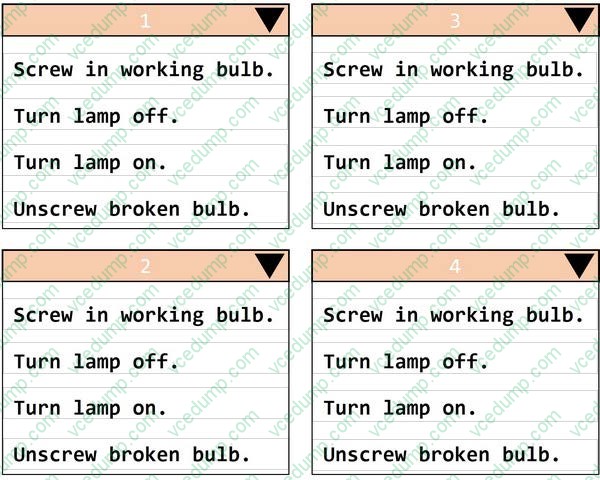
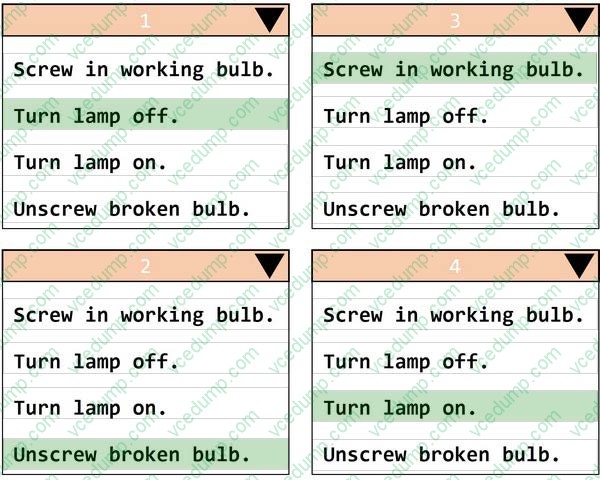
Oder the tasks needed to safely replace a lamp's light bulb from first (1) to last (4).
Select your answer from the pull down list.
Explanation
Safety and proper procedure are paramount when replacing a light bulb to avoid any electrical hazards or injuries. First, always ensure the lamp is turned off to prevent electrical shock. Next, carefully unscrew the broken or burnt-out bulb from the socket; it might be hot, so caution is advised. After removing the old bulb, screw in the new working bulb securely but without overtightening to avoid damaging the bulb or socket. Finally, turn the lamp on to verify that the new bulb is functioning properly. References The answer and explanation are based on general knowledge and common safety practices for handling electrical appliances; specific documents or standards on Scripting and Programming Foundations are not applicable here. The image displays multiple-choice options for ordering tasks needed to safely replace a lamp's light bulb, providing an interactive learning method for understanding safety procedures in handling electrical items.
Question 47:
What is the out of the given pseudocode?
A. 6
B. 12
C. 15
D. 18C. 15The pseudocode provided appears to be a loop that calculates the sum of numbers. Without seeing the exact pseudocode, I can deduce based on common programming patterns that if the loop is designed to add numbers from 1 to 5, the sum would be 1 + 2 + 3 + 4 + 5, which equals 15. This is a typical example of a series where the sum of the first n natural numbers is given by the formula 2n(n+1), and in this case, with n being 5, the sum is 25(5+1)=15 References: This answer is based on the standard algorithm for the sum of an arithmetic series and common looping constructs in programming. The formula for the sum of the first n natural numbers is a well-known result in mathematics and is often used in computer science to describe the behavior of loops and series calculations.
Question 48:
What would a string be used to store?
A. A positive whole number
B. The word "positive"
C. A true/false indication of whether a number is composite
D. A positive number between 2 and 3B. The word "positive"In programming, a string is used to store sequences of characters, which can include letters, numbers, symbols, and spaces. Strings are typically utilized to store textual data, such as words and sentences12. For example, the word "positive" would be stored as a string. While strings can contain numbers, they are not used to store numbers in their numeric form but rather as text. Therefore, options A, C, and D, which involve numbers or boolean values, would not be stored as strings unless they are meant to
be treated as text.
References:
1: Coderslang: Become a Software Engineer - What is a String in Programming.
2: Wikipedia - String (computer science).
Question 49:
Which two operators are found in the snippet not (g != 8)? Choose 2 answers.
A. Equality and logical
B. Logical and arithmetic
C. Equality and arithmetic
D. Assignment and arithmeticA. Equality and logicalThe snippet not (g != 8) contains two operators: not (logical NOT) and != (not equal, an equality operator). According to foundational programming principles (e.g., Certiport Scripting and Programming Foundations Study Guide), operators are categorized by their function, such as logical, equality, arithmetic, or assignment.
Snippet Analysis:
not: A logical operator that negates a boolean expression (e.g., not True yields False).
!=: An equality operator that checks if two values are not equal (e.g., g != 8 returns True if g is not 8).
Option A: "Equality and logical." This is correct. The snippet includes != (equality) and not (logical).
Option B: "Logical and arithmetic." This is incorrect. There are no arithmetic operators (e.g., +, -, *, /) in the snippet.
Option C: "Equality and arithmetic." This is incorrect. The snippet lacks arithmetic operators.
Option D: "Assignment and arithmetic." This is incorrect. There are no assignment operators (e.g., =) or arithmetic operators in the snippet.
Certiport Scripting and Programming Foundations Study Guide (Section on Operators).
Python Documentation: "Logical Operators" (https://docs.python.org/3/reference/expressions.html#boolean- operations).
W3Schools: "C Operators" (https://www.w3schools.com/c/c_operators.php).
Question 50:
Which of the following data types can store a sequence of characters?
A. int
B. float
C. string
D. booleanC. stringA string stores a sequence of characters in Python, such as "hello".
Related Exams:
-
WGU-IAC1
WGU Principles of Management at Western Governors University -
WGU-IBC1
WGU Organizational Behaviors and Leadership -
WGU-JY02
WGU Managing Cloud Security (JY02) -
WGU-KEO1
WGU Secure Software Design (D487, KEO1) -
WGU-MTC1
WGU Integrated Physical Sciences (MTC1) -
WGU-NSF
WGU Network and Security Foundation -
WGU-NVO1
WGUWeb Development Foundation (NVO1) -
WGU-QCO1
WGU Ethics In Technology (QCO1) -
WGU-QGC1
WGU Information Technology Management (QGC1) -
WGU-SPF
WGU Scripting and Programming Foundations
Tips on How to Prepare for the Exams
Nowadays, the certification exams become more and more important and required by more and more enterprises when applying for a job. But how to prepare for the exam effectively? How to prepare for the exam in a short time with less efforts? How to get a ideal result and how to find the most reliable resources? Here on Vcedump.com, you will find all the answers. Vcedump.com provide not only WGU University exam questions, answers and explanations but also complete assistance on your exam preparation and certification application. If you are confused on your WGU-SPF exam preparations and WGU University certification application, do not hesitate to visit our Vcedump.com to find your solutions here.