VCP5-DCV Exam Details
-
Exam Code
:VCP5-DCV -
Exam Name
:VMware Certified Professional 5 - Data Center Virtualization (VCP5-DCV) -
Certification
:VMware Certifications -
Vendor
:VMware -
Total Questions
:571 Q&As -
Last Updated
:Dec 21, 2024
VMware VCP5-DCV Online Questions & Answers
-
Question 211:
Which two traffic types can be enabled on the VMkernel adapters of an ESXi 5.5 host using the vSphere Web Client? (Choose two.)
A. Fault Tolerance Traffic
B. Virtual SAN Traffic
C. iSCSI Traffic
D. Virtual Machine Traffic -
Question 212:
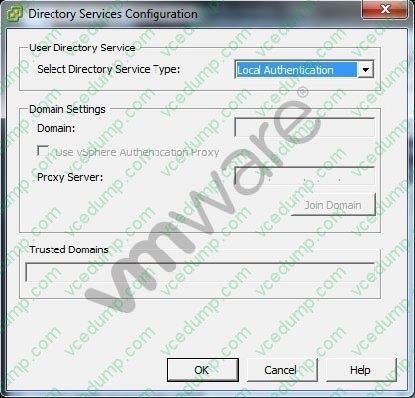
The vSphere administrator is configuring directory services for an ESXi host: -- Exhibit -
-- Exhibit -
What should the vSphere administrator do to configure the host to use CAM services?
A. Check the Use vSphere Authentication Proxy checkbox.
B. Set Select Directory Service Type to CAM services.
C. Specify CAM$ for the Domain.
D. Set Trusted Domains to cam\name.tld where name.tld is the domain that the host is joining. -
Question 213:
An administrator needs to prevent two virtual machines from running on the same host at any time.
Which DRS rule should the administrator apply?
A. vm-to-vm affinity
B. vm-to-host affinity
C. vm-to-vm anti-affinity
D. vm-to-host anti-affinity -
Question 214:
What two statements regarding the VSWP file are true? (Choose two.)
A. The VSWP file is equal to the memory allocation.
B. The VSWP file size is equal to the memory reservation.
C. The VSWP file size is equal to the difference between the memory assigned and reservation.
D. No VSWP file is created if reserved memory to the same value as allocated memory. -
Question 215:
An administrator is configuring a vSphere HA cluster for three ESXi 5.x hosts and their resident virtual machines. The cluster will be configured to support a single host failure. Resource reservations must be enforced during a failover event. Assuming default settings, how does HA determine the current failover capacity?
A. Calculating the largest possible CPU and Memory guarantee for any running virtual machine in the cluster, then calculating how many virtual machines of that size can be started on the largest host and reserving space in the cluster accordingly.
B. Averaging the largest possible CPU and Memory guarantee for any running virtual machine in the cluster, then calculating how many virtual machines of that size can be started on the largest host and reserving space in the cluster accordingly.
C. Calculating the largest possible CPU and Memory guarantee for any virtual machine in the cluster, then calculating how many virtual machines of that size can be started on the largest host and reserving space in the cluster accordingly.
D. Averaging the largest possible CPU and Memory guarantee for any virtual machine in the cluster, then calculating how many virtual machines of that size can be started on the largest host and reserving space in the cluster accordingly. -
Question 216:
Which minor badge items make up the Efficiency badge score for an ESXi host in vCenter Operations Manager?
A. Workload, Anomalies, Faults
B. Workload, Stress, Density
C. Time Remaining, Capacity Remaining
D. Reclaimable Waste, Density -
Question 217:
Which statement is accurate when choosing the storage controller for a virtual machine using the Create New Virtual Machine wizard in custom mode?
A. There is a predetermined controller based on the guest OS, which cannot be changed.
B. A controller is recommended based on the guest OS type. The administrator can choose this controller or select any other.
C. There is a predetermined controller based on the guest OS, which can only be changed after the virtual machine is deployed.
D. The controller options presented will be based on the guest OS type. The administrator must choose one of these options. -
Question 218:
What reasons would prevent an administrator from deploying a virtual machine from a template? (Choose two.)
A. The template is missing the .vmx configuration file.
B. The vSphere Client is connected to an ESXi host.
C. The template is listed as Orphaned.
D. The administrator is using the vSphere Web Client. -
Question 219:
A Windows Server 2008 virtual machine with the following configuration receives an Out of Space condition indicator:
The virtual machine uses thin provisioned virtual disks.
The VMFS5 datastore on which the virtual machine's files reside is on a thin provisioned LUN.
30% of the VMFS datastore content is no longer needed.
The storage array supports VASA and VAAI.
Which action should the vSphere administrator take to resolve the Out of Space problem without requesting additional space on the storage array?
A. Delete unneeded files on the VMFS datastore and then use vmkfstools to reclaim deleted blocks.
B. Delete unneeded files on the VMFS datastore, right-click the datastore in vSphere Web Client, and then select the Reclaim Deleted Blocks option.
C. Delete some files from the guest OS and defrag its file system.
D. Delete some files from the guest OS and use vmkfstools to reclaim the deleted blocks. -
Question 220:
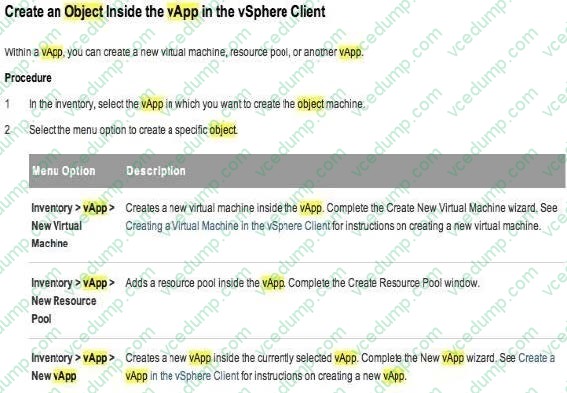
What are three valid objects to place in a vApp? (Choose three.)
A. Folders
B. Hosts
C. Resource pools
D. vApps
E. Virtual machines
Related Exams:
-
1V0-21.20
Associate VMware Data Center Virtualization -
1V0-31.21
Associate VMware Cloud Management and Automation -
1V0-41.20
Associate VMware Network Virtualization -
1V0-61.21
Associate VMware Digital Workspace -
1V0-71.21
Associate VMware Application Modernization -
1V0-81.20
Associate VMware Security -
2V0-11.24
VMware Cloud Foundation 5.2 Administrator -
2V0-11.25
VMware Cloud Foundation 5.2 Administrator -
2V0-13.24
VMware Cloud Foundation 5.2 Architect -
2V0-13.25
VMware Cloud Foundation 9.0 Architect
Tips on How to Prepare for the Exams
Nowadays, the certification exams become more and more important and required by more and more enterprises when applying for a job. But how to prepare for the exam effectively? How to prepare for the exam in a short time with less efforts? How to get a ideal result and how to find the most reliable resources? Here on Vcedump.com, you will find all the answers. Vcedump.com provide not only VMware exam questions, answers and explanations but also complete assistance on your exam preparation and certification application. If you are confused on your VCP5-DCV exam preparations and VMware certification application, do not hesitate to visit our Vcedump.com to find your solutions here.