USMLE USMLE-STEP-2 Online Practice
Questions and Exam Preparation
USMLE-STEP-2 Exam Details
Exam Code
:USMLE-STEP-2
Exam Name
:United States Medical Licensing Step 2
Certification
:USMLE Certifications
Vendor
:USMLE
Total Questions
:738 Q&As
Last Updated
:May 25, 2026
USMLE USMLE-STEP-2 Online Questions &
Answers
Question 371:
Select the ONE best lettered answer that is most closely associated with it. Each lettered answer may be selected once, more than once, or not at all.
Workers in certain occupations are exposed to diseases for which animals are the reservoir. These workers may then become a source of infection to others.
Butchers are most likely to acquire and transmit the infectious disease?
A. anthrax B. brucellosis C. Lyme disease D. murine (endemic) typhus E. salmonellosis
A. anthrax
Explanation
Cutaneous anthrax is associated with a characteristic skin lesion, which becomes infected by the introduction of the bacillus through the skin. Occasionally, an infected carcass is not identified before butchering. A minor wound on the butcher may become infected. Human anthrax is secondary to the disease in animals, primarily mammals. In humans, the disease has three major clinical forms:
cutaneous, inhalational, and GI.
Question 372:
Several groups of organic compounds are associated with serious toxic effects when used in transformers because they withstand high temperatures
A. nitrosamines B. epoxy compounds C. PCBs D. formaldehydes E. organophosphorus compounds
C. PCBs
Explanation
PCBs were extensively used in the manufacture of electrical transformers until production was halted in the mid-1970s. The first sign of chronic exposure to these substances is the appearance of an acne- like eruption with inflammatory pustules. Other effects are eye irritation and GI disturbance. The substances are persistent, and more than 25% of the population in the United States was discovered to have residues of greater than one part per million (ppm) in adipose tissue. Dietary exposure of the general population has been alleged to occur through milk, eggs, cheese, meat, and fish
Question 373:
An investigator in a community hospital decides to examine all patients for a problem with alcoholism to determine prevalence in the community. In addition to recall bias, which of the following is the most obvious error in selecting all patients admitted to a community hospital?
A. observer bias B. selection bias C. detection bias D. interpretive bias E. calculation bias
B. selection bias
Explanation
Bias is a systematic error that may be introduced, generally unwittingly, into an investigation. Selection bias is due to systemic differences between those selected and not selected for a study. When selecting all admissions to a community hospital, alcoholics may be overrepresented among hospital patients and not reflect the community base from which the patients were admitted. Further, the investigator has not chosen a control sample but only patients already in the hospital, which further invalidates any outcome. While other biases may creep into this study, the selection bias is the major problem with the study.
Question 374:
A 58-year-old woman with a history of chronic paranoid schizophrenia, who has been continuously treated with antipsychotics for the past 20 years, lives in a community-based residential facility. She has recently suffered an increase in auditory hallucinations, and her haloperidol dose has been increased from 2.5 to 10 mg/day. Four days later, she is brought by a visiting nurse to the emergency room, where she presents with confusion, marked flexor and extensor rigidity in her legs and arms, and a temperature of 103.5°F. Her blood pressure is160/120 mmHg, her pulse is 120/min and irregular. Which of the following is the most likely diagnosis that best describes this woman's current condition?
A. neuroleptic malignant syndrome (NMS) B. metabolic syndrome C. extrapyramidal symptoms D. malingering E. alcohol withdrawal
A. neuroleptic malignant syndrome (NMS)
Explanation
NMS is a rare complication of neuroleptic therapy which involves symptoms of severe muscle rigidity, elevated temperature, and two or more of the following: diaphoresis, dysphagia, and tremor, and incontinence, changes in level of consciousness, tachycardia, mutism, leukocytosis, elevated CPK, or labile blood pressure. EPS would not explain the extensor rigidity, elevated temperature, and blood pressure. Metabolic syndrome refers to another neuroleptc side effect where lipid levels are elevated and adult onset diabetes can develop. Malingering would not easily explain the elevated vital signs. Though alcohol withdrawal would be in the differential with the elevated vital signs, the pipe-like rigidity could not be explained.
Question 375:
Identify the following personality disorders with the symptoms listed below. Is quick to perceive a slight as an attack or assault on one's character
A. antisocial B. avoidant C. borderline D. dependent E. histrionic F. narcissistic G. obsessive-compulsive H. paranoid I. schizoid J. schizotypal
H. paranoid
Explanation
Persons with personality disorders are rigidly bound to the use of patterns of defense and various traits that distinguish the disorders. All have problems with interpersonal relationships.
Question 376:
A 39-year-old woman at 16 weeks' gestation complains of headaches, blurred vision, and epigastric pain. Her blood pressure is now 56/104 mmHg. Her uterine fundus is palpable 2 cm above her symphysis pubis. Fetal heart tones could not be heard with a handheld Doppler. She has 3+ proteinuria.
Which of the following is the most likely diagnosis?
A. anencephaly B. twin gestation C. maternal renal disease D. hydatidiform mole E. gestational diabetes mellitus
D. hydatidiform mole
Explanation
The onset of preeclampsia before the 20th week of pregnancy is clinically seen only with a hydatidiform mole. Advanced maternal age, uterine size greater than gestational weeks, and the absence of a fetal heartbeat are added features to suggest gestational trophoblastic disease. Hydramnios, which can be associated with anencephaly and other fetal developmental abnormalities, also predisposes to preeclampsia, but its onset does not occur before 24 weeks. Renal disease, diabetes mellitus, and chronic hypertension also increase the likelihood of preeclampsia, but not before 24 weeks of pregnancy. The incidence of preeclampsia is increased in twin gestation, but again, its onset is not before 24 weeks
Question 377:
A 10-month-old infant presents to the emergency department with a 24-hour history of low-grade fever and anorexia. The parents report several episodes in which the child has been suddenly inconsolable and crying, followed by periods of lethargy. He has had nonbilious vomiting and several loose stools. On examination, the infant is pale and mildly dehydrated. His abdomen is soft and nondistended, with fullness to palpation in the right upper quadrant. The child passed another stool in the emergency department
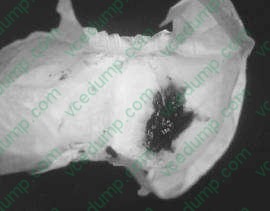
Which of the following is the most appropriate next step in the diagnostic evaluation and management of this patient?
A. proctoscopy B. oral rehydration and stool cultures C. IV fluid rehydration and a hydrostatic barium enema D. technetium scan E. IV fluid rehydration, NG decompression, and a UGI contrast study
C. IV fluid rehydration and a hydrostatic barium enema
Explanation
Intussusception most commonly occurs between 2 months and 2 years of age, often associated with a prodromal viral illness. Children will present with intermittent episodes of abdominal colic, secondary to peristaltic waves of the ileum against the partially obstructing ileocolic lesion. Reflex nonbilious vomiting is secondary to bowel distention and partial obstruction. There may be a palpable, right-sided, "sausageshaped" mass, but in many patients, the abdominal examination is entirely normal. The classic "currant jelly" stool is a late sign and is a result of ischemia and mucosal sloughing of the lead point. After the child has received IV fluid resuscitation, the management is hydrostatic reduction, either by contrast enema or air enema. Intussusception may occur during the clinical course of viral gastroenteritis. Bloody stools are more commonly associated with bacterial gastrointestinal infections, with characteristically loose, mucousy stools, and blood mixed with fecal material. Diagnosis is aided by obtaining stool cultures. A midgut volvulus can be associated with passage of a "currant jelly" stool secondary to small-bowel ischemia. However, these children usually present with bilious vomiting. Diagnosis may be confirmed with a UGI contrast study. Rectal bleeding from a Meckel's diverticulum is typically painless, without other associated gastrointestinal symptoms. Technetium scan is useful for diagnosis. Bleeding from a juvenile rectal polyp is usually small in amount and often occurs during normal stool passage. The children are clinically well, without other gastrointestinal symptoms. These polyps may be seen on proctoscopy.
Question 378:
Ayoung woman with a history of seizures has a series of grand mal seizures in the emergency room. She is lethargic and has a nonfocal neurologic examination. Her blood gas reveals a pH of 7.12, carbon dioxide of 48, PO2 of 86, and calculated bicarbonate of 16. How would you best characterize her underlying acid- base problem?
A. respiratory acidosis B. metabolic and respiratory acidosis C. metabolic acidosis and respiratory alkalosis D. metabolic alkalosis and respiratory acidosis E. metabolic acidosis
B. metabolic and respiratory acidosis
Explanation
The pH is 7.12, indicating acidosis as the primary disorder. Alow bicarbonate is consistent with a metabolic cause of the acidosis and a high carbon dioxide is consistent with a respiratory cause of the acidosis. Therefore, both are contributing as primary problems. The metabolic source likely is lactic acidosis from muscle breakdown resulting from the seizures. The respiratory source likely is related to the patient's postictal state and hypoventilation after the seizures.
Question 379:
Your patient has just had twins and wonders if there is any way to determine whether the twins are identical. You correctly tell her which of the following?
A. Close examination of the placenta can often provide this answer. B. There is no way to tell unless one is a girl and one a boy. C. Only matching of human lymphocyte antigens could determine this with certainty. D. Identical twins occur only once in about 80 births of twins. E. It is unlikely because the birth weights differed by more than 200 g.
C. Only matching of human lymphocyte antigens could determine this with certainty.
Explanation
Different-sex twins must be dizygous. Prenatal ultrasound can detect monochorionic, monoamnionic twins, and these must be monozygous. For same-sex twins, careful examination of the amniotic membranes after birth can reveal monozygous twins if the placental membranes are monochorionic. Dichorionic membranes can occur with either monozygous or dizygous twins. Ultimately, assessment of DNA polymorphism is the best way to determine twin zygosity
Question 380:
For the screening tests listed below, select the screening schedule that is appropriate for women (as per the U.S. Preventive Services Task Force [USPSTF], The Guide to Clinical Preventive Services, 2006)
Screening for hepatitis B
A. do not routinely screen B. yearly over age 50 C. at first prenatal visit D. every 12 years at age 40 and older E. every 12 years at age 50 and older F. every 3 years following an initial examination, but not after age 65 G. every 3 years at age 50 and older
C. at first prenatal visit
Explanation
The USPSTF strongly recommends screening pregnant women for hepatitis B at their first prenatal visit, but recommends against screening the general population.
Nowadays, the certification exams become more and more important and required by more and more
enterprises when applying for a job. But how to prepare for the exam effectively? How to prepare
for the exam in a short time with less efforts? How to get a ideal result and how to find the
most reliable resources? Here on Vcedump.com, you will find all the answers.
Vcedump.com provide not only USMLE exam questions,
answers and explanations but also complete assistance on your exam preparation and certification
application. If you are confused on your USMLE-STEP-2 exam preparations
and USMLE certification application, do not hesitate to visit our
Vcedump.com to find your solutions here.