USMLE-STEP-2 Exam Details
-
Exam Code
:USMLE-STEP-2 -
Exam Name
:United States Medical Licensing Step 2 -
Certification
:USMLE Certifications -
Vendor
:USMLE -
Total Questions
:738 Q&As -
Last Updated
:May 25, 2026
USMLE USMLE-STEP-2 Online Questions & Answers
-
Question 261:
A 7-year-old boy presents with a rash. His mother states that he was well until 3 days ago when he developed fever and malaise. The next day, the rash started as papules on the trunk, which rapidly changed to vesicles. The lesions have spread all over the body. On physical examination, he has no fever and seems well. You note numerous vesicles all over the body, some of which have crusted over.
Which of the following is the most likely diagnosis?
A. chicken pox
B. Kawasaki disease
C. measles
D. rubella
E. staphylococcal scalded skin syndrome -
Question 262:
A 3-year-old boy presents to the physician's office with an asymptomatic neck mass located in the midline, just below the level of the thyroid cartilage. The mass moves with deglutition and on protrusion of the tongue. For the above patient with a neck mass, select the most likely diagnosis.
A. thyroid carcinoma
B. cystic hygroma
C. acute suppurative lymphadenitis
D. thyroglossal duct cyst
E. lipoma
F. carotid artery aneurysm
G. mixed parotid tumor (pleomorphic adenoma)
H. laryngeal carcinoma
I. parathyroid adenoma
J. branchial cleft cystK. tuberculosis -
Question 263:
A 39-year-old woman presents to the physician's office for evaluation of a palpable nodule in the neck of 2 years' duration. Her past history is pertinent for Hashimoto's disease diagnosed 5 years ago, for which she takes thyroid hormone. She has a history of low-dose chest irradiation for an enlarged thymus gland during infancy. On examination, a 2.5-cm nodule is palpable in the left lobe of the thyroid and is firm and nontender.
Which of the following is the most appropriate next step in her management?
A. ultrasound of the neck
B. thyroid scintiscan
C. MRI of the neck
D. CT scan of the neck and chest
E. FNA of the nodule -
Question 264:
A10-year-old boy comes to the office with fever and chills for 5 days and myalgia. He has recently returned from a 2-week vacation to New England with his family. On physical examination he has mild splenomegaly. Which of the following is the most likely cause of his symptoms?
A. Kawasaki disease
B. pneumococcus
C. babesiosis
D. leptospirosis
E. psittacosis -
Question 265:
A 4-year-old child presents to his pediatrician with a complaint of a mild rash and fevers. His travel history is positive for a camping trip 2 weeks prior. The parents do not recall a tick bite on the child and do not remember if there were ticks in the area. No other members of the family complain of similar symptoms and the child does not attend day care. Physical examination is positive for a temperature of 100.9°F with an erythematous rash noted over the child's trunk. Which of the following factors would significantly increase the possibility that the child has Lyme disease?
A. The camping trip occurred in an area endemic for the tick Ixodes dentatus.
B. The camping trip occurred in Texas.
C. The camping trip occurred in an area with a high indigenous population of lizards.
D. The camping trip occurred in an area endemic for the white-footed mouse.
E. The camping trip occurred in an area which had recently been sprayed with pesticides. -
Question 266:
It is reported that an alarming number of fractures are occurring among the elderly in your community. You are contacted by a local radio station for an interview on this subject. You explain that which of the following is the most likely cause of the high number of fractures?
A. Alzheimer's disease
B. osteoporosis
C. obesity
D. Parkinson's disease
E. deteriorating eyesight -
Question 267:
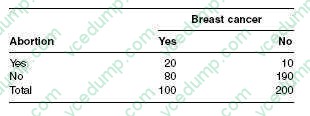
Doing a retrospective chart review of unmatched cases and controls, you calculate an OR to make an initial assessment of whether women who have had induced abortions are more likely to develop breast cancer. Twenty of 100 women with breast cancer reported a history of induced abortion. Ten of 200 women without breast cancer reported a history of induced abortion.
What are the exposure odds among cases?
A. 0.250
B. 0.500
C. 2.000
D. 4.000
E. 8.000 -
Question 268:
Apreviously healthy 19-year-old woman has a sudden onset of headache, profound myalgias, profuse vomiting, and diarrhea. The woman is near the end of her menstrual period and is using tampons. She appears to be suffering from toxic shock syndrome (TSS). Which of the following is the most likely skin finding?
Which of the following is another common finding in TSS and is part of the case definition?
A. hypertension: systolic BP 160 mmHg
B. hyperreflexia
C. fever with temperature 102°F
D. elevated platelet count 400,000
E. hypercalcemia -
Question 269:
A 65-year-old woman presents to the physician's office for her yearly physical examination. She has no complaints except for a recent 10-lb weight loss. Past history is pertinent for a 40 pack-year smoking history, hypertension, asthma, and hypothyroidism. Examination reveals a thin woman with normal vital signs and unremarkable heart and abdominal examinations. Lung examination reveals mild wheezing and a few bibasilar rales. A chest x-ray is obtained and is shown in Figure. Achest x-ray obtained 3 years ago was normal. Yearly laboratory tests including a CBC, electrolytes, and lipid panels are normal.
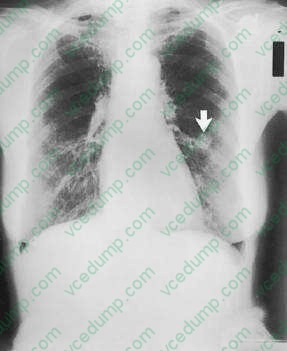
Which of the following is the most appropriate next diagnostic test?
A. percutaneous needle biopsy
B. CT scan
C. pulmonary function tests
D. mediastinoscopy
E. bronchoscopy -
Question 270:
Identify the following personality disorders with the symptoms listed below. Unwilling to take personal risks; perceives self as inept, unappealing, inferior
A. antisocial
B. avoidant
C. borderline
D. dependent
E. histrionic
F. narcissistic
G. obsessive-compulsive
H. paranoid
I. schizoid
J. schizotypal
Tips on How to Prepare for the Exams
Nowadays, the certification exams become more and more important and required by more and more enterprises when applying for a job. But how to prepare for the exam effectively? How to prepare for the exam in a short time with less efforts? How to get a ideal result and how to find the most reliable resources? Here on Vcedump.com, you will find all the answers. Vcedump.com provide not only USMLE exam questions, answers and explanations but also complete assistance on your exam preparation and certification application. If you are confused on your USMLE-STEP-2 exam preparations and USMLE certification application, do not hesitate to visit our Vcedump.com to find your solutions here.