USMLE-STEP-2 Exam Details
-
Exam Code
:USMLE-STEP-2 -
Exam Name
:United States Medical Licensing Step 2 -
Certification
:USMLE Certifications -
Vendor
:USMLE -
Total Questions
:738 Q&As -
Last Updated
:May 25, 2026
USMLE USMLE-STEP-2 Online Questions & Answers
-
Question 111:
A 65-year-old woman presents to the physician's office with a 6-month history of epigastric discomfort, poor appetite, and 10-lb weight loss. Past history is pertinent for hypertension, diabetes, a 30 pack-year smoking history, and occasional alcohol intake. Examination is unremarkable except for mild epigastric tenderness to deep palpation. An abdominal ultrasound reveals cholelithiasis, and one view of a UGI x-ray series is shown in the figure.
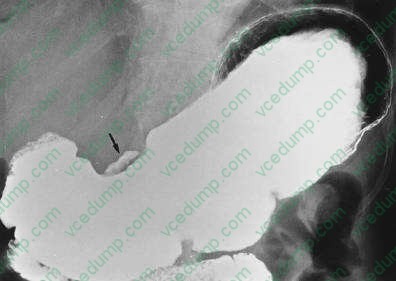
Which of the following is the most appropriate next step in management?
A. H2 blockers with re-evaluation by UGI in 6 months
B. vagotomy and pyloroplasty
C. total gastrectomy
D. endoscopy
E. CT scan -
Question 112:
A70-year-old man presents to urgent care complaining of a painful, swollen left knee. He previously has had no problems with this knee. Three days prior to onset, he went out dancing for 23 hours but recalls no specific injury. Examination of the knee reveals a moderatesized effusion and mild pain with any range of motion. Plain x-ray shows no fracture. Which of the following is the best next management?
A. MRI of knee
B. aspiration of effusion fluid
C. rest, ice, and leg elevation
D. physical therapy referral
E. arthroscopy -
Question 113:
The mother of a 3-year-old girl brings her daughter to see you because the girl developed breasts 6 months ago. The girl has had no vaginal bleeding, and there is no pubic hair. She takes no medication.
Which of the following is the most appropriate next diagnostic step?
A. an ultrasound of the pelvis
B. a pelvic examination under general anesthesia
C. computed tomography (CT) scan of her head
D. a serum estradiol concentration
E. a serum follicle-stimulating hormone (FSH) concentration -
Question 114:
A 33-year-old woman experiences visions of flashing lights followed by throbbing left-sided temporal pain and nausea. Which of the following is the most likely diagnosis?
A. tension headache
B. transient ischemic attack (TIA)
C. temporal arteritis
D. migraine headache
E. cluster headache -
Question 115:
A 30-year-old asymptomatic male presents to your office because his father just had a heart attack. He is concerned that he may have inherited his father's condition because a cholesterol level test done at his work site last year was 220 mg/dL. You review his history and find that he smokes 25 cigarettes a day, eats mostly at fast food restaurants, sits at a desk job, and has no regular moderate intensity physical activities. His blood pressure is 130/85 mmHg and his body mass index (BMI) is 26.
Which of the following is the best first recommendation?
A. electrocardiography (ECG)
B. ECG and an exercise treadmill test (ETT)
C. a diet for weight loss
D. commencement of a daily exercise routine
E. antihypertensive medication -
Question 116:
A 1-day-old infant who received silver nitrate eye drops in the delivery room is suffering from bilateral purulent conjunctival discharge. Which of the following is the most likely cause of this child's condition?
A. N. gonorrhoeae infection
B. herpes simplex infection
C. nasolacrimal duct obstruction
D. chemical irritation
E. Pseudomonas infection -
Question 117:
Select the appropriate incubation period of the Pertussis infectious disease of childhood.
A. 16 days
B. 78 days
C. 810 days
D. 1021 days
E. 3050 days
F. 120180 days -
Question 118:
A 31-year-old primigravida develops gestational diabetes mellitus and is managed appropriately during pregnancy. She asks you about the consequences of gestational diabetes to her and her fetus. Which one of the following statements is correct?
A. The risk of fetal anomalies is increased.
B. The risk of stillbirth is increased if her fasting blood sugars are elevated.
C. The risk of a growth-restricted newborn is increased.
D. Insulin is the preferred treatment to maintain euglycemia.
E. The risk of fetal macrosomia is not increased with gestational diabetes. -
Question 119:
Which of the following is the most appropriate evaluative procedure for an otherwise normal 7-day-old boy with perineal hypospadias?
A. renal ultrasonography
B. serum creatinine determination
C. cystography
D. circumcision
E. intravenous pyelography (IVP) -
Question 120:
A 36-year-old female complains of 5 days of fever, nasal congestion, sinus pressure, and postnasal drip. On examination, nasal discharge is yellow and the posterior pharynx is slightly erythematous. Tapping over the maxillary sinuses elicits mild pain. Which of the following is the most appropriate treatment for this patient?
A. treatment of symptoms (analgesics, antipyretics, decongestants)
B. a 7-day course of amoxicillin
C. a 10-day course of amoxicillin clavulanic acid
D. a 14-day course of clarithromycin
Tips on How to Prepare for the Exams
Nowadays, the certification exams become more and more important and required by more and more enterprises when applying for a job. But how to prepare for the exam effectively? How to prepare for the exam in a short time with less efforts? How to get a ideal result and how to find the most reliable resources? Here on Vcedump.com, you will find all the answers. Vcedump.com provide not only USMLE exam questions, answers and explanations but also complete assistance on your exam preparation and certification application. If you are confused on your USMLE-STEP-2 exam preparations and USMLE certification application, do not hesitate to visit our Vcedump.com to find your solutions here.