USMLE-STEP-1 Exam Details
-
Exam Code
:USMLE-STEP-1 -
Exam Name
:United States Medical Licensing Step 1 -
Certification
:USMLE Certifications -
Vendor
:USMLE -
Total Questions
:847 Q&As -
Last Updated
:May 25, 2026
USMLE USMLE-STEP-1 Online Questions & Answers
-
Question 631:
A 10-year-old boy is brought to a pediatric clinic by his mother, who states that he has been voiding brown- colored urine for the past 2 days. The child's history is negative except for a sore throat about 2 weeks ago. Physical examination reveals moderate periorbital edema and mild hypertension. Urinalysis demonstrates red cells, both red and white cell casts, and 2+ protein. If a renal biopsy were obtained, what would be the characteristic light and/or electron microscopic finding in the glomeruli?
A. hypercellularity with duplication of the basement membrane
B. hypercellularity with subepithelial "humps"
C. hypercellularity with "wire loop"lesions
D. normocellularity with effacement of epithelial cell foot processes
E. normocellularity with segmental sclerosis
F. normocellularity with thickened basement membranes -
Question 632:
An 18-year-old male patient was thrown from a horse and suffered extensive damage to the back and pelvic region. After 2 weeks of recovery, it is noted that the patient has a spastic neurogenic urinary bladder. Although the patient is unable to initiate micturition, the bladder periodically empties itself. Where is the lesion affecting control of the bladder in this patient located?
A. cauda equine
B. spinal cord, above the level of S2
C. spinal cord, at the level of S2
D. spinal cord, at the level of S3
E. spinal cord, at the level of S4 -
Question 633:
An investigational diabetes treatment involving a hypoglycemia-inducing drug has been developed. This drug is designed to inhibit dipeptidylpeptidase IV (DPP IV) activity and has been shown to decrease plasma glucose concentration and pancreatic glucagon secretion. DPP IV hydrolyzes which of the following hormones such that its inhibition results in the observed effects?
A. glucagon
B. glucagon-like peptide-1 (GLP-1)
C. insulin
D. insulin-like growth factor-I (IGF-I)
E. pancreatic polypeptide -
Question 634:
A 66-year-old woman initially develops some subtle changes in memory, judgment, and behavior. However, this is followed by a very severe and rapidly progressive dementia that is accompanied by startle myoclonus. She dies 8 months after the original onset of her symptoms. Her disease is most likely the result of which of the following?
A. acquired or inherited prion
B. hereditary lysosomal storage disease
C. increased neurofibrillary tangles (NFTs)
D. protozoan infection
E. repeated exposure to a chemical toxin -
Question 635:
Diltiazem as used in angina pectoris has several beneficial actions that contribute to the prevention of the anginal symptoms. Which of the following actions is detrimental in angina?
A. reduced arterial blood pressure
B. increased diastolic heart size
C. reduced systolic myocardial fiber tension
D. bradycardia
E. slowed AV conduction -
Question 636:
A 64-year-old man with long-standing hypertension experiences severe abdominal pain and loses consciousness. He dies en route to the hospital. Significant autopsy findings include dilation of the aorta just above the iliac bifurcation and massive abdominal hemorrhage. Which of the following was most likely the initiating event that resulted in his fatal lesion?
A. antibody-mediated endothelial damage
B. autosomal dominant inheritance of an abnormal gene on chromosome 15
C. intimal proliferation with fibrous cap formation
D. luminal narrowing of the vasa vasorum leading to medial degeneration and fibrosis
E. ossification of calcific deposits in the tunica media -
Question 637:
A 22-year-old man complains to his family physician of fatigue, night sweats, and a dry unproductive cough. Until the past few months, he had apparently been in good health. Acomplete blood count (CBC) and differential blood count reveal that he is lymphopenic. X-ray examination reveals an interstitial pneumonia. Skin test reactions to a battery of materials are normal. Which of the following should be the next step in evaluating this patient's illness?
A. CH50 complement assay
B. chemotaxis assay
C. identification of the organism that is causing the pneumonia
D. intracellular killing assay
E. nitroblue tetrazolium reduction assay -
Question 638:
"Executive monkeys" as described by Brady tended to develop bleeding ulcers. Which of the following statements best characterizes them?
A. Alpha monkeys that have the highest level of testosterone in the colony.
B. Beta-male monkeys having too many decisions to make.
C. Male monkeys that had too many available females.
D. Monkeys that had to keep pressing bars to avoid shock.
E. Monkeys that had to press a bar to get a pellet of food. -
Question 639:
Your young female patient has a large bulge on the anterior thigh below the inguinal ligament. You suspect an abdominal hernia that has passed through the femoral ring into the femoral sheath and then through the saphenous hiatus into the subcutaneous layer of the upper thigh. In addition to the hernia sac, you would expect the femoral canal to contain which of the following?
A. connective tissue and lymph nodes
B. femoral artery
C. femoral nerve
D. femoral vein
E. great saphenous vein -
Question 640:
Ahemagglutination (HA) assay was performed with influenza virus. Afixed number of chicken red blood cells were mixed with increasing dilutions of the influenza virus. The results of the assay are shown in below figure. Which of the following represents the HA titer of the virus?
A. 20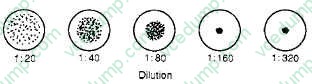
B. 40
C. 80
D. 160
E. 320
Tips on How to Prepare for the Exams
Nowadays, the certification exams become more and more important and required by more and more enterprises when applying for a job. But how to prepare for the exam effectively? How to prepare for the exam in a short time with less efforts? How to get a ideal result and how to find the most reliable resources? Here on Vcedump.com, you will find all the answers. Vcedump.com provide not only USMLE exam questions, answers and explanations but also complete assistance on your exam preparation and certification application. If you are confused on your USMLE-STEP-1 exam preparations and USMLE certification application, do not hesitate to visit our Vcedump.com to find your solutions here.