USMLE USMLE-STEP-1 Online Practice
Questions and Exam Preparation
USMLE-STEP-1 Exam Details
Exam Code
:USMLE-STEP-1
Exam Name
:United States Medical Licensing Step 1
Certification
:USMLE Certifications
Vendor
:USMLE
Total Questions
:847 Q&As
Last Updated
:May 25, 2026
USMLE USMLE-STEP-1 Online Questions &
Answers
Question 621:
An infant is born anencephalic. He presents without both a forebrain and a cerebrum. The remaining brain tissue is exposed, not covered by bone or skin. The infant is blind, deaf, unconscious, and unable to feel pain. Because the infant has a rudimentary brainstem, reflex actions such as respiration (breathing) and responses to sound or touch occur. However, the lack of a functioning cerebrum permanently rules out the possibility of ever gaining consciousness. Anencephaly is the result of a defect in which of the following?
A. closure of the caudal neuropore B. closure of the rostral neuropore C. formation of the first branchial arch D. formation of the somites E. fusion of the metopon
B. closure of the rostral neuropore
Explanation
Section: Anatomy Malclosure of the rostral neuropore during the fourth week of development results in anencephaly and is lethal in the affected newborn. The condition is better termed meroanencephaly because of the presence of the rudimentary brainstem with some functioning nervous tissues. Defects in the closure of the caudal neuropore (choice A) result in varying conditions of spina bifida at the lower end of the spinal cord. The first branchial arch (choice C) and the somites (choice D) do not play any role in the formation of the brain. Fusion of the metopon or forehead (choice E) occurs after birth and also does not play a role in brain formation.
Question 622:
A 57-year-old man seeks medical attention for the recent appearance of numerous, large, fluid-filled, cutaneous blisters. These involve the face, scalp, neck, and axillae. Manual pressure to the skin results in epidermal separation. These changes are most likely the result of which of the following?
A. autoimmune disorder B. bacterial infection C. dietary deficiency D. exposure to a chemical toxin E. local ischemia
A. autoimmune disorder
Explanation
Section: Pathology and Path physiology Pemphigus vulgaris is an autoimmune disorder. The autoantibodies are directed against keratinocyte antigens with subsequent dyshesion and fluid-filled blister formation. Bacterial infections (choice B), dietary deficiencies (choice C), chemical toxins (choice D), and local ischemia (choice E) are not thought to be the causative agent of pemphigus vulgaris.
Question 623:
The most rapid onset of action of inhaled general anesthetics correlates with the smallest value for which of the following variables?
A. blood-gas partition coefficient B. MAC C. molecular size D. oilwater partition coefficient E. onset of hepatic metabolism
A. blood-gas partition coefficient
Explanation
Section: Pharmacology The blood-gas partition coefficient is a measure of the solubility of the inhalation anesthetic in the blood relative to its solubility in the inspired air. Circulating blood provides the means of anesthetic delivery to the brain and the partial pressure determines the rate of transfer into the CNS. The solubility of an agent in blood determines how rapidly the partial pressure rises in the blood. Agents with high solubility (large blood- gas partition coefficients) require large amounts of the anesthetic to dissolve in the blood before the partial pressure in the blood increases enough to effectively deliver them to the brain. Thus, agents with lower blood solubilities (small blood-gas partition coefficients) have more rapid rates of onset of anesthesia. Desirable properties for inhalation anesthetic agents include high potency and low blood solubility. The halogenated hydrocarbons, such as desflurane and sevoflurane, fit these criteria and are used extensively. The MAC value (median alveolar anesthetic concentration) required for anesthesia (choice B) is a measure of the potency of the agent, but does not give an indication of the rate of onset of anesthesia. Molecular size (choice C) may play a role in determining the blood-gas partition coefficient, but it is only a partial determinant. The oilwater partition coefficient (choice D) is a measure of the lipid solubility of the anesthetic agent. This correlates with the potency as measured by the MAC. Hepatic metabolism (choice E) plays no role in onset of action, but may be important in terms of possible liver and kidney damage resulting from the production of toxic metabolites from some of the halogenated inhaled anesthetic agents.
Question 624:
Which of the following is the drug(s) of choice for the treatment of the graduate student's illness?
A. chloroquine B. metronidazole and iodoquinol C. stibogluconate D. sulfonamide and pyrimethamine E. trimethoprim and sulfamethoxazole
B. metronidazole and iodoquinol
Explanation
Section: Microbiology/Immunology The drugs of choice for acute amoebic dysentery are metronidazole and iodoquinol. Chloroquine (choice A) is normally used for the treatment of malaria. Stibogluconate (choice C) is recommended for the treatment of leishmaniasis. Sulfonamide and pyrimethamine (choice D) is used for the treatment of toxoplasmosis. Trimethoprim and sulfamethoxazole (choice E) are the drugs of choice for the treatment of pneumonia caused by P. carinii.
Question 625:
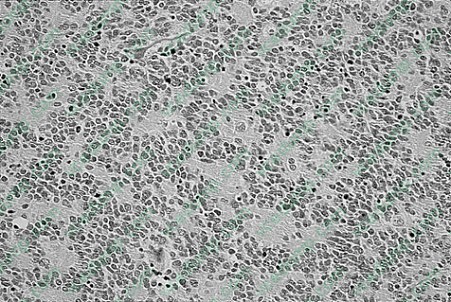
A 15-month-old girl presents with a large abdominal mass, weight loss, and fever. At surgery, a large infiltrative tumor with areas of hemorrhage and necrosis is removed. A photomicrograph of a section from this tumor is shown in below figure. Which of the following is the most likely diagnosis?
A. embryonal rhabdomyosarcoma B. malignant lymphoma C. neuroblastoma D. teratoma E. Wilms' tumor
C. neuroblastoma
Explanation
Section: Pathology and Path physiology This is a neuroblastoma and is one of a group of childhood tumors described as "small, round, blue-cell tumors," consisting as they do of monotonous small cells with dense, blue nuclei. The characteristic microscopic feature of a neuroblastoma is the pseudorosette, a ring of primitive neuroblasts surrounding a central space filled with fibrillar extensions from the cells. Many of these can be seen in figure. These are called pseudorosettes because they do not have a central lumen as is found, for example, in the rosettes in retinoblastoma. Embryonal rhabdomyosarcoma (choice A) is a type of rhabdomyosarcoma typically found in children under the age of 10. It can arise in a number of locations and sarcoma botryoides is one form. It does not form rosettes. Malignant lymphomas (choice B) and leukemias are together the most common malignancies of childhood in the United States, but rosette formation is not a distinctive microscopic feature. Teratomas (choice D) in infants and young children are usually benign tumors found in the midline (e.g., sacrococcygeal, mediastinal). They are composed of tissues with a normal histologic appearance derived from all three germ layers. Wilms' tumor (choice E) or nephroblastoma is derived from primitive blastema cells and sometimes displays aborted attempts to form glomeruli or renal tubules, but not rosettes.
Question 626:
Which of the following laxatives acts osmotically to increase the water content of the stool?
A. cascara B. docusate C. glycerine D. magnesium hydroxide E. senna
D. magnesium hydroxide
Explanation
Section: Pharmacology Magnesium hydroxide is an osmotic laxative that retains water in the lumen of the colon. Cascara (choice A) is a naturally occurring plant product that stimulates the bowel and causes evacuation within 612 hours when given orally. Docusate (choice B) is a stool-softening agent that acts entirely within the lumen. Glycerine (choice C), given by suppository, is a stool softener. Senna (choice E) is a stimulant and bulk- forming agent that increases the volume of the stool and stimulates evacuation.
Question 627:
Which of the following antidiabetic agents acts on the peroxisome proliferator-activated receptor- gamma (PPAR-gamma) nuclear receptor?
A. acarbose B. glyburide C. insulin lispro D. metformin E. pioglitazone
E. pioglitazone
Explanation
Section: Pharmacology The glitazone drugs (pioglitazone, rosiglitazone) reduce insulin resistance in peripheral tissues by activating the PPAR-gamma receptor, which promotes glucose uptake and utilization. Acarbose (choice A) interferes with the action of intestinal alpha-glucosidases and reduces absorption of glucose. Glyburide (choice B) and other sulfonylurea hypoglycemic drugs block the ATP-activated potassium channel in pancreatic cells and cause increased insulin release. Insulin lispro (choice C) is a modified insulin with rapid onset and offset of action. All insulins act by causing insertion of glucose transporters into cell membranes and several other mechanisms. The mechanism of action of metformin (choice D) and similar biguanide antidiabetic drugs is still unclear but may involve reduction of glucagon release, stimulation of glycolysis in peripheral tissues, or decreased hepatic and renal gluconeogenesis.
Question 628:
A 9-year-old boy is stung on the arm by a wasp and very rapidly develops redness and swelling at the site of the sting. Which of the following substances is most responsible for these early changes?
A. bradykinin B. complement 3a C. histamine D. leukotriene E. thromboxane
C. histamine
Explanation
Section: Pathology and Path physiology Histamine is a preformed inflammatory mediator found principally in mast cells and basophils that has a major role in the early vascular changes of inflammation; that is, dilation of precapillary arterioles which produces the local redness (rubor) and warmth (calor), and the increased permeability of postcapillary venules which produces the swelling (tumor). Bradykinin (choice A) has similar effects to histamine, but it is produced by the activation of the kinin system so it is not immediately available as is histamine. Complement 3a (choice B) and complement 5a are called anaphylatoxins because they can stimulate the release of histamine from mast cells. Leukotriene B4 (choice D) is a major activator and chemotactic agent for leukocytes and potentiates their adhesion to vessel walls. Thromboxane A2 (choice E) promotes platelet aggregation and vasoconstriction; it functions in opposition to prostaglandin, which inhibits platelet aggregation and causes vasodilation.
Question 629:
Which of the following drugs causes hyperchloremic metabolic acidosis and may cause hyperammonemia in a patient with cirrhosis?
A. acetazolamide B. amiloride C. furosemide D. hydrochlorothiazide E. spironolactone
A. acetazolamide
Explanation
Section: Pharmacology Acetazolamide acts in the proximal tubule to block carbonic anhydrase, greatly increasing bicarbonate excretion and alkalinizing the urine while causing metabolic acidosis. In cirrhosis, ammonia is excreted in larger amounts because urea production in the liver is limited. If an acid urine (necessary for converting ammonia to ammonium ion) cannot be produced, the ammonia is promptly reabsorbed, causing hyperammonemia and hepatic encephalopathy. None of the other drugs (choices BE) causes hyperammonemia in cirrhotic patients.
Question 630:
Gene therapy has taken an approach of expressing TNF in tumor-infiltrating lymphocytes (TIL). It is hoped that this approach will induce which of the following events?
A. allow the TIL to return to the tumor and produce locally high levels of TNF B. generate high serum levels of endotoxin C. lyse tumor cells due to retrovirus infection D. stimulate natural killer (NK) cell activity E. stimulate T-cell proliferation
A. allow the TIL to return to the tumor and produce locally high levels of TNF
Explanation
Section: Microbiology/Immunology TNF is cytotoxic to certain tumor cells. Recent experiments in gene therapy have taken the approach of expressing TNF in TIL, with the hope of allowing the TIL to return to the tumor and produce a high concentration of TNF and kill the tumor cells. TNF is a mediator of endotoxin- induced shock and is involved in inflammation, but does not generate high levels of endotoxin (choice B). There is no evidence to support that TNF stimulates T-cell proliferation (choice E). TNF is cytotoxic to certain tumor cells, but it does not lyse tumor cells by retroviral participation (choice C). NK cells can destroy tumor cells; however, they cannot be stimulated by TNF (choice D).
Nowadays, the certification exams become more and more important and required by more and more
enterprises when applying for a job. But how to prepare for the exam effectively? How to prepare
for the exam in a short time with less efforts? How to get a ideal result and how to find the
most reliable resources? Here on Vcedump.com, you will find all the answers.
Vcedump.com provide not only USMLE exam questions,
answers and explanations but also complete assistance on your exam preparation and certification
application. If you are confused on your USMLE-STEP-1 exam preparations
and USMLE certification application, do not hesitate to visit our
Vcedump.com to find your solutions here.