USMLE USMLE-STEP-1 Online Practice
Questions and Exam Preparation
USMLE-STEP-1 Exam Details
Exam Code
:USMLE-STEP-1
Exam Name
:United States Medical Licensing Step 1
Certification
:USMLE Certifications
Vendor
:USMLE
Total Questions
:847 Q&As
Last Updated
:Jun 02, 2026
USMLE USMLE-STEP-1 Online Questions &
Answers
Question 481:
Mutant genes that affect several organ systems and bodily functions frequently show variable expressivity, a phenomenon referred to as phenotypic variation. The most striking example of phenotypic variability is manifest in an autosomal- dominant condition characterized by the appearance of café au lait spots on the skin and cutaneous and subcutaneous neurofibromas. These symptoms are associated with which of the following?
A. familial adenomatous polyposis B. FH C. Li Fraumeni syndrome D. von Hippel-Lindau syndrome E. von Recklinghausen disease (type I neurofibromatosis)
E. von Recklinghausen disease (type I neurofibromatosis)
Question 482:
A patient with chronic renal insufficiency due to renal vascular disease has a net functional loss of nephrons. If we assume that production of urea and creatinine is constant and that the patient is in a steady state, a 50% decrease in the normal GFR will cause which of the following to occur?
A. decrease plasma urea concentration B. greatly increase plasma C. increase the percent of filtered Na+ excreted D. not affect plasma creatinine E. significantly decrease plasma
C. increase the percent of filtered Na+ excreted
Question 483:
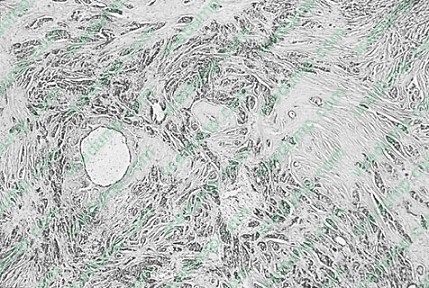
A 53-year-old woman recently noticed a firm, 2-cm nodule in her right breast during monthly self- examination. The histology of her breast biopsy tissue is displayed in below figure. Which of the following is an adverse prognostic indicator that may be seen with this disorder?
A. estrogen receptor positive B. low S phase C. overexpression of Her2/neu oncogene D. progesterone receptor positive E. well-differentiated histology, grade I of III
C. overexpression of Her2/neu oncogene
Explanation
Section: Pathology and Path physiology Overexpression of NEU oncogene in invasive breast carcinoma (shown in figure) is an adverse prognostic indicator. Breast cancers that are estrogen-receptor positive (choice A), have a low S phase (choice B), are progesterone-receptor positive (choice D), and are well differentiated (choice E), considered to have more favorable prognostic implications. Size of the primary breast carcinoma and the status of the axillary lymph nodes are also major factors that influence the prognosis of invasive ductal breast adenocarcinoma.
Question 484:
Which of the following antidepressants is most selective in blocking reuptake of serotonin as compared with norepinephrine?
A. amitriptyline B. citalopram C. desipramine D. imipramine E. trazodone
B. citalopram
Explanation
Section: Pharmacology Citalopram is one of the highly selective SSRIs, as is its (S) isomer, escitalopram. Most older, tricyclic, and heterocyclic antidepressants block--to varying degrees--reuptake of both norepinephrine and serotonin amine neurotransmitters into the presynaptic nerve terminals. Different agents are relatively selective for one or the other amine. Amitriptyline (choice A), desipramine (choice C), imipramine (choice D), and trazodone (choice E) are members of the tricyclic/heterocyclic group and all have mixed effects on both norepinephrine and serotonin reuptake. Desipramine (choice C) is the most selective agent for blocking uptake of norepinephrine. The selective serotonin uptake inhibitors offer the advantage that they do not produce sedation or autonomic side effects, in contrast to many of the tricyclic and heterocyclic antidepressants.
Question 485:
A 76-year-old man with a long history of coronary artery disease presents to the emergency room with progressive substernal chest pain over the past 4 hours. He is short of breath and reports pain in his left jaw and shoulder area. His vital signs include blood pressure of 146/90 mm Hg, respiration rate of 20 per minute, pulse of 98 per minute, and normal temperature. An initial ECG demonstrates ST elevation changes and a baseline troponin I level of 2.8 ng/mL. He is admitted to the coronary care unit for treatment. Four hours post-admission, the patient reports having no chest pain or dyspnea and is resting comfortably. His vital signs are stable. Which of the following complications are you most concerned about occurring in this patient within the next 24 hours?
A. cardiac tamponade B. cardiogenic shock C. holosystolic murmur D. systemic thromboembolism E. ventricular arrhythmia
E. ventricular arrhythmia
Explanation
Section: Pathology and Path physiology The findings in this patient confirm the diagnosis of an acute MI. While all of the given choices are potential post-MI complications, they differ in incidence and temporality. Ventricular arrhythmias are the most common complication, occurring in >75% of cases; they typically arise in the first 3 days following an MI, but are especially frequent in the first 24 hours. Cardiac tamponade (choice A) can develop with rupture of the left ventricular free wall and is frequently fatal; although this is most likely to occur within the first 48 hours, incidence is far lower compared to arrhythmias (~ <10%). Cardiogenic shock (choice B) may occur at any time, either as an early post-MI event (24 hours) with large infarctions or secondary to later complications (37 days); however, incidence is estimated at roughly 10%, and patients suffering from early cardiogenic shock would have signs of hypotension and pulmonary edema. Post-MI holosystolic murmurs (choice C) may develop secondary to mitral valve regurgitation (infrequently, tricuspid valve regurgitation) stemming from rupture of a papillary muscle, or from potential rupture of the interventricular septum; these are both rare events (12%). Systemic thromboembolism (choice D) is a potential consequence of mural thrombus formation, which develops as a result of endocardial injury and stasis caused by poor myocardial contractility; incidence of both events is fairly common (2040%). Mural thrombi typically form within the first 12 weeks post-MI; systemic thromboemboli may occur at any point after formation of a mural thrombosis, and do not adhere to any particular time course.
Question 486:
A 29-year-old male AIDS patient presents with discrete and confluent white plaques adherent to the oral and pharyngeal mucosa. Microscopic examination of these plaques would most likely reveal which of he following?
A. broad nonseptate mold with right angle branching B. encapsulated yeast with narrow-based budding C. narrow septate mold with acute angle branching D. pseudohyphae with yeast-like forms E. unencapsulated yeast with broad-based budding
D. pseudohyphae with yeast-like forms
Explanation
Section: Pathology and Path physiology Candida is the most common fungal infection in AIDS patients and most frequently involves the oral cavity and esophagus; the clinical appearance is typically as described. Microscopically, Candida is composed of pseudohyphae with some yeast-like forms. Choices A, B, C, and E are, respectively, the microscopic appearances of Mucor, Cryptococcus, Aspergillus, and Blastomyces.
Question 487:
Patients with functional dyspepsia (disturbed indigestion) and prominent nausea frequently experience spurts of excessive acid exposure to the upper duodenum. This results in pancreatic secretion, mainly through the action of which of the following substances?
A. cholecystokinin B. gastrin C. glucagon D. secretin E. vasoactive intestinal polypeptide (VIP)
D. secretin
Explanation
Section: Physiology The strongest stimulator for the release of secretin from cells in the upper small-intestinal mucosa is the contact with acidic chyme. Increased serum secretin levels stimulate water and alkali secretions from the pancreas and the hepatic ducts and inhibit gastrin release. The release of pancreatic enzymes is stimulated by cholecystokinin (choice A). The most potent stimulators for the release of cholecystokinin are not acid, but digestion products of fat and protein. Strong stimulators for gastrin secretion (choice B) are vagus nerve excitation, distention of the stomach, and protein digestion products. Gastrin then stimulates acid secretion and mucosal growth. The major effect of glucagon (choice C) is to increase blood glucose levels. Hence, it is secreted in response to hypoglycemia and protein digestion products, which are then used for gluconeogenesis. VIP (choice E) indeed stimulates intestinal and pancreatic secretion. However, it acts as neurotransmitter in the enteric nervous system and is mainly released by mechanical and neuronal stimulation.
Question 488:
Which of the following receptor types is associated with the most rapid response time?
A. G-protein-coupled receptors (e.g., muscarinic receptors) B. ion channel receptors (e.g., nicotinic receptors) C. Jak-STAT receptors (e.g., for cytokines) D. steroid receptors (e.g., for corticosteroids) E. transmembrane enzyme receptors (e.g., for insulin)
B. ion channel receptors (e.g., nicotinic receptors)
Explanation
Section: Pharmacology Response times for ion channel receptors are measured in milliseconds, for G proteincoupled receptors (choice A), transmembrane enzyme receptors (choice E), and Jak-STAT receptors (choice C) in seconds to minutes, and for steroid receptors (choice D) in hours or days.
Question 489:
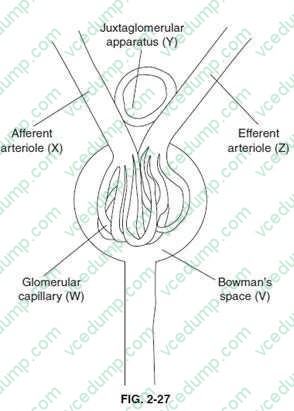
With respect to below figure, which of the following will decrease the GFR?
A. decreased hydrostatic pressure in V B. decreased plasma protein concentration in W C. dilation of X D. dilation of Z E. increased aldosterone secretion by Y
D. dilation of Z
Explanation
Section: Physiology These choices revolve around the Starling forces that directly regulate glomerular filtration. Choice D is correct and choice C is incorrect because glomerular capillary pressure is regulated by the ratio of upstream (afferent arteriole) and downstream (efferent arteriole) resistance to flow. Dilation of the afferent arteriole (choice C) will increase glomerular capillary pressure and increase filtration, whereas dilation of the efferent arteriole (choice D) will decrease the pressure and thus decrease filtration. Choice A is incorrect because Bowman's space pressure normally acts to oppose filtration, hence a decreased pressure will increase filtration. Choice B is incorrect because the osmotic pressure of the plasma proteins opposes filtration, so a decreased plasma protein concentration will predictably increase filtration. Choice E is incorrect, first of all because the juxtaglomerular apparatus does not secrete aldosterone, but instead secretes renin, which ultimately can trigger aldosterone secretion from the adrenal cortex via angiotensin II. Secondly, aldosterone is likely to trigger salt and water retention by an action on the distal nephron of the kidney, which is likely to alter the Starling forces in favor of increased glomerular filtration.
Question 490:
A 7-year-old boy experienced respiratory tract inflammation, sore throat, and fever. Labored breathing soon followed the development of a gray membrane in the tonsil area, and diphtheria was diagnosed. Which of the following represents the most immediate course of action by his physician?
A. acid-fast stain of a throat specimen B. culture of a throat specimen on blood agar C. injection of diphtheria antitoxin D. oral administration of sulfonamides E. performance of a spinal tap
C. injection of diphtheria antitoxin
Explanation
Section: Microbiology/Immunology A physician is justified in giving antitoxin on clinical evidence, or suspicion of diphtheria, without waiting for laboratory confirmation. The antitoxin dosage should be adjusted according to the weight of the patient and the severity of the infection. The antitoxin is given to neutralize free diphtheria exotoxin in the body fluids and timeliness is of extreme importance. Once the exotoxin has been bound by the body cells and exerted its influence, diphtheria antitoxin is of little value. C. diphtheria localizes in the throat, and thus spinal taps are useless (choice E). Tellurite agar, not blood agar, is used for the isolation of C. diphtheriae from throat swabs, because it is a selective medium for this germ, inhibiting the growth of other bacteria present in throat swabs (choice B). C. diphtheriae is not an acid-fast microbe. Methylene blue is used to stain smears for the bacteriological diagnosis of diphtheria (choice A). This initial treatment of choice for diphtheria is antitoxin. Treatment with penicillin G or erythromycin, but not sulfonamides, may be used. Penicillin G or erythromycin are not substitutes for diphtheria antitoxin (choice D).
Nowadays, the certification exams become more and more important and required by more and more
enterprises when applying for a job. But how to prepare for the exam effectively? How to prepare
for the exam in a short time with less efforts? How to get a ideal result and how to find the
most reliable resources? Here on Vcedump.com, you will find all the answers.
Vcedump.com provide not only USMLE exam questions,
answers and explanations but also complete assistance on your exam preparation and certification
application. If you are confused on your USMLE-STEP-1 exam preparations
and USMLE certification application, do not hesitate to visit our
Vcedump.com to find your solutions here.