USMLE USMLE-STEP-1 Online Practice
Questions and Exam Preparation
USMLE-STEP-1 Exam Details
Exam Code
:USMLE-STEP-1
Exam Name
:United States Medical Licensing Step 1
Certification
:USMLE Certifications
Vendor
:USMLE
Total Questions
:847 Q&As
Last Updated
:Jun 02, 2026
USMLE USMLE-STEP-1 Online Questions &
Answers
Question 451:
A 47-year-old gardener receives an insect sting while pruning some rose bushes. Within a few minutes the area around the sting is swollen and red. The swelling is mostly the result of which of the following?
A. decreased plasma oncotic pressure B. increased hydrostatic pressure C. increased vascular permeability D. lymphatic obstruction E. venous obstruction
C. increased vascular permeability
Explanation
Section: Pathology and Path physiology Following tissue injury (in this case caused by the insect sting), vasoactive inflammatory mediators originating from both cellular and humoral sources are released at the site of injury. These produce vasodilation of arterioles and increased blood flow producing the redness, and increased vascular permeability of enules allowing the formation of an exudates that produces swelling. All of the other choices can produce edema, but do not feature an increase in vascular permeability (they produce noninflammatory edema). Decreased plasma oncotic pressure (choice A) can result from either excessive loss (e.g., nephrotic syndrome) or decreased synthesis (e.g., cirrhosis, protein malnutrition) of plasma proteins, principally albumin. Increased hydrostatic pressure (choice B) occurs, for example, in heart failure where the pressure builds up behind the failing pump. Lymphatic obstruction (choice D) occurs where there is blockage to the normal lymphatic drainage. This could be due to the growth of an obstructing cancer or to inflammation and fibrosis (e.g., postsurgery, filariasis). Venous obstruction (choice E) leads to increased hydrostatic pressure as the blood backs up behind the obstruction.
Question 452:
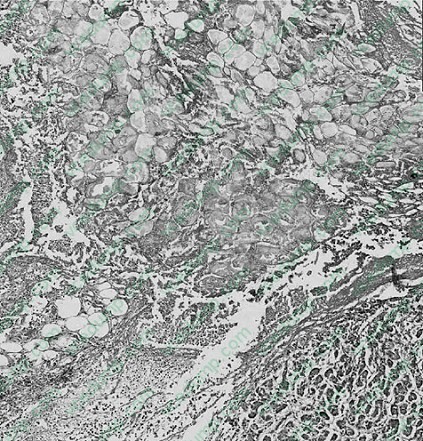
A 45-year-old man developed severe abdominal pain and was transported to the emergency room where he was found to be hypotensive and in shock. He was unresponsive to therapy and died 2 days later. Based upon this history and the accompanying image in below figure, which of the following most likely initiated this sequence of events?
A. acute pancreatitis B. esophageal varices C. gastric ulcer D. liver cirrhosis E. splenic infarct
A. acute pancreatitis
Explanation
Section: Pathology and Path physiology In the lower left corner of figure is pancreas while the rest is composed of necrotic fat cells, some viable fat cells, and inflammatory exudate. Thus, the initiating event in this case is acute pancreatitis. The image does not show any of the other organs listed, thereby ruling out choices B through E.
Question 453:
Which of the following represents the average age for puberty?
A. 11 for boys and 13 for girls B. 11 for girls and 13 for boys C. 14 for boys and 16 for girls D. 14 for girls and 16 for boys E. 15 for both girls and boys
B. 11 for girls and 13 for boys
Explanation
Section: Behavioral Science and Biostatics The onset of puberty varies, but girls usually enter puberty 1218 months earlier than boys. The average age is 11 (range, 813) for girls and 13 (range, 1014) for boys. Choices A, C, and E are incorrect because they do not distinguish between girls and boys. Choice D is above the upper limit for both girls and boys.
Question 454:
Which of the following drugs has opioid antagonist actions and also reduces nicotine and alcohol craving in persons dependent on those drugs?
A. bupropion B. flumazenil C. nalbuphine D. naloxone E. naltrexone
E. naltrexone
Explanation
Section: Pharmacology Naltrexone is a very long-acting opioid antagonist that has also been shown to reduce craving and dependence in smokers and alcoholics. The mechanisms for the latter effects are not fully understood. Bupropion (choice A) is an antidepressant that has some efficacy in tobacco dependence. It is not an opioid antagonist. Flumazenil (choice B) is a benzodiazepine antagonist that is useful in BDZ overdose. It has no opioid antagonist effect. Nalbuphine (choice C) is an opioid partial agonist that has analgesic effects but can also antagonize the actions of strong agonists like morphine. Naloxone (choice D) is a shortacting opioid antagonist but has not been shown to have efficacy in tobacco or alcohol dependence.
Question 455:
Unmyelinated C fibers are thought to carry which of the following pain sensations?
A. aching B. burning C. dull D. gnawing E. pricking
B. burning
Explanation
Section: Behavioral Science and Biostatics It is now believed that specific pain receptors (free nerve endings) are stimulated mainly by chemicals such as bradykinin, and that two types of pain sensations ("pricking" and "burning") are transmitted by different types of nerves. The burning pain sensation is transmitted by small C-fibers, and the pricking pain sensation is transmitted by larger, myelinated A-delta fibers. The pain fibers eventually terminate in the thalamus in a somatotopical fashion. Choices A, C, D, and E are incorrect.
Question 456:
A healthy 27-year-old male is given a treadmill stress test. His cardiovascular values at rest and during exercise were:
When compared to rest, what was the change in his estimated mean arterial pressure?
A. decreased by 10 mm Hg B. increased by 5 mm Hg C. increased by 25 mm Hg D. increased by 35 mm Hg E. increased by 140 mm Hg
B. increased by 5 mm Hg
Explanation
Section: Physiology True mean arterial pressure cannot be determined without a pressure transducer, which averages the systolic and diastolic pressures throughout the cardiac cycle. However, mean arterial pressure can be estimated by adding one-third of pulse pressure to the minimum diastolic pressure. At rest his mean pressure is 30/3 + 75 = 85; during exercise mean pressure is 75/3 + 65 = 90. Hence, estimated mean pressure increased by 5 mm Hg.
Question 457:
Oseltamivir is used for the treatment of infections by a virus with a segmented negative strand genome.
Which of the following would respond to this treatment?
A. EBV B. herpes simplex virus C. influenza virus D. rabies virus E. rhinovirus
C. influenza virus
Explanation
Section: Microbiology/Immunology The NA inhibitors zanamivir and oseltamivir (tamiflu) were approved in 1999 for the treatment of influenza Aand influenza B. Amantadine (generic name) or Symmetrel (trade name) inhibits an early event in the multiplication cycle of influenza virus, as well as arenaviruses. It blocks the uncoating process. Mutations in the M protein genes result in the development of drug-resistant mutants. The drug is not used extensively in the United States because it seems impractical to control this type of infectious disease that is not ordinarily fatal. To protect individuals at high risk, and in those in whom the infection is potentially dangerous, the choice is between this drug and the influenza vaccine. In most cases, the vaccine is usually preferred. Acyclovir is used to shorten the duration of herpes simplex virus episodes and also to limit the duration of viral shedding (choice B). There are no antiviral drugs for rabies (choice D). Acyclovir has slight antiviral action for EBV (choice A). There is no antiviral agent against rhinovirus (choice E).
Question 458:
A newborn infant displays wheezing respiration, which is aggravated when she feeds, flexes her neck, and/ or cries. Radioimaging studies of her chest reveal a double aortic arch compressing her trachea and esophagus. This rare developmental defect results from persistence of the right dorsal aorta, which normally disappears. The arch of the aorta arises from which of the following structures?
A. fifth pair of aortic arches B. fourth pair of aortic arches C. second pair of aortic arches D. sixth pair of aortic arches E. third pair of aortic arches
B. fourth pair of aortic arches
Explanation
Section: Anatomy The arch of the aorta is formed from the left fourth aortic arch. Part of the right fourth aortic arch becomes the proximal portion of the right subclavian artery, whereas the rest of the fourth arch disappears. However, if it persists, a right aortic arch is formed passing posterior to the trachea and esophagus. With the formation of the normally occurring left aortic arch, which runs anterior to the trachea and esophagus, a double aortic arch is created. This defect clamps the trachea and esophagus resulting in the respiratory symptoms. The second pair of aortic arches (choice C) partially form the stapedial arteries in the middle ear of the embryo. The third pair of aortic arches (choice E) form the common carotid arteries and contribute to the internal carotid arteries. The fifth pair of aortic arches (choice A) either does not develop or form primitive vessels, which disappear eventually. The sixth pair of aortic arches (choice D) contribute to the formation of the pulmonary arteries and ductus arteriosus.
Question 459:
Your patient reports that several days earlier he "threw his back out" when he bent from the waist and picked up a very heavy package. The pain was immediate and extended from his hip, down the back of the thigh, and into his leg and foot. As he lies on the examining table, you raise his leg by the foot keeping the knee extended and elicit intense pain over the distribution of the sciatic nerve. An MRI scan confirms your conclusion that your patient has a herniated intervertebral disk between the fourth and fifth lumbar vertebrae.
Herniation of the intervertebral disk between the fourth and fifth lumbar vertebrae most likely impinges on the roots of which spinal nerve?
A. L3 B. L4 C. L5 D. S1 E. S2
C. L5
Explanation
Section: Anatomy A bulging or protruded disk typically affects the traversing nerve root; that is, the nerve affected is one number greater than the number of the disk. The L3 spinal nerve (choice A) would be affected by protrusion of the L2 intervertebral disk. The L4 spinal nerve (choice B) would be affected by protrusion of the L3 intervertebral disk. The S1 spinal nerve (choice D) would be affected by protrusion of the L5 intervertebral disk. The S2 spinal nerve (choice E) exits through the foramina of the fused sacrum and, therefore, is not subject to compression by herniated intervertebral disks.
Question 460:
A 34-year-old woman who has been taking oral contraceptives for many years presents with acute abdominal pain and fullness. Paracentesis harvests 200 mL of bloody fluid. Imaging studies show a 6- cm mass in the liver that is subsequently resected. Histological examination of this specimen would most likely reveal this to be which of the following?
A. angiosarcoma B. cholangiosarcoma C. focal nodular hyperplasia D. hepatocellular carcinoma E. liver cell adenoma
E. liver cell adenoma
Explanation
Section: Pathology and Path physiology Liver cell adenomas may occur after several years of taking oral contraceptives but the actual mechanism of tumor formation is unknown. The clinical presentation is often acute abdominal pain due to necrosis of the tumor and hemorrhage. Given the patient's history, liver cell adenoma is by far the most likely choice. Angiosarcomas of the liver (choice A) are very rare tumors associated with exposure to vinyl chloride (used in the manufacture of the plastic polyvinyl chloride). Cholangiosarcomas (choice B) are rare tumors that arise in the intrahepatic bile ducts. However, they are more common in the Far East, where there is an association with the liver fluke, Clonorchis sinensis. Focal nodular hyperplasia (choice C) is a tumor-like lesion that occurs more frequently in women. It has a weak association with oral contraceptive use. On cut section, it typically has a central stellate scar. It is usually asymptomatic and is only resected in the symptomatic patient. Hepatocellular carcinoma (choice D) in the United States usually arises in a background of cirrhosis due either to alcoholism or HBV infection. However, worldwide, hepatitis B is the major etiologic factor and up to 50% of patients with hepatocellular carcinoma may be noncirrhotic.
Nowadays, the certification exams become more and more important and required by more and more
enterprises when applying for a job. But how to prepare for the exam effectively? How to prepare
for the exam in a short time with less efforts? How to get a ideal result and how to find the
most reliable resources? Here on Vcedump.com, you will find all the answers.
Vcedump.com provide not only USMLE exam questions,
answers and explanations but also complete assistance on your exam preparation and certification
application. If you are confused on your USMLE-STEP-1 exam preparations
and USMLE certification application, do not hesitate to visit our
Vcedump.com to find your solutions here.