USMLE USMLE-STEP-1 Online Practice
Questions and Exam Preparation
USMLE-STEP-1 Exam Details
Exam Code
:USMLE-STEP-1
Exam Name
:United States Medical Licensing Step 1
Certification
:USMLE Certifications
Vendor
:USMLE
Total Questions
:847 Q&As
Last Updated
:May 25, 2026
USMLE USMLE-STEP-1 Online Questions &
Answers
Question 441:
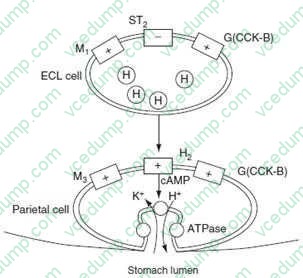
Below figure illustrates a current concept of the control of gastric acid secretion. Which of the following drugs acts at the site labeled "ATPase"?
A. aluminum hydroxide B. misoprostol C. omeprazole D. ranitidine E. sucralfate
C. omeprazole
Question 442:
Occlusion of which of the following vessels affects the entire dorsolateral part of the rostral medulla (level of the restiform body) and produces the lateral medullary (Wallenberg) syndrome?
A. anterior inferior cerebellar artery B. anterior spinal artery C. posterior inferior cerebellar artery D. posterior spinal artery E. superior cerebellar artery
C. posterior inferior cerebellar artery
Explanation
Section: Anatomy The posterior inferior cerebellar artery supplies the rostral, dorsolateral medulla. The posterior spinal (choice D) and anterior spinal (choice B) arteries supply dorsal and ventral portions, respectively, of the caudal medulla. The anterior inferior cerebellar (choice A) and superior cerebellar (choice E) arteries supply portions of the pons and mesencephalon.
Question 443:
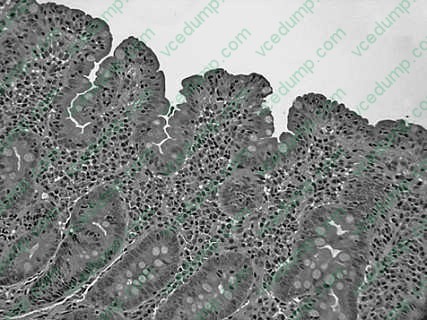
A 6-year-old child presents with diarrhea, malabsorption, and steatorrhea. A photomicrograph from a small intestinal mucosal biopsy is displayed in below figure. An appropriate treatment would be which of the following?
A. alpha-interferon therapy B. antineoplastic drugs C. initiation of a gluten-free diet D. referral to hospice for supportive care E. surgical resection of a segment of small Bowel
C. initiation of a gluten-free diet
Explanation
Section: Pathology and Path physiology The child has celiac disease, a disorder resulting from a hypersensitivity reaction to gluten in the diet. Withdrawal of gluten from the diet is usually curative. Clinically, there is diarrhea, malabsorption, and steatorrhea. Histologically, there is villous atrophy of the small intestinal mucosa. A referral to hospice for supportive care (choice D) is unlikely to be necessary; more than 95% of patients respond to the removal of gluten from their diet. Recalcitrant cases are rarely life threatening and may be successfully treated with various forms of hyperalimentation that bypass the small intestine. Because the disease is usually cured by dietary measures, the use of alphainterferon therapy (choice A), antineoplastic drugs (choice B), and surgical resection of the small intestine (choice E) are not appropriate treatment options.
Question 444:
A young boy was treated for 2 years with several antibacterial agents to eradicate tuberculosis. On entering school the following year, his teacher reports that he seems to be retarded. Upon investigation, he is found to have profound hearing loss. Which of the following agents may have been responsible for this hearing loss?
A. ethambutol B. isoniazid C. pyrazinamide D. rifampin E. streptomycin
E. streptomycin
Explanation
Section: Pharmacology The agents listed are the primary drugs used in the treatment of tuberculosis. Streptomycin (choice E) and other aminoglycosides cause eighth nerve damage, which is often irreversible and may take the form of auditory or vestibular dysfunction. Isoniazid and rifampin are the most efficacious and least toxic, but even when used together are insufficient in many cases to prevent the development of resistance. Therefore, most cases of tuberculosis are treated with three or even four agents in an effort to eradicate the infection before resistance develops. Because each drug has different toxicities, it is sometimes possible to achieve a cure without severe toxicity. Ethambutol (choice A) causes visual dysfunction and possible retinal damage, not hearing loss. Isoniazid (choice B) causes peripheral neuropathies and hepatic damage. Fortunately, hepatitis is uncommon in children treated with this drug. Pyrazinamide (choice C) causes joint pains and swelling, GI upset, and rash. Rifampin (choice D) causes proteinuria, rash, and thrombocytopenia.
Question 445:
A 5-year-old girl has had numerous childhood fractures. She is also found to have blue sclera, hearing abnormalities, and misshapen teeth. Which of the following is the most likely cause of these findings?
A. abnormal intestinal receptors for calcium B. an inability to metabolize vitamin D C. inadequate mineralization of bone matrix D. renal inability to conserve phosphorous E. synthesis of abnormal type I collagen
E. synthesis of abnormal type I collagen
Explanation
Section: Pathology and Path physiology Osteogenesis imperfecta type I, is a genetic disorder characterized by synthesis of an abnormal type I collagen. Frequent childhood fractures, blue sclera, poor hearing, and misshapen teeth may all occur clinically because of the abnormal collagen synthesis. Abnormal intestinal receptors for calcium (choice A), inability to metabolize vitamin D (choice B), inadequate mineralization of bone matrix (choice C), and renal inability to conserve phosphorous (choice D) are not the primary pathologic alterations responsible for this disorder.
Question 446:
A 53-year-old healthy male undergoes an exercise stress test, running on a treadmill until a maximum exertion is obtained. Which of the following statements correctly describes effects of autonomic nerve activity on the cardiovascular system in such a healthy subject?
A. inhibition of parasympathetic nerves decreases total peripheral resistance B. inhibition of parasympathetic nerves increases heart rate C. inhibition of parasympathetic nerves increases total peripheral resistance D. stimulation of parasympathetic nerves decreases the strength of cardiac ventricular contractions E. stimulation of sympathetic nerves decreases the strength of cardiac ventricular contractions
B. inhibition of parasympathetic nerves increases heart rate
Explanation
Section: Physiology Since cardiac SA nodal cells receive tonic input from both sympathetic and parasympathetic nerves, heart rate increases whenever sympathetic firing rate increases or parasympathetic firing rate decreases. In humans, the parasympathetic innervation of ventricular muscle is negligible (choice D), and the strength of contraction increases with increasing preload and with increasing sympathetic firing rate (choice E). With few exceptions, blood vessels are not innervated by parasympathetic nerves, and there is little effect of changes in parasympathetic tone on total peripheral resistance (choices A and C).
Question 447:
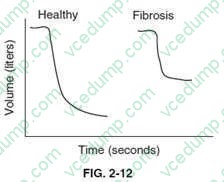
Below figure shows pulmonary function test tracings from a healthy person and a patient with pulmonary fibrosis. Of the following measures which would you expect to be increased in this patient, as compared to the expected norms?
A. Forced expiratory volume (FEV)/forced vital capacity (FVC) B. FRC C. FVC D. tidal volume E. vital capacity
A. Forced expiratory volume (FEV)/forced vital capacity (FVC)
Question 448:
Which of the following enzymes is inhibited by drugs of the class to which amoxicillin belongs?
A. alanine racemase B. beta lactamase C. enolpyruvate transferase D. transglycosylase E. transpeptidase
E. transpeptidase
Explanation
Section: Pharmacology All of the beta-lactam antibiotics (penicillins, cephalosporins, carbapenems, monobactams) inhibit one of the final steps in the synthesis of the bacterial cell wall, cross-linking of peptidoglycan chains by transpeptidase. Alanine racemase (choice A) is inhibited by cycloserine, which is used in the treatment of M. tuberculosis. Beta lactamase (choice B) is inhibited by drugs (e.g., clavulanic acid, sulbactam, tazobactam) used to prevent resistance by bacteria that possess it. Enolpyruvate transferase (choice C) is inhibited by fosfomycin, which is used for urinary tract infections. Transglycosylase (choice D), another enzyme important in cell wall cross linking, is inhibited by vancomycin.
Question 449:
After extraction of a wisdom tooth, an 18-yearold male student was diagnosed as having subacute bacterial endocarditis. He has a congenital heart disease which has been under control. Which of the following is the most likely organism causing his infection?
A. Enterococcus faecalis B. S. aureus C. S. epidermidis D. S. pneumonia E. S. viridans
E. S. viridans
Explanation
Section: Microbiology/Immunology The viridans streptococci include S. mitis, S. mutans, S. salivarius, S. sangus, and others. They make up a major part of oral normal flora and are alpha hemolytic. They reach the bloodstream as a result of trauma and are a principal cause of endocarditis on abnormal heart valves (choice E). They produce large amounts of polysaccharides and contribute to dental caries. S. aureus (choice B) and S. epidermidis (choice C) are usually found on the skin and may be opportunistic, but they are not as significant
for endocarditis as the alpha hemolytic streptococci. E. faecalis (choice A) are usually found in the intestinal tract flora and are opportunistic if they escape that location. The major lesion for enterococci is an abscess. S. pneumonia (choice D) is primarily found in lung infections (pneumonias) and are pathogenic primarily due to their polysaccharide capsules which inhibit phagocytosis.
Question 450:
During development, which of the following structures act as a temporary set of kidneys in the fetus?
A. mesonephroi B. metanephroi C. paramesonephric ducts D. pronephroi E. ureteric bud
A. mesonephroi
Explanation
Section: Anatomy The second set or mesonephroi appear late in the fourth week and are functional until the permanent kidneys or metanephroi are fully developed. During development, three sets of kidneys are formed in the embryo. The first set or pronephroi (choice D) are transitional, nonfunctional structures that appear around the fourth week of development. Next come the mesonephroi, then the permanent set of kidneys develops from the metanephroi. The paramesonephric ducts (choice C) are structures developing lateral to the gonads and mesonephric ducts. They play an essential role in the female reproductive system, but are not involved in the formation of the kidneys. The ureteric bud (choice E) is an outgrowth from the mesonephric duct that gives rise to the ureter, renal pelvis, calices, and collecting tubules.
Nowadays, the certification exams become more and more important and required by more and more
enterprises when applying for a job. But how to prepare for the exam effectively? How to prepare
for the exam in a short time with less efforts? How to get a ideal result and how to find the
most reliable resources? Here on Vcedump.com, you will find all the answers.
Vcedump.com provide not only USMLE exam questions,
answers and explanations but also complete assistance on your exam preparation and certification
application. If you are confused on your USMLE-STEP-1 exam preparations
and USMLE certification application, do not hesitate to visit our
Vcedump.com to find your solutions here.