USMLE USMLE-STEP-1 Online Practice
Questions and Exam Preparation
USMLE-STEP-1 Exam Details
Exam Code
:USMLE-STEP-1
Exam Name
:United States Medical Licensing Step 1
Certification
:USMLE Certifications
Vendor
:USMLE
Total Questions
:847 Q&As
Last Updated
:May 25, 2026
USMLE USMLE-STEP-1 Online Questions &
Answers
Question 421:
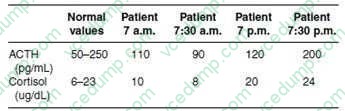
A dislocated shoulder of a middle-aged man was corrected under conscious sedation with etomidate. Since etomidate has been reported to affect adrenocortical function as a side effect, the patient's ACTH and cortisol were measured in blood samples taken at the indicated times on the following day. What do the ACTH results indicate?
A. inverted circadian pulsatile release B. normal circadian pulsatile release C. normal circadian non-pulsatile release D. primary adrenal insufficiency E. secondary adrenal insufficiency
A. inverted circadian pulsatile release
Explanation
Section: Physiology The differences in the hormone concentrations of blood samples taken half-an-hour apart indicate pulsatile release. Hence, non-pulsatile release (choice C) is excluded. However, the normal circadian rhythm for ACTH (choice B) is likely to be highest early in the morning, with cortisol production following ACTH by a short delay, opposite to the patient's values. Such a reversed pattern could, for instance, be observed for night workers and is not likely to be caused by etomidate. Etomidate has been associated with suppression of glucocorticoid and mineralcorticoid synthesis in the adrenal cortex. Substantial damage to the adrenal gland might indeed lead to adrenocortical hypofunction, called Addison disease. However, primary adrenal insufficiency (disorder of the gland, choice D), and secondary adrenal insufficiency (inadequate ACTH secretion, choice E) both present with low levels of cortisol.
Question 422:
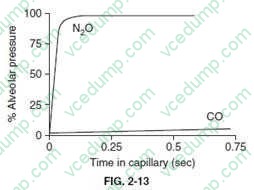
below figure illustrates uptake of two gases (nitrous oxide and carbon monoxide) from alveolar air to pulmonary capillary blood. Based on this information what can we conclude about carbon monoxide?
A. it does not dissolve in blood B. it does not interact with hemoglobin C. it has equilibrated with pulmonary capillary blood D. it is a diffusion-limited gas E. it is a perfusion-limited gas
D. it is a diffusion-limited gas
Explanation
Section: Physiology The plot shows that carbon monoxide fails to equilibrate with pulmonary capillary blood during the time that blood is exposed to alveolar air. Since pulmonary partial pressure rises to only a few percent of alveolar partial pressure, carbon monoxide is a diffusion-limited gas. In contrast, nitrous oxide, which does equilibrate, is a perfusion-limited gas (choice E). Carbon monoxide does cross the respiratory membrane (choice C), dissolve in pulmonary capillary blood (choice A), and binds with hemoglobin (choice B). In fact, its affinity for hemoglobin is about 250-fold greater than that of oxygen.
Question 423:
The sensory innervation of the posterior onethird of the tongue is performed by cranial nerve IX (glossopharyngeal). During development, this region of the tongue develops from which of the following pharyngeal arches?
A. first B. fourth C. second D. sixth E. third
E. third
Explanation
Section: Anatomy The posterior one-third of the tongue is derived from the third pharyngeal arch and is thus innervated by cranial nerve IX (glossopharyngeal). The first pharyngeal arch (choice A) and second pharyngeal arch (choice C) give rise to the anterior two-thirds of the tongue. The mandibular division of cranial nerve V (trigeminal) provides general sensation to the anterior two-thirds of the tongue, and cranial nerve VII via the chorda tympani provides special sensation (taste). The fourth pharyngeal arch (choice B) gives rise to the epiglottis and, along with the sixth pharyngeal arch (choice D), to the laryngeal cartilages. The nerve to the fourth pharyngeal arch is cranial nerve X (vagus).
Question 424:
An 81-year-old man who contracted syphilis while serving in World War II is now found to have a saccular aneurysm of the thoracic aorta. The pathogenesis of this lesion is best explained by which of the following?
A. endarteritis obliterans of the vasa vasorum with subsequent mural ischemia B. hypersensitivity reaction with multinucleated giant cells and mural fibrinoid necrosis C. immune complex formation and complement activation D. intimal fibroplasia and lipid deposition E. medial cystic necrosis
A. endarteritis obliterans of the vasa vasorum with subsequent mural ischemia
Explanation
Section: Pathology and Path physiology Syphilitic saccular aneurysms of the thoracic aorta result from endarteritis obliterans of the vasa vasorum with subsequent mural ischemic necrosis. Hypersensitivity reactions, multinucleate giant cells, and fibrinoid necrosis (choice B) play no significant role in the development of syphilitic aortic aneurysms. Immune complex formation and complement activation (choice C) may be seen with tertiary syphilis, but involve only the small vessels, without aneurysm formation. Intimal fibroplasias and lipid deposition (choice D) are the early lesions of atherosclerosis. Cystic medial necrosis (choice E) is a noninfectious disorder characterized by abnormally weak connective tissue in the aortic media and deposits of myxoid substances.
Question 425:
Aprimary viral isolate from a suspected case of poliomyelitis was inoculated into cell culture, and a dramatic cytopathic effect (CPE) was noted within 24 hours. The isolate was confirmed as poliovirus by neutralization with polyvalent antibody to poliovirus types I, II, and III; however, monospecific antibody to each type failed to block CPE. This finding suggests that the isolated contained which of the following?
A. hybrid virus of type I and type II poliovirus B. mixture of polio and another type of picornavirus mixture C. mixture of two types of poliovirus D. recombinant of type I and type II viruses E. virus that shares a few antigenic determinants with poliovirus
C. mixture of two types of poliovirus
Explanation
Section: Microbiology/Immunology Polioviruses 1, 2, and 3 are enteroviruses that belong to the picornavirus group. Even though wild-type polioviruses have not been detected in North America for many years, both the live-attenuated and killed vaccines are currently used in pediatric vaccinations. It is fairly easy to isolate and identify poliovirus strains. In this case, poliovirus was isolated and neutralized by a polyvalent antibody against all three polio strains, prompting a presumptive diagnosis of poliomyelitis in the patient. A follow-up study using separate monovalent antibodies failed to duplicate the viral identification that was indicated by the trivalent serum product. The most logical reason for this would be that two types of polioviruses were isolated and neutralized by the polyvalent reagent but not the monovalent reagents (choice C). While work is being reported on attempts to create a recombinant virus with 1, 2, and 3 antigen markers (choice D), this has not yet become successful. Neither have any hybrid polio viruses (choice A) been reported. A mixture of poliovirus and another picornavirus (choice B) would not explain the situation described because there is little to no cross reactivity of poliovirus antisera to the other members of the picornavirus group. Choice E would not be appropriate either because no other picornavirus shares only some antigenic determinants with the polioviruses.
Question 426:
A 52-year-old woman has experienced personality change and headaches over the past 3 months and is now developing a right hemiparesis. CT scan shows a mass in the left temporal lobe. Her condition deteriorates rapidly and she dies 7 months later. At autopsy, a large, hemorrhagic, necrotic tumor is identified in the left temporal lobe with extension to the right hemisphere. Microscopically there are highly pleomorphic cells with frequent mitoses. Serpentine areas of necrosis can be seen surrounded by masses of tumor cells. Which of the following is the most likely diagnosis?
A. ependymoma B. glioblastoma multiforme C. medulloblastoma D. meningioma E. oligodendroglioma
B. glioblastoma multiforme
Explanation
Section: Pathology and Path physiology Glioblastoma multiforme is the most malignant astrocytoma and is also the most common intracranial primary neoplasm. It is typically a large tumor with areas of necrosis and hemorrhage and extends to the contralateral side of the brain (butterfly tumor). Microscopically the tumor is very pleomorphic with giant cells, palisading necrosis, and endothelial proliferation. The prognosis is universally poor. Ependymoma (choice A) is somewhat more common in children and originates from the ependymal cells lining the ventricles and central canal of the spinal cord. It is a slowgrowing tumor but has the ability to seed via the cerebrospinal fluid. Medulloblastoma (choice C) is principally a highly malignant tumor of childhood that originates in the cerebellum and has the well-known ability to metastasize via the cerebrospinal fluid. Meningioma (choice D) is a benign tumor arising from the arachnoid cap cells. However, it may involve the dura and calvaria making complete removal difficult. The tumor is only considered malignant if it grows into the underlying brain. Oligodendroglioma (choice E) occurs in adults and typically arises from the white matter of the cerebrum. Most of these tumors have areas of calcification which may be seen on x-ray. Many of these tumors are mixed tumors showing areas of astrocytoma.
Question 427:
A retired policeman who received a kidney transplant developed a generalized infection by an enveloped double-stranded DNA virus. This organism formed owl's eye inclusions in cells found in urinary sediments. Which of the following viruses is the most likely etiological agent? Which of the following approaches most likely might have prevented the infection of the policeman?
A. administration of gamma interferon B. injection of alpha interferon C. treatment with methisazone D. treatment with zanamivir E. viral screening of donor and recipient
E. viral screening of donor and recipient
Explanation
Section: Microbiology/Immunology In this case, prevention of infection most likely involves careful prescreening of the kidney donor and the recipient for CMV presence by antibody detection, isolation, or PCR. For treatment, ganciclovir is moderately effective for CMV pneumonia and retinitis in AIDS patients. Alpha interferon is used for patients with chronic hepatitis caused by B or C virus. However, only some genotypes appear to be susceptible (choice B). Gamma interferon, like alpha, has been shown to have viral replicative inhibitory activity, and also to be able to activate macrophages as well as other immune cells (choice A). Zanamivir inhibits the release of influenza virus from infected cells and thus limits the infection (choice D). Methisazone inhibits protein synthesis of vaccinia and smallpox viruses (choice C).
Question 428:
A newborn boy appears to be lethargic and septic. Aspinal tap was performed, and a Gram stain of the spinal fluid revealed gram-positive bacilli. Cultures of the spinal fluid on sheep blood agar plates, at a temperature of 2225°C, yielded catalase-positive he molytic rods that had a tumbling motion. Penicillin cleared the infection. Which of the following is the most likely organism that caused this disease?
A. Bacillus cereus B. Bordetella pertussis C. Corynebacterium diphtheria D. Listeria monocytogenes E. Neisseria meningitidis
D. Listeria monocytogenes
Explanation
Section: Microbiology/Immunology
L. monocytogenes causes meningitis and sepsis in newborns and patients whose immune systems have been compromised by irradiation or chemotherapy. When this microbe is growing at a temperature of 22- 25°C on blood agar, it yields gram-positive rods, w hich move with a characteristic tumbling motion. A slight zone of hemolysis surrounds the colonies of
L. monocytogenes. These characteristics are not applicable to
B. cereus (choice A),
B. pertussis (choice B),
N. meningitides (choice E), or C.
diphtheriae (choice C).
Question 429:
Exhibit:
Please refer to the exhibit.
A 14-month-old baby boy is brought to your office by his mother because he seems to be in pain whenever he tries to move. During your physical examination you note bowing of his legs, depression of the sternum with outward projection of the ends of the ribs, reluctance to move his limbs, and numerous bruises on his legs as well as gingival hemorrhages. These findings lead you to suspect that this child suffers from a dietary deficiency of which of the following vitamins?
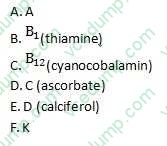
A. A B. B C. C D. D E. E F. F
D. D
Explanation
Section: Pathology and Path physiology Deficiencies of vitamin C and vitamin D can produce similar skeletal abnormalities in young children such as those listed. However, a major difference is that vitamin C deficiency is accompanied by hemorrhages, as seen in this child. This also leads to hemarthrosis (bleeding into joints) that makes movement very painful. Vitamin A deficiency (choice A) is associated with night blindness, with or without keratomalacia and papular dermatitis. Vitamin B1 deficiency (choice B) produces beriberi marked by polyneuropathy, heart failure, and edema (or Wernicke syndrome in chronic alcoholics). Vitamin B12 deficiency (choice C) produces megaloblastic anemia and subacute combined degeneration of the spinal cord. Vitamin D deficiency (choice E) produces osteomalacia in adults and rickets in children due to defective mineralization of bone. Vitamin K deficiency (choice F) can result in a bleeding diathesis because it is required for the activity of clotting factors II, VII, IX, and X.
Question 430:
The change in elimination rate after hour 12 when sodium bicarbonate was administered is expected if drug W is which of the following chemical types?
A. nonelectrolyte B. strong acid C. strong base D. weak acid E. weak base
D. weak acid
Explanation
Section: Pharmacology By inspection of the graph, it is observed that administration of sodium bicarbonate increases the rate of elimination of the drug (the slope of the line increases and the half-life is shortened). Sodium bicarbonate causes alkalinization of the urine. Alkalinization causes increased ionization of weak acids and accelerates their urinary excretion because the ionized (charged) forms cannot be easily reabsorbed through the tubular epithelium, whereas the uncharged forms of many weak acids are readily reabsorbed. Urinary alkalinization is a strategy sometimes used to hasten the excretion of weak acids, such as aspirin, in overdose situations. Excretion of a nonelectrolyte (choice A) is unaffected by changes in urinary pH because the polarity of nonelectrolytes is insensitive to pH. A strong acid (choice B) is fully ionized (unprotonated) at all attainable urinary pH values so that alteration of urinary pH has no effect on its excretion. A strong base (choice C) is similarly fully charged at all attainable urinary pH values so that alteration of urinary pH has no effect on its excretion. Excretion of a weak base (choice E) is slowed by alkalinization of urinary pH because the uncharged form of a base is readily reabsorbed from the tubular urine predominates.
Nowadays, the certification exams become more and more important and required by more and more
enterprises when applying for a job. But how to prepare for the exam effectively? How to prepare
for the exam in a short time with less efforts? How to get a ideal result and how to find the
most reliable resources? Here on Vcedump.com, you will find all the answers.
Vcedump.com provide not only USMLE exam questions,
answers and explanations but also complete assistance on your exam preparation and certification
application. If you are confused on your USMLE-STEP-1 exam preparations
and USMLE certification application, do not hesitate to visit our
Vcedump.com to find your solutions here.