USMLE USMLE-STEP-1 Online Practice
Questions and Exam Preparation
USMLE-STEP-1 Exam Details
Exam Code
:USMLE-STEP-1
Exam Name
:United States Medical Licensing Step 1
Certification
:USMLE Certifications
Vendor
:USMLE
Total Questions
:847 Q&As
Last Updated
:May 25, 2026
USMLE USMLE-STEP-1 Online Questions &
Answers
Question 341:
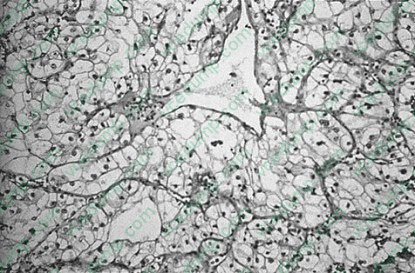
A 64-year-old man presents to his family physician with hematuria and flank pain. A radiology study identifies a renal mass. Aphotograph of this renal lesion's histology is displayed in below figure. The kidney mass is most likely which of the following?
A. angiomyolipoma B. oncocytoma C. renal cell carcinoma D. transitional cell carcinoma E. xanthogranulomatous pyelonephritis
C. renal cell carcinoma
Explanation
Section: Pathology and Path physiology Figure shows a clear cell adenocarcinoma, which is the most common histologic appearance for renal cell carcinoma. The patient's age, gender, and clinical presentation are typical for this malignant neoplasm. Angiomyolipoma (choice A) is a benign renal tumor that displays a mixture of blood vessels, smooth muscle, and mature fat on microscopic examination. Oncocytoma (choice B) is a benign renal neoplasm constructed by monomorphic cells with granular eosinophilic cytoplasm. Transitional cell carcinoma (choice D) usually arises in the renal pelvis and histologically is composed of anaplastic transitional cells without a clear cell adenocarcinoma component. Xanthogranulomatous pyelonephritis (choice E) is a benign inflammatory condition of the kidney that may produce a mass effect. The gross appearance, but not the microscopic appearance, may be confused with renal cell carcinoma.
Question 342:
A 67-year-old woman presents with a 4-week history of headaches, facial pain, blurred vision, and intense pain and stiffness in her shoulders and hips. She is diagnosed with a vasculitis, and a biopsy of an affected artery is taken. Histological examination is most likely to reveal which of the following characteristic findings?
A. concentric "onion skin" thickening and fibrosis B. extensive intra- and extravascular granulomatous inflammation C. fragmentation of the internal elastic lamina with giant cells D. hyaline arteriolosclerosis and luminal narrowing E. segmental fibrinoid necrosis and neutrophil infiltration
C. fragmentation of the internal elastic lamina with giant cells
Explanation
Section: Pathology and Path physiology The most likely diagnosis in this case is giant cell (temporal) arteritis; it is both the most common systemic vasculitis in this woman's age group (>60) and is suggested by the clinical history. Giant cell arteritis may affect any medium- and large-sized arteries, but principally involves vessels in the head, that is, extracranial branches of the carotid arteries. Vascular insufficiency leads to symptoms of jaw or facial pain, headaches, and visual changes, as reported by this patient. In particular, ischemic optic neuropathy may occur abruptly, resulting in permanent blindness; for this reason, patients with ocular disturbances in suspected cases demand immediate medical intervention. Temporal arteritis has a strong, well-known association with polymyalgia rheumatica, a systemic inflammatory disorder causing symmetrical, often severe muscle pain and stiffness in the shoulders and pelvic girdle (also reported by this patient); both conditions are associated with the HLA-D4 haplotype. Microscopically, a section of a vessel affected by giant cell arteritis will demonstrate fragmentation of the internal elastic lamina and the presence of multinucleated giant cells. Concentric "onion skin" thickening and fibrosis (choice A) may be seen most commonly in malignant hypertension but also in other conditions such as primary sclerosing cholangitis. Extensive intra- and extravascular granulomatous inflammation (choice B) refers to Wegener granulomatosis which often includes: (i) acute necrotizing granulomas of the upper and/or lower respiratory tract; (ii) granulomatous vasculitis; and (iii) renal disease. Hyaline arteriolosclerosis and luminal narrowing (choice C) is found in association with benign hypertension and in diabetes mellitus but is also seen in some normotensive, nondiabetic elderly individuals. Segmental fibrinoid necrosis and neutrophil infiltration (choice E) is a description of the acute phase of polyarteritis nodosa.
Question 343:
Which of the following is the current drug of choice for treatment of roundworm (Ascaris) infections?
A. diethylcarbamazine B. ivermectin C. mebendazole D. niclosamide E. praziquantel
C. mebendazole
Explanation
Section: Pharmacology Mebendazole is a broad-spectrum antihelmintic that is effective against a variety of nematodes including ascarids, hookworm (Necator, Ancylostoma), whipworm (Trichuris), threadworm (Strongyloides), and pinworm (Enterobius). Adverse effects are rare. Diethylcarbamazine (choice A) was developed as a treatment for filariasis. Because of adverse effects that include nausea, vomiting, headache, leukocytosis, and proteinuria, it has been largely supplanted by other antifilarial agents, except in the case of Loa loa, where it remains the drug of choice. Ivermectin (choice B) is used to treat Onchocerca volvulus, the agent responsible for river blindness in west and central Africa. Niclosamide (choice D) and praziquantel (choice E) are agents with primary efficacy against flukes and tapeworms. In the case of Fasciola hepatica (sheep liver fluke), however, bithionol or triclabendazole (a veterinary drug) are drugs of choice; in cysticercosis, albendazole is the drug of choice.
Question 344:
A 14-year-old boy presents with acne with inflamed follicles and sebaceous glands. Gram stain of a pustule from his face reveals pleomorphic gram-positive bacilli. Which of the following is the organism implicated in this condition?
B. Erysipelothrix rhusiopathiae C. L. monocytogenes D. S. aureus E. S. epidermidis
A
Explanation
Section: Microbiology/Immunology The non-spore forming gram-positive bacilli are a diverse group of bacteria. While C. diphtherae is the most important pathogen, many corynebacteria and propionibacteria (anerobes) are members of the normal flora of skin and mucus membranes. These bacteria tend to be clubbed or irregularly shaped. C. durum (choice A) is a diphtheroid, a normal flora species that can be opportunistic in the right location, such as hair follicles and sebaceous glands. It may contribute to lesion development or be part of a mixed culture of skin bacteria present in the pustule. E. rhusiopathial (choice B) causes disease in domestic swine. Erysipelas in humans is caused by Group A streptococci. L. monocytogenes (choice C) enters the body through the GI tract after ingestion of contaminated cheese or vegetables. S. aureus (choice D) and S. epidermidis (choice E) are welldefined gram-positive cocci.
Question 345:
Which of the following personality traits would most likely result from anal-phase fixation?
A. dependency B. fierce competitiveness C. parsimony D. narcissism
C. parsimony
Explanation
Section: Behavioral Science and Biostatics The anal phase of development occurs around age 2, around the time of toilet training. Developmental difficulty around this time may result in "anal-phase fixation," in which some characteristics of this phase may unduly influence the adult personality. Such characteristics include struggles over the issue of control. Excessive cleanliness and orderliness, or the opposite, as well as parsimony and hoarding may occur. Dependency (choice A) is characteristic of oral phase, and fierce competitiveness (choice B) may be characteristic of the Oedipal phase. Narcissism (choice D) is a complex phenomenon that develops from very early life and not confined to any particular stage of development.
Question 346:
The statin class of drugs that are currently used to control hypercholesterolemia function to lower circulating levels of cholesterol by which of the following mechanisms?
A. increasing the elimination of bile acids, leading to increased diversion of cholesterol into bile acid production B. increasing the synthesis of apolipoprotein B-100 (apo ), resulting in increased elimination of cholesterol through the action of low-density lipoprotein (LDL) uptake by the liver C. decreasing the absorption of dietary cholesterol from the intestines D. inhibiting the interaction of LDLs with the hepatic LDL receptor E. inhibiting the rate-limiting step in cholesterol biosynthesis
E. inhibiting the rate-limiting step in cholesterol biosynthesis
Explanation
Section: Biochemistry The statin class of cholesterol-lowering drugs all exert their effects on the activity of HMG-CoA reductase. This enzyme carries out the rate-limiting step in cholesterol biosynthesis. The cholestyramine-based resins are used therapeutically to bind up intestinal bile salts, which increases the excretion of bile (choice A). The net effect of increased bile excretion is increased diversion of cholesterol into bile acid synthesis, thereby lowering circulating cholesterol levels. No current therapy targets synthesis of apolipoprotein synthesis (choice B), decreasing intestinal absorption of cholesterol (choice C), or inhibition of LDL-receptor interactions (choice D).
Question 347:
Exhibit:
Please refer to the exhibit.
The majority of in the blood is carried in which of the following forms?
A. A B. B C. C D. D E. E
D. D
Question 348:
Your patient reports that several days earlier he "threw his back out" when he bent from the waist and picked up a very heavy package. The pain was immediate and extended from his hip, down the back of the thigh, and into his leg and foot. As he lies on the examining table, you raise his leg by the foot keeping the knee extended and elicit intense pain over the distribution of the sciatic nerve. An MRI scan confirms your conclusion that your patient has a herniated intervertebral disk between the fourth and fifth lumbar vertebrae.
Intervertebral disks may protrude or rupture in any direction, but they most commonly protrude in which direction?
A. anteriorly B. anterolaterally C. laterally D. posteriorly E. posterolaterally
E. posterolaterally
Explanation
Section: Anatomy Intervertebral disks may protrude or rupture in any direction but do so most commonly in a posterolateral direction, just lateral to the strong central portion of the posterior longitudinal ligament. This is usually the weakest part of the disk, because the annulus is thinner here and is not supported by other ligaments. Anteriorly (choice A) the intervertebral disks are supported by the broad and strong anterior ligament. Herniation is less common in this direction. Anterolaterally (choice B) the intervertebral disk is supported by the broad anterior longitudinal ligament. The nucleus pulposus is also situated posteriorly in the disk, making herniation here less likely. Herniation of the intervertebral disk laterally (choice C) is not particularly common. Posteriorly (choice D) the intervertebral disks are supported by the posterior longitudinal ligament. Herniation is less common in this direction.
Question 349:
James is 3 years old and he will not part with his filthy terrycloth blanket. Whenever it is taken away from him, he throws a temper tantrum to get it back. He holds it, sucks on it, and seems content when he has it.
Of which of the following is this an example?
A. childhood fetishism B. codependence C. displacement D. separation anxiety E. transitional object
E. transitional object
Explanation
Section: Behavioral Science and Biostatics Transitional objects are "mother substitutes" such as a blanket or a soft toy, to which a child may become attached and that she or he may carry around all the time. This is a normal developmental phenomenon and not a sign of pathology. Choices A, B, C, and D do not refer to this phenomenon.
Question 350:
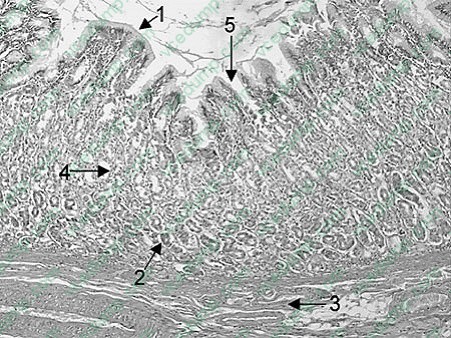
The chief or peptic (zymogenic) cells of the gastric glands secrete pepsinogen. The latter is converted to pepsin, a 35-kilodalton (kDa) proteolytic enzyme, when the pH in the stomach falls below 5.0. In Following figure, which of the following arrows point to the location of chief or peptic (zymogenic) cells?
A. 1 B. 2 C. 3 D. 4 E. 5
B. 2
Explanation
Section: Anatomy Arrow 2 points to the base of the gastric glands where chief or peptic (zymogenic) cells tend to be clustered. Arrow 1 points to the luminal surface of the stomach where mucus-secreting cells are found. Arrow 3 points to the muscularis mucosae. Arrow 4 points to the middle of the gastric glands where parietal or oxyntic cells tend to be most numerous. Arrow 5 point to the side of a gastric pit where mucus-secreting cells are also found.
Nowadays, the certification exams become more and more important and required by more and more
enterprises when applying for a job. But how to prepare for the exam effectively? How to prepare
for the exam in a short time with less efforts? How to get a ideal result and how to find the
most reliable resources? Here on Vcedump.com, you will find all the answers.
Vcedump.com provide not only USMLE exam questions,
answers and explanations but also complete assistance on your exam preparation and certification
application. If you are confused on your USMLE-STEP-1 exam preparations
and USMLE certification application, do not hesitate to visit our
Vcedump.com to find your solutions here.