USMLE-STEP-1 Exam Details
-
Exam Code
:USMLE-STEP-1 -
Exam Name
:United States Medical Licensing Step 1 -
Certification
:USMLE Certifications -
Vendor
:USMLE -
Total Questions
:847 Q&As -
Last Updated
:May 25, 2026
USMLE USMLE-STEP-1 Online Questions & Answers
-
Question 181:
A 25-year-old man has experienced chronic blistering and scarring of his skin when exposed to sunlight. This man is a smoker and drinks heavily, both of which exacerbate his responses to sunlight. Analysis of his urine and plasma indicates a high accumulation of complex porphyrins, predominantly uroporphyrin. The symptoms and clinical signs displayed by this patient indicate he is suffering from which of the following disorders?
A. acute intermittent porphyria (AIP)
B. hereditary coproporphyria (HCP)
C. porphyria cutanea tarda (PCT)
D. variegate porphyria
E. X-linked sideroblastic anemia -
Question 182:
Approximately 6 months ago, a 59-year-old man developed a dull, continuous abdominal pain that radiated to the right upper quadrant and was relieved by bending forward. He has also had recurrent thrombophlebitis. He now develops jaundice. Of the following, which is the condition that would most likely explain all of these findings?
A. alcoholic cirrhosis
B. cholecystitis
C. cholelithiasis
D. pancreatic adenocarcinoma
E. viral hepatitis -
Question 183:
Which of the following drugs corrects the anemia of pernicious anemia and prevents the neurological consequences of the disease?
A. beta-carotene
B. ferrous sulfate
C. folic acid
D. hydroxocobalamin
E. vitamin E -
Question 184:
Which of the following is a true statement regarding renal clearance of a substance?
A. is measured in milligram per minute
B. glucose is greater than that of insulin in the normal kidney
C. insulin is zero
D. PAH remains constant regardless of the plasma level
E. potassium clearance will increase after an injection of aldosterone -
Question 185:
A patient presented with an acute abdomen including fever, marked abdominal distension, acidosis, and leukocytosis. Laparoscopy revealed that large parts of the small intestine were necrotic and as a consequence, the entire ileum of the patient was resected. It is expected that very soon after the surgery the patient will have considerable problems resulting from the malabsorption of which of the following?
A. iron
B. bile acids
C. sodium
D. vitamin
E. protein -
Question 186:
Exhibit:
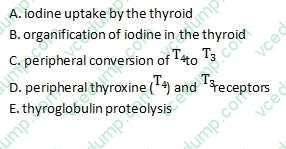
Please refer to the exhibit.
Which of the following mechanisms most accurately describes the blocking action of methimazole?
A. A
B. B
C. C
D. D
E. E -
Question 187:
Antibodies against acetylcholine neural receptors were measured in a 35-year-old woman and are thought to be involved in the pathogenesis of which of the following?
A. acute idiopathic polyneuritis
B. Guillain-Barr syndrome
C. multiple sclerosis
D. myasthenia gravis
E. postpericardiotomy syndrome -
Question 188:
The terminal ileum was removed from a 50-year-old woman during excision of a tumor. About 3 years later, the patient was admitted to the hospital. She is very pale. Hemoglobin is 9 g/dL, MCV (mean corpuscular volume) has increased to 110 (110 fL). The provisional diagnosis is a vitamin

deficiency. Which of the following vitamins is the most likely one causing the symptoms?
A. A
B. B1
C. B6
D. B12
E. K -
Question 189:
During the first 57 days of life, the umbilical vein can be catherized and used for central venous pressure monitoring. The umbilical vein leads to which of the following vessels?
A. descending aorta
B. ductus arteriosus
C. ductus venosus
D. inferior vena cava
E. portal vein -
Question 190:
A 35-year-old male patient suffering from pulmonary hypertension has been diagnosed with ostium secundum atrial septal defect. Abnormal development of which of the following structures is responsible for this developmental defect?
A. aorticopulmonary septum
B. endocardial cushion
C. interventricular septum
D. septum primum
E. sinus venosus
Tips on How to Prepare for the Exams
Nowadays, the certification exams become more and more important and required by more and more enterprises when applying for a job. But how to prepare for the exam effectively? How to prepare for the exam in a short time with less efforts? How to get a ideal result and how to find the most reliable resources? Here on Vcedump.com, you will find all the answers. Vcedump.com provide not only USMLE exam questions, answers and explanations but also complete assistance on your exam preparation and certification application. If you are confused on your USMLE-STEP-1 exam preparations and USMLE certification application, do not hesitate to visit our Vcedump.com to find your solutions here.