USMLE USMLE-STEP-1 Online Practice
Questions and Exam Preparation
USMLE-STEP-1 Exam Details
Exam Code
:USMLE-STEP-1
Exam Name
:United States Medical Licensing Step 1
Certification
:USMLE Certifications
Vendor
:USMLE
Total Questions
:847 Q&As
Last Updated
:May 25, 2026
USMLE USMLE-STEP-1 Online Questions &
Answers
Question 201:
Which of the following is the most common type of substance dependency in the United States?
A. alcohol B. cannabis C. cocaine D. heroin E. tobacco
E. tobacco
Explanation
Section: Behavioral Science and Biostatics Tobacco addiction is the most common type of drug dependency in the United States. Nicotine is extremely addictive. Since the Surgeon General's report in 1964 that identified the health risks of tobacco smoking, there has been an encouraging trend in the United States. Approximately 42% of the US adult population smoked cigarettes in 1965. The rate was 37% in 1975 and 30% in 1985. The reduction rate of smoking has been more pronounced in males than in females. Choices A, B, C, and D are incorrect.
Question 202:
Serous cells are glandular acinar cells that produce a watery, proteinaceous fluid. This cell type is most predominant in which of the following glands?
A. esophageal glands B. intestinal glands (of Lieberkün) C. the parotid gland D. the sublingual gland E. the submandibular gland
C. the parotid gland
Explanation
Section: Anatomy The parotid gland is the only major salivary gland containing almost exclusively serous secretory cells. Esophageal (choice A) and intestinal glands (choice B) are small mucus-secreting glands. The sublingual (choice D) and submandibular glands (choice E) are mixed glands with differing proportions of serous and mucous cells.
Question 203:
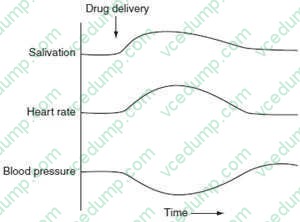
In a study of a new drug, the agent was administered to anesthetized animals while blood pressure, heart rate, and salivation were recorded. The results of a typical experiment are shown in below figure.
What is the best characterization of this new agent?
A. alpha-adrenoceptor agonist B. alpha-adrenoceptor antagonist C. cholinesterase inhibitor D. direct-acting muscarinic agonist E. ganglionic nicotinic agonist
D. direct-acting muscarinic agonist
Explanation
Section: Pharmacology Salivary glands contain muscarinic receptors, primarily of the M3 subtype, that receive parasympathetic innervation. Direct-acting agonists such as bethanechol and indirect agents such as neostigmine mimic parasympathetic nerve stimulation. Blood vessel endothelial cells contain M3 receptors that are not innervated, but respond to circulating directacting muscarinic agonists. When these endothelial receptors are activated, nitric oxide synthesis is stimulated and smooth muscle relaxation occurs promptly with vasodilation and a drop in blood pressure. Because no nerve endings are present, indirect-acting cholinomimetics such as cholinesterase inhibitors do not have this vasodilating effect. In the presence of hypotension induced by a direct-acting muscarinic agonist, a strong compensatory reflex originates in the baroreceptors and results in tachycardia. In the case of cholinesterase inhibitors, the normal heart rate slowing effect of the vagus is amplified and at normal doses, bradycardia results. The effect of the new drug illustrated in figure is most consistent with a direct-acting muscarinic agonist (choice D). Alpha receptor ligands (choices A and B) have little effect on salivation, although indirectly acting agents like ephedrine can cause a sensation of dry mouth. However, ephedrine causes increased blood pressure. Aganglionic stimulant drug (choice E) causes increased salivation but also increases sympathetic discharge to the blood vessels and results in increased, not decreased, blood pressure.
Question 204:
A 56-year-old man complains of increasing dyspnea on exertion over the past few days. He is noted to be overweight and cyanotic. He has smoked cigarettes for at least 35 years and has a long-standing history of persistent cough, producing a large amount of thick mucopurulent sputum. Auscultation reveals scattered rhonchi and wheezes. Histological examination of his lung tissue would most likely how which of the following?
A. expanded alveolar septae infiltrated by mononuclear cells B. mucous gland hypertrophy and fibrosis of bronchiolar walls C. neutrophilic exudate occupying the alveoli of an entire lobe D. pink, proteinaceous layer lining the alveolar spaces E. thickened basement membranes and many eosinophils
B. mucous gland hypertrophy and fibrosis of bronchiolar walls
Explanation
Section: Pathology and Path physiology This presentation is fairly typical for a patient with chronic bronchitis. Microscopically one would expect to see hypertrophy of bronchial mucous glands accompanied by chronic inflammation and fibrosis of bronchiolar walls. Expanded or thickened alveolar septae infiltrated by mononuclear cells (choice A) would be seen when there is an interstitial response in the lung as, for example, in viral or mycoplasmal pneumonia. Neutrophilic exudate occupying the alveoli of an entire lobe (choice C) is a description of a classic lobar pneumonia. Pink, proteinaceous layer lining the alveolar spaces (choice D) is a hyaline membrane that one might see in shock lung or respiratory distress syndrome. Thickened basement membranes and many eosinophils (choice E) would be seen in asthma.
Question 205:
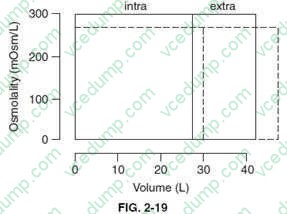
Below figure illustrates the extracellular and intracellular volumeosmolarity status of a patient (broken lines) and that of a normal subject (solid lines) for comparison. This patient most likely suffers from which of the following conditions?
A. adrenal insufficiency B. chronic vomiting C. iatrogenic fluid overload with 0.9% NaCl D. iatrogenic fluid overload with hypertonic solution E. syndrome of inappropriate hypersecretion of antidiuretic hormone (SIADH)
E. syndrome of inappropriate hypersecretion of antidiuretic hormone (SIADH)
Explanation
Section: Physiology This patient has increased extra- and intracellular volumes and a decreased osmolarity. SIADH results in inappropriately low water permeability of the renal collecting duct tubular cells and inappropriate water retention. As a result, patients with SIADH often present with hypotonic overhydration. Adrenal insufficiency (lack of aldosterone) (choice A) and chronic vomiting (choice B) lead to dehydration. Fluid overload with isotonic NaCl (choice C) results in volume expansion without change in osmolarity. Fluid overload with hypertonic solution (choice D) results in volume expansion with increased osmolarity.
Question 206:
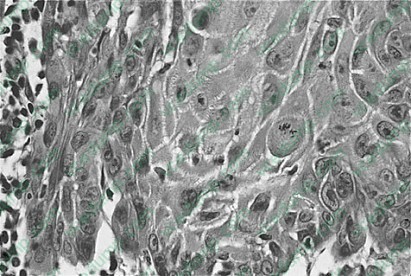
A 66-year-old man presents with a 3-month history of intermittent dysphagia that has now become constant and is accompanied by pain and some weight loss. X-rays of the esophagus with barium swallow show structural and filling defects, and reduced peristalsis. Abiopsy is taken and is shown in below figure. The best diagnosis is which of the following?
A. adenocarcinoma of the esophagus B. Barrett esophagus C. Candida esophagitis D. fibrous stricture of the esophagus E. squamous cell carcinoma of the esophagus
E. squamous cell carcinoma of the esophagus
Explanation
Section: Pathology and Path physiology The cells in figure are pleomorphic and invasive indicating their malignant character. Additionally, there are many intercellular bridges ("prickles") joining the cells indicating their squamous origin. Therefore, this is a squamous cell carcinoma. The presentation described is fairly typical for squamous cell carcinoma of the esophagus. Its development is closely associated with the risk factors of smoking and alcoholism. Adenocarcinoma of the esophagus (choice A) arises in the lower esophagus in a background of Barrett esophagus and is, of course, composed of malignant glandular cells, not the squamous cells seen here. Barrett esophagus (choice B) demonstrates metaplastic glandular epithelium. Candida esophagitis (choice C) is recognized by the presence of yeast and pseudohyphae. Fibrous stricture (choice D) can be caused, for example, by severe chronic reflux from ingestion of corrosives and produces fibrosis. Lye ingestion is associated with a 1000-fold increase in risk for squamous cell carcinoma.
Question 207:
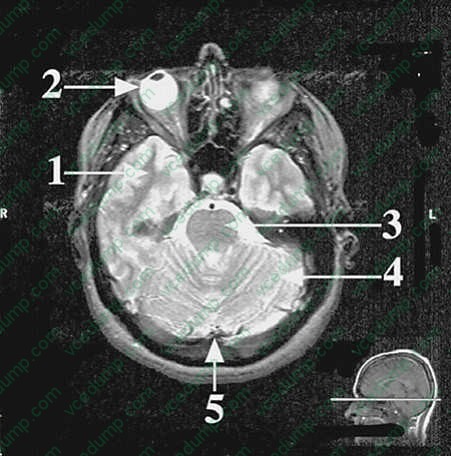
A 30-year-old patient displays ataxia of extremities and asynergy with decomposition of movement. He also has dysmetria (past-pointing phenomenon), dysdiadochokinesia (the inability to perform rapidly alternating movements), and intention tremor. These neurological signs are characteristic of a lesion in the structure indicated by which arrow in following figure ?
A. 1 B. 2 C. 3 D. 4 E. 5
D. 4
Explanation
Section: Anatomy The collective neurological signs are characteristic of a lesion of the neocerebellum (cerebellar hemispheres). Alesion in the archicerebellum (cerebellar vermis; arrow 5, choice E) results in loss of equilibrium. None of the other choices apply to the collection of neurological signs displayed by this patient:
arrow 1 (choice A) points to the temporal lobe, arrow 2 (choice B) to the eyeball, and arrow 3 (choice C) to the pons.
Question 208:
Cells in the pancreas that secrete glucagon and insulin are which of the following?
A. A and B cells B. acinar cells C. D cells D. pancreatic D1 cells E. pancreatic polypeptide cells
A. A and B cells
Explanation
Section: Anatomy In the human pancreas, A and B cells of the islets of Langerhans secrete glucagon and insulin, respectively. Pancreatic D1 cells (choice D) release a product similar to vasoactive intestinal polypeptide. Pancreatic polypeptide cells (choice E) secrete pancreatic polypeptide and D cells (choice C) release somatostatin. All the aforementioned cells belong to the endocrine pancreas. Acinar cells (choice B) are part of the exocrine pancreas and do not secrete glucagon or insulin.
Question 209:
A 14-year-old, severely physically disabled individual is now on a respirator. His first 4 years of life were medically uneventful. Over the last 10 years, he has suffered from increasing symmetric muscle weakness that first affected the pelvic girdle and now involves almost all muscle groups. Several years ago, the calf portion of his legs appeared enlarged and on biopsy demonstrated fatty pseudohypertrophy with random alternating muscle fiber atrophy and hypertrophy. Which of the following is the most likely diagnosis?
A. cerebral palsy B. muscular dystrophy C. myositis ossificans D. poliomyelitis E. trichinosis
B. muscular dystrophy
Explanation
Section: Pathology and Path physiology The clinical scenario describes a classic example of Duchenne muscular dystrophy. The weakness is symmetric and most often begins at the pelvic girdle. Fatty pseudohypertrophy with alternating muscle fiber atrophy and hypertrophy typify the histologic changes. Many patients die before reaching their 20s. The other diagnostic options, cerebral palsy (choice A), myositis ossificans (choice C), poliomyelitis (choice D), and trichinosis (choice E), do not fit the clinical picture.
Question 210:
The abdominal aorta provides for the major blood supply in this region and its branches are organized into paired or unpaired and visceral or parietal branches. Which of the following are paired visceral branches of the abdominal aorta?
A. celiac trunk B. gonadal arteries C. inferior phrenic arteries D. lumbar arteries E. superior mesenteric artery
B. gonadal arteries
Explanation
Section: Anatomy The gonadal arteries are paired visceral branches of the abdominal aorta. Other branches in this category are the suprarenal and renal arteries. The celiac trunk (choice A) and superior mesenteric artery (choice E) are unpaired visceral branches. The inferior phrenic (choice C) and lumbar (choice D) arteries are paired parietal branches.
Nowadays, the certification exams become more and more important and required by more and more
enterprises when applying for a job. But how to prepare for the exam effectively? How to prepare
for the exam in a short time with less efforts? How to get a ideal result and how to find the
most reliable resources? Here on Vcedump.com, you will find all the answers.
Vcedump.com provide not only USMLE exam questions,
answers and explanations but also complete assistance on your exam preparation and certification
application. If you are confused on your USMLE-STEP-1 exam preparations
and USMLE certification application, do not hesitate to visit our
Vcedump.com to find your solutions here.