USMLE USMLE-STEP-1 Online Practice
Questions and Exam Preparation
USMLE-STEP-1 Exam Details
Exam Code
:USMLE-STEP-1
Exam Name
:United States Medical Licensing Step 1
Certification
:USMLE Certifications
Vendor
:USMLE
Total Questions
:847 Q&As
Last Updated
:May 25, 2026
USMLE USMLE-STEP-1 Online Questions &
Answers
Question 151:
Within hours after being bitten by a cat trapped in a flood drain, a member of the rescue team develops redness, swelling, and intense pain at the site of the bite. Laboratory results indicate the presence of mixed flora in the wound, including a gram-negative rod that is frequently associated with cat and dog bites and that often leads to complications such as osteomyelitis if untreated. Which of the following is most likely to be this organism?
C. Francisella tularensis D. Pasteurella multocida E. P. aeruginosa
D. Pasteurella multocida
Explanation
Section: Microbiology/Immunology Pasteurella species are primarily animal pathogens, but they can produce a range of human diseases. All yersiniae and franciseliae were formerly classified under this genus. P. multocida (choice D) occurs worldwide in the respiratory and GI tracts of many domestic and wild animals. It is the most common organism in humans inflicted by bites from cats and dogs. It may produce human infections in many systems and may, at times, even be part of the normal/usual human flora. Ahistory of animal bite, pain and pus drainage at the bite site, gram-negative bipolar rods, and culture of the organism would confirm the diagnosis. B. canis (choice A) may cause mild reticuloendothelial disease in humans. F. tularensis (choice C) can be transmitted by direct contact with infected animal tissues or by inhalation or ingestion, seldom if ever by bites. C. coli (choice B), along with C. jejuni, are common human pathogens, causing mainly enteric infections. P. aeruginosa (choice E) is widely distributed in nature and in moist environments in hospitals. It can cause opportunistic diseases in immunocompromised humans. Such infections may present with bluegreen pus and are difficult to treat with antimicrobials.
Question 152:
A 1-year-old infant presents with cardiomegaly and congestive heart failure. She has increased intracranial pressure with hydrocephaly and cranial bruit. A vein of Galen aneurysm, revealed by MRI, is shown to compress the aqueduct of Sylvius, the posterior part of the third ventricle, and the splenium of the corpus callosum. Normally, the cerebral vein of Galen joins with which dural venous sinus?
A. inferior sagittal sinus B. sigmoid sinus C. superior petrosal sinus D. superior sagittal sinus E. transverse sinus
A. inferior sagittal sinus
Explanation
Section: Anatomy The great cerebral vein of Galen joins with the inferior sagittal sinus to form the straight sinus. The latter drains into the transverse sinus (choice E). The superior sagittal sinus (choice D) drains posteriorly into the transverse sinus. The transverse sinus which runs bilaterally on the posterior wall of the posterior cranial fossa becomes the sigmoid sinus (choice B) which flows into the internal jugular vein. The superior petrosal sinus (choice C) extends from the cavernous sinus to the beginning of the sigmoid sinus.
Question 153:
A patient suffers from Frey's syndrome manifested by perspiration of the skin covering the left parotid gland whenever the patient eats. On inquiry, the patient reveals that he suffered deep injuries on that side of his face and neck in an automobile accident. You explain to him that his syndrome results from abnormal connections between the great auricular nerve and parasympathetic secretomotor fibers, which normally innervate only the parotid gland. This abnormal reinnervation occurred during the healing period after the accident. The parasympathetic secretomotor fibers to the parotid gland are carried by which of the following?
A. auriculotemporal nerve B. buccal branch of the facial nerve C. buccal nerve D. greater petrosal nerve E. lesser petrosal nerve
A. auriculotemporal nerve
Explanation
Section: Anatomy The auriculotemporal nerve is a branch of the mandibular division of the trigeminal nerve. It carries postganglionic parasympathetic fibers from the otic ganglion to the parotid gland. The buccal nerve (choice C) is a sensory branch of the mandibular division of the trigeminal nerve. It innervates the gingival adjacent to the two posterior molar teeth, the mucosa, and skin of the cheek. The buccal branch of the facial nerve (choice B) provides motor innervation to the muscles around the mouth. The greater petrosal nerve (choice D) is a branch of the facial nerve from the geniculate ganglion. It carries preganglionic parasympathetic fibers to the pterygopalatine ganglion. The lesser petrosal nerve (choice E) is a continuation of the tympanic branch of the glossopharyngeal nerve and carries preganglionic parasympathetic fibers to the otic ganglion.
Question 154:
A 3-year-old child presents at the physician's office with symptoms of coryza, conjunctivitis, low- grade fever, and Koplik's spots. The causative agent of this disease belongs to which group of viruses?
A. adenovirus B. herpesvirus C. orthomyxovirus D. paramyxovirus E. picornavirus
D. paramyxovirus
Explanation
Section: Microbiology/Immunology Measles or rubeola belongs to the paramyxovirus group (choice D). Measles is an acute, highly infectious disease characterized by fever, respiratory symptoms, and a maculopapular rash. Complications are common and serious. Humans are the only natural host for measles virus, which is spread by respiratory secretions. The virus grows first in the respiratory tract and then to the local lymphatics. Koplik's spots can be observed in the buccal mucosa. The virus replicates in the RE system and is then spread to the skin and other epithelial surfaces. The incubation period can be up to 3 weeks and the rash can last up to 2 weeks (hard measles). The rash appears to be a T-cell interaction with virus-infected cells. The main complication involves the CNS and lungs. Arare complication is SSPE. An excellent live-attenuated virus vaccine has been widely used and has decreased measles presence in the population greatly. Immunity (natural or artificially acquired) is lifelong. Adenovirus (choice A) is most often seen as respiratory infections, although significant eye and enteric diseases are caused by different strains of adenovirus. Herpesvirus (choice B) produces crops of vesicular lesions, not a maculopapular rash. Othromyxovirus (choice C) is influenza, which has no rash presentations. Picornaviruses (choice E) consist of polioviruses, coxsackieviruses and ECHO viruses. Koplik's spots do not appear in these infections although macular rashes may occasionally be observed.
Question 155:
When glucose is chronically elevated in poorly controlled diabetes mellitus, nonenzymatic glycosylation of various proteins occurs. The change of which of the following substances is most commonly monitored as indicator for the efficiency of blood glucose control?
A. hemoglobin A1c (HbA1c) B. lipoprotein A. C. modified albumin D. myoinositol E. sorbitol
A. hemoglobin A1c (HbA1c)
Explanation
Section: Physiology The hallmark of poorly controlled diabetes mellitus is elevated blood glucose, which causes unphysiological glycosylation of proteins. An important long-term measure of blood glucose control in patients with diabetes mellitus is to monitor the modification of hemoglobin A to form glycated hemoglobins. HbA1c is the major subfraction, and determination of HbA1c is usually achieved by ion- exchange or gel electrophoresis. The level of glycated hemoglobins in the blood is directly related to the average blood glucose levels over the life span of the hemoglobin in the circulation. Since the half- life of red blood cells is about 120 days, a single determination of glycated hemoglobin reflects the average blood glucose level during the preceding 812 weeks. Lipoprotein A. (choice B) is a lipoprotein particle implicated in atherosclerosis and thrombosis. Albumin (choice C) is the most abundant plasma protein, but is not significantly affected by glycosylation. Myoinositol (choice D) is a signaling molecule the decrease in response of which to elevated sorbitol has been suggested as a complication of diabetes. Sorbitol (choice E) is another sugar derivative, unrelated to HbA1c that is believed important in causing other diabetic complications such as cataracts and peripheral neuropathy.
Question 156:
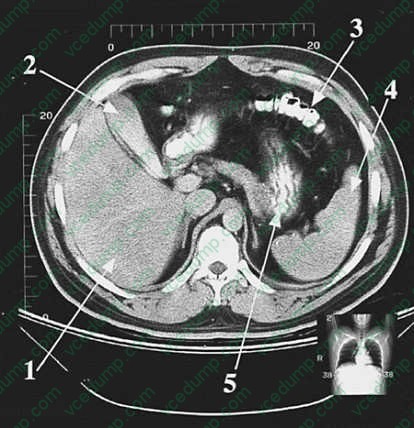
A 42-year-old female patient has to undergo emergency cholecystectomy due to intense biliary colic. The structure to be removed during the surgery is indicated in following figure by which of the following arrows?
A. 1 B. 2 C. 3 D. 4 E. 5
B. 2
Explanation
Section: Anatomy Arrow 2 points to the gallbladder, which will be removed during the cholecystectomy (surgical removal of the gallbladder). Biliary colic may be due to impaction of a gallstone in the cystic duct, resulting in cholecystitis (inflammation of the gallbladder). Arrow 1 (choice A) points to the liver. Arrow 3 (choice C) points to the transverse colon. Arrow 4 (choice D) points to the spleen and arrow 5 (choice E) indicates the stomach, recognizable by its internal rugae.
Question 157:
Your patient is convinced that she has cancer. She is clearly agitated and is complaining of pain in her abdomen. A workup for cancer is negative, yet your patient refuses to accept the diagnosis and becomes increasingly anxious and expresses an intense sense of impending doom. Which of the following drugs is most appropriate for the treatment of this patient?
A. carbamazepine B. methylphenidate C. olanzapine D. paroxetine E. valproic acid
D. paroxetine
Explanation
Section: Behavioral Science and Biostatics Paroxetine is a selective serotonin reuptake inhibitor (SSRI), an antidepressant, and is the drug of choice for treating this patient's depression. Carbamazepine (choice A), like valproic acid (choice E), is an anticonvulsant and mood stabilizer which may be used to treat bipolar disorder. Methylphenidate (choice B) is a CNS stimulant; olanzapine (choice C) is an atypical antipsychotic.
Question 158:
The parents of a 1-year-old boy are alarmed at the increasing frequency of their child biting his lips and finger tips. In addition, on several occasions they have noticed what appear to be particles of "orange sand" in their son's diapers. They report to their pediatrician that they believe their child is delayed in acquiring motor skills such as holding up his head and sitting unaided. Clinical tests performed on serum and urine indicate a threefold increase in serum uric acid and a tenfold elevation in the urinary ratio of uric acid to creatinine. These findings are suggestive of which of the following disorders?
A. adenosine deaminase deficiency B. adenylosuccinate lyase deficiency C. Lesch-Nyhan disease D. purine nucleotide phosphorylase deficiency E. orotic aciduria
C. Lesch-Nyhan disease
Explanation
Section: Biochemistry Deficiencies in the purine nucleotide salvage enzyme, HGPRT, cause three overlapping clinical syndromes. The most severe deficiency (patients having less than 1.5% residual enzyme activity) results in debilitating neurologic disability, overproduciton of uric acid, and behavioral abnormalities that include impulsive and self-injurious activities such as biting finger tips and lips. This severe form of HGPRT deficiency is referred to as Lesch-Nyhan disease. The overproduction of uric acid leads to symptoms of gout and the appearance of "orange sand" in the urine. Deficiencies in ADA (choice A), another purine nucleotide salvage enzyme, are the cause of severe-combined immunodeficiency syndrome, SCID. SCID is characterized by a lack of both cell-mediated and humoral immunity. ADSL (choice B) is an enzyme in the pathway of de novo purine nucleotide synthesis. It is also an important component of the purine nucleotide cycle (see below figure). Deficiencies in ADSLcause psychomotor retardation, epileptic seizures, growth retardation, and muscle wasting. Deficiencies in PNP (choice D) result in a form of immunodeficiency characterized by defective cell-mediated responses. Afflicted individuals may also have normal, hyperactive, or reduced humoral immunity. Orotic aciduria is caused by deficiencies in the de novo pathway of pyrimidine nucleotide synthesis. Adeficiency in either of the last two enzymes in the pathway, orotate phosphoribosyltransferase or OMP decarboxylase, leads to orotic aciduria.
Question 159:
A 14-year-old female patient complains of a severe sore throat and you use a cotton swab to obtain specimens for a culture. As you lightly touch the pharyngeal wall with the cotton swab, the patient gags. What is the location of neuronal cell bodies innervating pharyngeal constrictor muscles involved in the gag reflex?
A. abducens nucleus B. ambiguus nucleus C. dorsal motor nucleus of the vagus D. facial nucleus E. hypoglossal nucleus
B. ambiguus nucleus
Explanation
Section: Anatomy Motor innervation of the pharyngeal constrictor muscles is derived from the ambiguous nucleus in the medulla oblongata. These motor fibers reach the constrictor muscles via the vagus nerve. The abducens nucleus (choice A) provides motor innervation to the lateral rectus muscle of the eye. The dorsal motor nucleus of the vagus (choice C) provides preganglionic parasympathetic innervation for the organs of the thorax and abdomen. The facial nucleus (choice D) sends motor innervation to the muscles of facial expression and the stapedius. The hypoglossal nucleus (choice E) innervates the muscles of the tongue.
Question 160:
Which of the following is likely to cause a negative free-water clearance by the kidney?
A. central diabetes insipidus B. demeclocycline, an inhibitor of the renal tubular actions of ADH C. nephrogenic diabetes insipidus D. water deprivation E. water drinking
D. water deprivation
Explanation
Section: Physiology Water deprivation will eventually increase extracellular fluid osmolality, which triggers release of ADH. ADH acts on the collecting duct to increase water reabsorption, thus making the excreted urine more concentrated via a negative free-water clearance. Choices B and C will reduce the sensitivity of the collecting duct to normal circulating ADH. Choices A and E will reduce the amount of ADH secreted by the posterior pituitary.
Nowadays, the certification exams become more and more important and required by more and more
enterprises when applying for a job. But how to prepare for the exam effectively? How to prepare
for the exam in a short time with less efforts? How to get a ideal result and how to find the
most reliable resources? Here on Vcedump.com, you will find all the answers.
Vcedump.com provide not only USMLE exam questions,
answers and explanations but also complete assistance on your exam preparation and certification
application. If you are confused on your USMLE-STEP-1 exam preparations
and USMLE certification application, do not hesitate to visit our
Vcedump.com to find your solutions here.