USMLE USMLE-STEP-1 Online Practice
Questions and Exam Preparation
USMLE-STEP-1 Exam Details
Exam Code
:USMLE-STEP-1
Exam Name
:United States Medical Licensing Step 1
Certification
:USMLE Certifications
Vendor
:USMLE
Total Questions
:847 Q&As
Last Updated
:May 25, 2026
USMLE USMLE-STEP-1 Online Questions &
Answers
Question 131:
Production of specific granules occurs mainly during which stage of granulocyte development?
A. granulocyte colony-forming unit B. metamyelocyte C. myeloblast D. myelocyte E. promyelocyte
D. myelocyte
Explanation
Section: Anatomy Generation of specific granules occurs during the myelocyte stage. Development of all three types of granulocytes follows a similar sequence of stages. The granulocyte colonyforming unit (choice A) is an undifferentiated progenitor cell of the granulocyte line. Buildup of the protein synthesis machinery occurs during the myeloblast (choice C) and promyelocyte (choice E) stages. The promyelocyte stage is also characterized by production of primary (nonspecific) granules. After the myelocyte stage, further condensation and reshaping of the nucleus occurs during the metamyelocyte stage (choice B).
Question 132:
In Type I diabetes, the increased production of ketone bodies is primarily a result of which of the following?
A. a substantially increased rate of fatty acid oxidation by hepatocytes B. an increase in the rate of the citric acid cycle C. decreased cyclic adenosine monophosphate (cAMP) levels in adipocytes D. elevated acetyl-CoA levels in skeletal muscle E. increased gluconeogenesis
A. a substantially increased rate of fatty acid oxidation by hepatocytes
Explanation
Section: Biochemistry In fasting or diabetes, lipolysis predominates in adipocytes because of the inability of these cells to obtain glucose, which is normally used as a source of glycerol-3-phosphate. Glycerol-3-phosphate is necessary for the esterification of fatty acids into triacylglycerides. Circulating fatty acids become the predominant fuel source, and beta-oxidation in the liver becomes substantially elevated. This leads to an increased production of acetyl-CoA. Although gluconeogenesis is increased (choice E) in the liver as a result of the persistent elevation of glucagon levels, this pathway does not supply acetyl-CoA for the production of ketone bodies. The increased gluconeogenesis predisposes oxaloacetate and reduces (not increases, choice B) the flow of acetyl-CoA through the citric acid cycle. As a consequence, acetyl-CoA is diverted to the formation of ketone bodies. The persistently elevated levels of glucagon also increase the levels of cAMP in responsive tissues, such as adipocytes (choice C). This effect in adipocytes leads to persistently increased release of fatty acids to the circulation. Since skeletal muscle lacks receptors for glucagon, there is no diabetes-mediated increase in muscle metabolism and thus no elevation in acetyl-CoA levels in skeletal muscle (choice D).
Question 133:
On the basis of their mechanisms of action, which of the following combinations of drugs produces a beneficial additive or synergistic effect in therapy when each agent is present at its maximum effective concentration?
A. chlortetracycline plus amoxicillin B. clomiphene plus chorionic gonadotropin C. lovastatin plus cholestyramine D. pentazocine plus morphine E. succinylcholine plus atracurium
C. lovastatin plus cholestyramine
Explanation
Section: Pharmacology The hydroxymethylglutaryl-CoA (HMGCoA) reductase inhibitor lovastatin and the bile acid-binding resin cholestyramine (choice C) lower the concentration of cholesterol in the blood by different mechanisms. Because they act by different mechanisms, combination therapy is at least additive. The combination of chlortetracycline and amoxicillin (choice A) results in antagonism of amoxicillin's antibacterial action. The beta-lactam cell wall synthesis inhibitors such as the penicillins and cephalosporins are bactericidal, but are effective primarily when the bacteria proliferate rapidly. Tetracyclines are bacteriostatic agents that slow or inhibit the growth of bacterial cells by inhibiting protein synthesis. The combination of clomiphene and chorionic gonadotropin (choice B) does not produce any beneficial additive action. Both agents are used to treat female infertility. Clomiphene is an estrogen-receptor partial agonist that functions at the level of the hypothalamus to stimulate release of gonadotropinreleasing hormone (GnRH). The increased release of GnRH results in increased release of the gonadotropins LH and FSH from the anterior pituitary. This results in stimulation of ovulation. Administration of chorionic gonadotropin also stimulates ovulation. Because both preparations function through increases in gonadotropin levels and both are present at their maximum effective concentrations, a beneficial additive effect is unlikely. The combination of pentazocine and morphine (choice D) does not produce a beneficial interaction. Pentazocine exerts its pain-relieving activity by a weak (partial) agonist action at mu-opioid receptors. Morphine is a full agonist at the same receptors. When the two analgesic agents are combined, pentazocine acts as an antagonist for morphine at mu- receptors. The result is precipitation of withdrawal in addicted patients, and dysphoria and loss of morphine analgesia in nonaddicted patients. Succinylcholine and atracurium (choice E) are both skeletal musclerelaxing agents that block muscle contraction by actions at the neuromuscular junction. Succinylcholine is a depolarizing blocker that acts as an agonist at the nicotinic receptor. Atracurium is a competitive antagonist at the same receptor. Because they both act at the same receptor and are present at their effective concentrations, atracurium interferes with the action of succinylcholine.
Question 134:
A 32-year-old man is admitted for neuropsychiatric evaluation after exhibiting bizarre behavior. During his medical workup, he is found to have cirrhosis and a mild parkinsonian tremor. Which of the following diagnoses provides the best explanation for these findings?
A. congenial hepatic fibrosis B. peliosis hepatis C. primary sclerosing cholangitis D. Reye syndrome E. Wilson disease
E. Wilson disease
Explanation
Section: Pathology and Path physiology Wilson disease is an autosomal recessive disorder of copper metabolism due to defective biliary excretion of the copper-protein complex ceruloplasmin. Cells of the liver and brain, notably the basal ganglia, are particularly vulnerable to the toxic effects of excessive copper accumulation. Treatment with copper chelating agents, such as penicillamine or triethylene tetramine, has a dramatically beneficial effect. Congenital hepatic fibrosis (choice A) is a rare disorder of unknown etiology. It is most prevalent in India. Peliosis hepatis (choice B) is a rare hepatic circulatory disorder caused by dilation of sinusoids, resulting in small, blood-filled spaces within the liver; the condition is typically asymptomatic. Steroid hormone usage is associated with its development in some instances. Primary sclerosing cholangitis (choice C) is due to chronic inflammation and fibrosis of intra- and extrahepatic bile ductules. The etiology is obscure. Most of those affected also have ulcerative colitis. Reye syndrome (choice D) refers to acute hepatic failure in children following ingestion of aspirin for certain upper respiratory illnesses, particular influenza, or chickenpox.
Question 135:
Which of the following psychotropic drugs must be monitored for hematotoxic effects?
A. buspirone B. clozapine C. haloperidol D. lithium carbonate E. mirtazapine
B. clozapine
Explanation
Section: Pharmacology Clozapine causes agranulocytosis in a small but consistent fraction of patients; monitoring is mandatory. Buspirone (choice A) is an antianxiety agent with minimal sedative action. Haloperidol (choice C) is an older, highly potent antipsychotic drug used in schizophrenia. Lithium carbonate (choice D) is an important antimanic drug. It apparently acts by interfering with inositol phosphate cycling and second messenger synthesis in neurons. Mirtazapine (choice E) is a third-generation antidepressant related to antihistaminics and has significant sedative action.
Question 136:
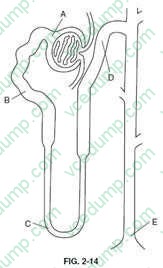
A 25-year-old male athlete has just completed a long distance bicycle race during a hot, humid day. At the conclusion of the race, he provides a urine sample for testing. Assuming that his fluid intake during the race was zero, in what portion of the nephron shown in below figure is the tubular fluid osmolality the lowest?
A. A B. B C. C D. D E. E
D. D
Explanation
Section: Physiology The bicycle racer is likely dehydrated from his exercise and ADH would be secreted by the posterior pituitary in response to increased extracellular osmolality. The area of the nephron with the lowest osmolality will be the early distal tubule (choice D), a nephrondiluting segment. The fluid in Bowman's capsule (choice A) will be at the same osmolality as the plasma entering the glomerular capillaries. The fluid at the end of the proximal tubule (choice B) is isoosmotic with the Bowman's capsule fluid while the fluid in the thin descending loop of Henle (choice C) is greatly concentrated due to water reabsorption into the hyperosmotic medullary interstitium. The fluid at the end of the collecting duct (choice E) can be very concentrated or very dilute, but since ADH greatly increases water reabsorption in this segment, the fluid becomes very concentrated.
Question 137:
A 59-year-old Caucasian female is self-donating blood in preparation for a hip replacement surgery in the near future. Shortly after her third session of donating a unit (pint) of whole blood, her mean arterial pressure remains unchanged, even though the venous return of blood to her heart is diminished. Which of the following is the most likely reason for the preservation of arterial pressure?
A. cardiac output rises to compensate for the reduced venous return B. end-diastolic ventricular filling pressure rises during hemorrhage C. fall in venous return is offset by an increase in total peripheral resistance D. heart rate rises to compensate for a reduced venous return E. venous return and blood pressure are unrelated
C. fall in venous return is offset by an increase in total peripheral resistance
Explanation
Section: Physiology By Ohm's law, a reduction in flow should also reduce pressure if resistance is constant. Therefore a rise in total peripheral resistance in the face of reduced flow would account for the preservation of arterial pressure. Choice A is incorrect since cardiac output and venous return must rise and fall together. Choice B is incorrect since end-diastolic ventricular filling pressure falls with decreased venous return. Choice D is incorrect since heart rate can maintain pressure only if venous return is also maintained.
Choice E is incorrect since Ohm's law states the inverse relationship of venous return and pressure.
Question 138:
Which of the following is the hypophyseotropic hormone that regulates the activity of the lactotrophs of the anterior pituitary?
A. CRH B. GnRH C. growth hormone-releasing hormone (GRH) D. prolactin-releasing factor (PRF) E. thyrotropin-releasing hormone (TRH)
D. prolactin-releasing factor (PRF)
Explanation
Section: Biochemistry The lactotrophs of the anterior pituitary secrete prolactin in response to the action of PRF. Corticotropin- releasing hormone, CRH (choice A) regulates primarily the secretion of ACTH, but also other products of the ACTH precursor protein, pro-opiomelanocortin, POMC. GnRH (choice B) controls the secretion of follicle-stimulating hormone (FSH) and luteinizing hormone (LH) from the pituitary gonadotrophs. GRH (choice C) stimulates growth hormone secretion from pituitary somatotrophs. TRH (choice E) stimulates the thyrotropes to secrete thyroid-stimulating hormone, TSH (also called thyrotropin).
Question 139:
Sputum from a patient with a respiratory infection reveals bacteria that resist engulfment by phagocytic WBCs. Which of the following factors is most likely responsible for this virulence?
A. A capsule B. fimbriae C. flagella D. lipid A E. peptidoglycan
A. A capsule
Explanation
Section: Microbiology/Immunology Capsules (choice A) are usually made of polysaccharides and allow bacteria to resist phagocytosis by PMNs and macrophages. Since the capsule contributes to the invasiveness of pathogenic bacteria, it is considered a virulence factor. If the host produces an antibody against the capsule materials, phagocytosis and destruction of the organism can occur. Fimbriae (choice B) are also called pili and attach to cell surfaces to promote microbial colonization. While some bacteria (N. gonorrhoeae, for instance) produce pili and are able to resist phagocytosis if firmly attached, fewer kinds of bacteria produce pili than those capable of producing capsules. Flagella (choice C) are organelles of locomotion and do not resist phagocytosis. Lipid A(choice D) is a component part of endotoxin from gram- negative cell walls. It is considered to be the toxic component of endotoxin, capable of causing inflammation, but does not resist phagocytosis. Peptidoglycan (choice E) is part of gram-positive cell walls. Peptidoglycans do not resist phagocytosis directly but do contain techoic acid residues that allow bacteria to adhere to cells.
Question 140:
A 23-year-old woman complains of depression and anxiety. While describing her symptoms, she looks dazed. A minute later, she looks around the room slowly, and says, in a heavily accented voice with a different tone, "Where am I?" Which of the following does this presentation suggest?
A. adjustment disorder B. catatonia C. dissociative identity disorder D. major depression E. schizophrenia
C. dissociative identity disorder
Explanation
Section: Behavioral Science and Biostatics Dissociative identity disorder (multiple personality disorder) is often associated with memory disturbance and an alternate personality, who may have a different speech tone, accent, or voice. Schizophrenia (choice E) is unlikely; there is no sign of psychosis. Major depression (choice D) is unlikely; there is no sign of depression. Catatonia (choice B) refers to muscle rigidity and mutism, and adjustment disorder (choice A) is a broad diagnostic category that does not include this presentation.
Nowadays, the certification exams become more and more important and required by more and more
enterprises when applying for a job. But how to prepare for the exam effectively? How to prepare
for the exam in a short time with less efforts? How to get a ideal result and how to find the
most reliable resources? Here on Vcedump.com, you will find all the answers.
Vcedump.com provide not only USMLE exam questions,
answers and explanations but also complete assistance on your exam preparation and certification
application. If you are confused on your USMLE-STEP-1 exam preparations
and USMLE certification application, do not hesitate to visit our
Vcedump.com to find your solutions here.