USMLE-STEP-1 Exam Details
-
Exam Code
:USMLE-STEP-1 -
Exam Name
:United States Medical Licensing Step 1 -
Certification
:USMLE Certifications -
Vendor
:USMLE -
Total Questions
:847 Q&As -
Last Updated
:May 25, 2026
USMLE USMLE-STEP-1 Online Questions & Answers
-
Question 111:
A 17-year-old patient suffers from tonicclonic seizures. This condition has been well controlled with a regimen of phenytoin. Which of the following signs or symptoms indicates phenytoin toxicity?
A. diplopia and abnormal gait
B. hyperprolactinemia
C. polydipsia and polyuria
D. postural hypotension
E. rigidity and tremor -
Question 112:
Which of the following colonizes the nasopharynx and produces toxins that kill ciliated epithelial cells, causes edema locally, and induces lymphocytosis systemically?
B. Hemophilus influenzae type b
C. L. pneumophila
D. N. meningitides
E. P. aeruginosa -
Question 113:
A 78-year-old man has ankle edema, tachycardia, and shortness of breath on mild exercise. His blood pressure is 155/98. He has been diagnosed with hypertension and mild heart failure. Which of the following regimens is most appropriate for starting therapy?
A. captopril plus dobutamine
B. captopril plus hydralazine
C. enalapril plus hydrochlorothiazide
D. furosemide plus spironolactone
E. losartan plus hydralazine -
Question 114:
An elderly resident of a nursing home fell down the front steps and subsequently became disoriented and lethargic. He is brought to the emergency room where an emergency MRI reveals that he has developed hydrocephalus due to a small hemorrhage obstructing the foramina of Monro. The foramina of Monro allow for communication between which of the following?
A. fourth ventricle and cerebral aqueduct
B. fourth ventricle and subarachnoid space
C. lateral ventricles and third ventricle
D. third ventricle and cerebral aqueduct
E. third ventricle and fourth ventricle -
Question 115:
A 50-year-old man presents with a blood pressure of 160/100. He is to be started on hydrochlorothiazide. Which of the following is a common adverse effect of hydrochlorothiazide?
A. atrioventricular (AV) blockade
B. constipation
C. drug-induced lupus erythematosus
D. potassium wasting
E. tachycardia -
Question 116:
A 28-year-old woman with no significant past medical history presents to her primary care physician complaining of a chronic productive cough with blood-tinged sputum, night sweats, low-grade fever, and a 15-lbs weight loss over the past 6 weeks. Chest x-ray reveals a cavitary lesion in the left upper lobe and a calcified left hilar lymph node. Biopsy of the left upper lobe mass would most likely demonstrate which of the following?
A. amorphous eosinophilic material surrounded by epithelioid cells and T-lymphocytes
B. disorganized pleomorphic and hyperchromatic cells with rare mitotic figures
C. numerous neutrophils and necrotic debris surrounded by a fibrous capsule
D. scattered macrophages interspersed with regenerating alveolar cells and sparse collagen deposition
E. sheets of small, uniform basophilic cells with large nuclei and scant cytoplasm -
Question 117:
A 57-year-old female patient has suffered a major stroke and as a result is in a coma. The attending neurologist is very concerned because the patient is developing ataxic breathing. The pneumotaxic center and apneustic centers of the brain are located in which of the following?
A. diencephalon
B. midbrain
C. pons
D. spinal cord
E. telencephalon -
Question 118:
A 62-year-old patient diagnosed with prostate carcinoma complains of a right-sided headache worsening over 4 days and displays a drooping right upper eyelid. Examination reveals a right third nerve palsy. An MRI reveals a single metastasis of the prostatic carcinoma in the right side of the midbrain, causing Benedikt's syndrome. Which of the following signs would also be seen in this patient?
A. complete paralysis of facial expression musculature on the left side
B. deviation of the tongue to the right
C. intention tremor in the left upper and lower extremity
D. ipsilateral hemiplegia
E. vertical gaze palsy -
Question 119:
During a routine dental examination of a 55-year-old man, a small, reddish, and raised lesion is noted on the posterior of the median sulcus of his tongue. The patient is referred to a surgeon who performs an excisional biopsy of the lesion. A section of the biopsy is shown in below figure. Which of the following is the most appropriate diagnosis?
A. amyloidosis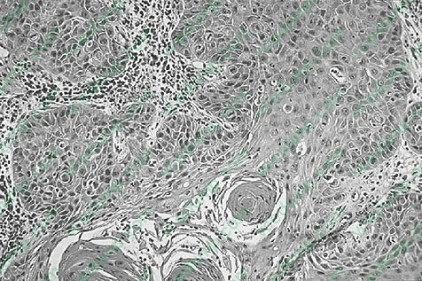
B. candidiasis
C. inverted papilloma
D. leukoplakia
E. squamous cell carcinoma -
Question 120:
A 7-year-old girl presents with a neck mass located at the anterolateral aspect of the neck, anterior to the sternocleidomastoid muscle. A biopsy of the lesion revealed a largely cystic mass lined by stratified squamous epithelium surrounded by an underlying dense layer of lymphoid tissue with germinal centers. Based on these findings, what is the most likely diagnosis?
A. branchial cleft cyst
B. granulomatous lymphadenitis
C. Hodgkin lymphoma
D. metastatic laryngeal carcinoma
E. thyroglossal duct cyst
Tips on How to Prepare for the Exams
Nowadays, the certification exams become more and more important and required by more and more enterprises when applying for a job. But how to prepare for the exam effectively? How to prepare for the exam in a short time with less efforts? How to get a ideal result and how to find the most reliable resources? Here on Vcedump.com, you will find all the answers. Vcedump.com provide not only USMLE exam questions, answers and explanations but also complete assistance on your exam preparation and certification application. If you are confused on your USMLE-STEP-1 exam preparations and USMLE certification application, do not hesitate to visit our Vcedump.com to find your solutions here.