UIPATH-ASAPV1 Exam Details
-
Exam Code
:UIPATH-ASAPV1 -
Exam Name
:UiPath Automation Solution Architect Professional v1.0 (UiASAP) -
Certification
:UiPath Certifications -
Vendor
:UiPath -
Total Questions
:150 Q&As -
Last Updated
:Jul 08, 2026
UiPath UIPATH-ASAPV1 Online Questions & Answers
-
Question 141:
What is UiPath Apps?
A. An IDE to develop custom activities for UiPath Studio.
B. A system for managing digital files and content storage.
C. A cloud platform for creating and managing RPA solutions.
D. A low-node platform for building custom applications for automation. -
Question 142:
What is the man difference between the deployment models for UiPath products?
A. How the product is managed from an IT infrastructure point of view.
B. The level of infrastructure integration between UiPath products.
C. The types of processes that can be automated using the products.
D. How each product I s licensed and billed -
Question 143:
What is the difference between rule-based and model-based data extraction methodologies?
A. Rule-based extraction is more computationally intensive whereas model based systems are simpler and require fewer computational resources
B. Rule-based extraction requires manual data labeling while model-based extraction does not need any label or tracing data
C. Rule-based extraction relies on predefined rules and patterns, while model-based extraction utilizes machine learning algorithms to automatically identify and extract data
D. Model-based extraction is only effective for structured data sources whereas rule-based extraction can handle both structured and unstructured data sources seamlessly -
Question 144:
What is the purpose of using a standard business process model and notations when creating a high-level solution design?
A. To show the sequence of steps in the solution without focusing on details
B. To ensure consistency and understanding across different process diagrams
C. To reduce the time spent on designing the solution by using obvious symbols
D. To make the diagrams visually appealing and engaging tor stakeholders -
Question 145:
What is the scope of the Decision Pipeline step within the Automation Pipeline (in UiPath Automation Hub)?
A. Check ideas and automation drafts you have saved but not shared yet.
B. Make good decisions about which ideas go to implementation.
C. Review automations in the Business Review and Technical Review phases.
D. Reflect on the overall score indicating how good a candidate's idea is for automation. -
Question 146:
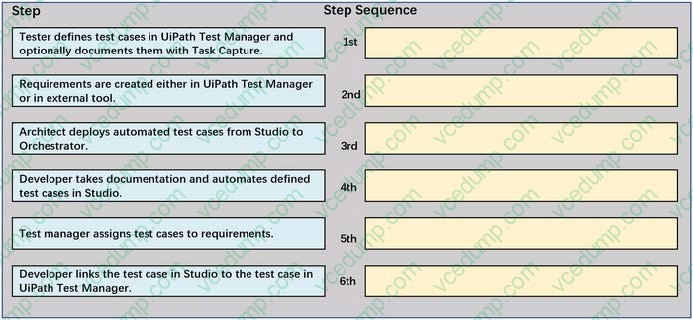
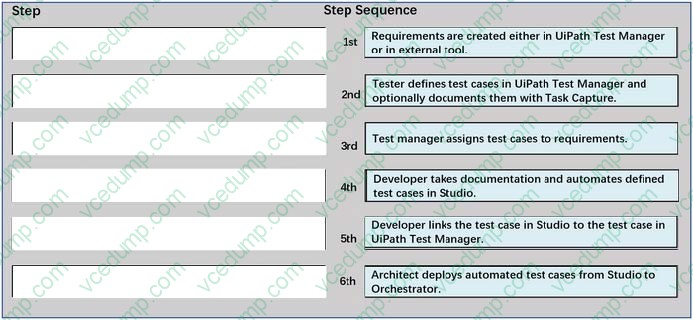
Arrange the flow steps in UiPath Test Manager before deployment in the right order.
Instructions: Drag the Description found on the left and drop on the correct Step Sequence found on the right.
Select and Place:
-
Question 147:
What is the main purpose of Workflow Analyzer in UiPath Studio?
A. Downloading external packages and resolving dependencies for a project.
B. Creating a visual flowchart that represents the logic of the workflow for easy understanding.
C. Evaluating best-practices usage in the process, identifying design errors and areas for improvement.
D. Debugging and executing the workflow step-by-step to track any errors. -
Question 148:
Which are the deployment options available for UiPath Orchestrator Standalone?
A. Single-node deployment High Availability deployment High Availability with Disaster Recovery - Active/Passive High Availability with Disaster Recovery - Two Active Data Centers
B. Single-node deployment Multi-node deployment High Availability deployment High Availability with Disaster Recovery - Active/Passive
C. High Availability with Disaster Recovery - Two Active Data Centers High Availability with Disaster Recovery - Multiple Active Data Centers
D. Single-node deployment Multi-node deployment High Availability deployment High Availability with Disaster Recovery - Active/Passive High Availability with Disaster Recovery - Two Active Data Centers
E. Single-node deployment Multi-node deployment High Availability deployment High Availability with Disaster Recovery - Active/Passive High Availability with Disaster Recovery - Two Passive Data Centers -
Question 149:
What is the responsibility of the user when deploying UiPath products using Standalone or Automation Suite deployment models?
A. Hosting, configuring, and maintaining the file servers.
B. Maintaining and scaling the infrastructures and upgrading to newer versions.
C. Provisioning scaling, and maintenance of the infrastructure of Kubernetes
D. Configuring the integration between UiPath products as it's not built-in -
Question 150:
What is the correct description of how Machine Learning works?
A. Machine learning works as any other computer program - by following a predefined sequence of instructions.
B. Machine Learning works by gaining experience from looking at multiple examples, and then using that experience to solve the problem by making predictions.
C. Machine learning works by mapping the input to the output based on a collection of algorithms stored in a relational database.
D. Machine Learning works by searching for the correct answer in a huge database of possible answers.
Related Exams:
-
UIPATH-AAAV1
UiPath Certified Professional Agentic Automation Associate (UiAAA) -
UIPATH-ABAAV1
UiPath Automation Business Analyst Associate (2023.10) -
UIPATH-ADAV1
UiPath Automation Developer Associate v1.0 (UiADA) -
UIPATH-ADPV1
UiPath Automation Developer Professional v1.0 (UiADP) -
UIPATH-ARDV1
UiPath Advanced RPA Developer v1.0 (UiARD) -
UIPATH-ASAPV1
UiPath Automation Solution Architect Professional v1.0 (UiASAP) -
UIPATH-RPAV1
UiPath RPA Associate v1.0 (UiRPA) -
UIPATH-SAIAV1
UiPath Specialized AI Associate (2023.10) -
UIPATH-SAIV1
UiPath Specialized AI Professional v1.0 (UiSAI)
Tips on How to Prepare for the Exams
Nowadays, the certification exams become more and more important and required by more and more enterprises when applying for a job. But how to prepare for the exam effectively? How to prepare for the exam in a short time with less efforts? How to get a ideal result and how to find the most reliable resources? Here on Vcedump.com, you will find all the answers. Vcedump.com provide not only UiPath exam questions, answers and explanations but also complete assistance on your exam preparation and certification application. If you are confused on your UIPATH-ASAPV1 exam preparations and UiPath certification application, do not hesitate to visit our Vcedump.com to find your solutions here.