SCS-C02 Exam Details
-
Exam Code
:SCS-C02 -
Exam Name
:AWS Certified Security - Specialty (SCS-C02) -
Certification
:Amazon Certifications -
Vendor
:Amazon -
Total Questions
:851 Q&As -
Last Updated
:Jul 12, 2026
Amazon SCS-C02 Online Questions & Answers
-
Question 391:
During a recent internal investigation, it was discovered that all API logging was disabled in a production account, and the root user had created new API keys that appear to have been used several times.
What could have been done to detect and automatically remediate the incident?
A. Using Amazon Inspector, review all of the API calls and configure the inspector agent to leverage SNS topics to notify security of the change to IAM CloudTrail, and revoke the new API keys for the root user.
B. Using IAM Config, create a config rule that detects when IAM CloudTrail is disabled, as well as any calls to the root user create-api-key. Then use a Lambda function to re-enable CloudTrail logs and deactivate the root API keys.
C. Using Amazon CloudWatch, create a CloudWatch event that detects IAM CloudTrail deactivation and a separate Amazon Trusted Advisor check to automatically detect the creation of root API keys. Then use a Lambda function to enable IAM CloudTrail and deactivate the root API keys.
D. Using Amazon CloudTrail, create a new CloudTrail event that detects the deactivation of CloudTrail logs, and a separate CloudTrail event that detects the creation of root API keys. Then use a Lambda function to enable CloudTrail and deactivate the root API keys. -
Question 392:
A Security Engineer who was reviewing IAM Key Management Service (IAM KMS) key policies found this statement in each key policy in the company IAM account.
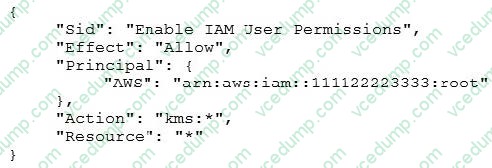
What does the statement allow?
A. All principals from all IAM accounts to use the key.
B. Only the root user from account 111122223333 to use the key.
C. All principals from account 111122223333 to use the key but only on Amazon S3.
D. Only principals from account 111122223333 that have an IAM policy applied that grants access to this key to use the key. -
Question 393:
A security engineer for a large company is managing a data processing application used by 1,500 subsidiary companies. The parent and subsidiary companies all use AWS. The application uses TCP port 443 and runs on Amazon EC2 behind a Network Load Balancer (NLB). For compliance reasons, the application should only be accessible to the subsidiaries and should not be available on the public internet. To meet the compliance requirements for restricted access, the engineer has received the public and private CIDR block ranges for each subsidiary.
What solution should the engineer use to implement the appropriate access restrictions for the application?
A. Create a NACL to allow access on TCP port 443 from the 1,500 subsidiary CIDR block ranges. Associate the NACL to both the NLB and EC2 instances.
B. Create an AWS security group to allow access on TCP port 443 from the 1,500 subsidiary CIDR block ranges. Associate the security group to the NLB. Create a second security group for EC2 instances with access on TCP port 443 from the NLB security group.
C. Create an AWS PrivateLink endpoint service in the parent company account attached to the NLB. Create an AWS security group for the instances to allow access on TCP port 443 from the AWS PrivateLink endpoint. Use AWS PrivateLink interface endpoints in the 1,500 subsidiary AWS accounts to connect to the data processing application.
D. Create an AWS security group to allow access on TCP port 443 from the 1,500 subsidiary CIDR block ranges. Associate the security group with EC2 instances. -
Question 394:
A company is storing data in Amazon S3 Glacier. A security engineer implemented a new vault lock policy for 10 TB of data and called the initiate-vault-lock operation 12 hours ago. The audit team identified a typo in the policy that is allowing unintended access to the vault.
What is the MOST cost-effective way to correct this error?
A. Call the abort-vault-lock operation. Update the policy. Call the initiate-vault-lock operation again.
B. Copy the vault data to a new S3 bucket. Delete the vault. Create a new vault with the data.
C. Update the policy to keep the vault lock in place
D. Update the policy. Call the initiate-vault-lock operation again to apply the new policy. -
Question 395:
A company uses AWS Organizations and has Amazon Elastic Kubernetes Service (Amazon EKS) clusters in many AWS accounts. A security engineer integrates Amazon EKS with AWS CloudTrail. The CloudTrail trails are stored in an Amazon S3 bucket in each account to monitor API calls. The security engineer observes that CloudTrail logs are not displaying Kubernetes pod creation events.
What should the security engineer do to view the Kubernetes events from Amazon CloudWatch?
A. Configure the EKS clusters to use private S3 VPC endpoints. Configure the S3 buckets for logging.
B. Enable Kubernetes API server component logs for each cluster.
C. Enable cross-origin resource sharing (CORS) in the S3 bucket that is used for logging.
D. Configure CloudWatch. View the events in the CloudWatch console. -
Question 396:
A security engineer wants to forward custom application-security logs from an Amazon EC2 instance to Amazon CloudWatch. The security engineer installs
the CloudWatch agent on the EC2 instance and adds the path of the logs to the CloudWatch configuration file.
However, CloudWatch does not receive the logs. The security engineer verifies that the awslogs service is running on the EC2 instance.
What should the security engineer do next to resolve the issue?
A. Add AWS CloudTrail to the trust policy of the EC2 instance. Send the custom logs to CloudTrail instead of CloudWatch.
B. Add Amazon S3 to the trust policy of the EC2 instance. Configure the application to write the custom logs to an S3 bucket that CloudWatch can use to ingest the logs.
C. Add Amazon Inspector to the trust policy of the EC2 instance. Use Amazon Inspector instead of the CloudWatch agent to collect the custom logs.
D. Attach the CloudWatchAgentServerPolicy AWS managed policy to the EC2 instance role. -
Question 397:
A company plans to migrate a sensitive dataset to Amazon S3. A Security Engineer must ensure that the data is encrypted at rest. The encryption solution must enable the company to generate its own keys without needing to manage key storage or the encryption process.
What should the Security Engineer use to accomplish this?
A. Server-side encryption with Amazon S3-managed keys (SSE-S3)
B. Server-side encryption with IAM KMS-managed keys (SSE-KMS)
C. Server-side encryption with customer-provided keys (SSE-C)
D. Client-side encryption with an IAM KMS-managed CMK -
Question 398:
A company wants to prevent SSH access through the use of SSH key pairs for any Amazon Linux 2 Amazon EC2 instances in its AWS account. However, a system administrator occasionally will need to access these EC2 instances through SSH in an emergency. For auditing purposes, the company needs to record any commands that a user runs in an EC2 instance.
What should a security engineer do to configure access to these EC2 instances to meet these requirements?
A. Use the EC2 serial console Configure the EC2 serial console to save all commands that are entered to an Amazon S3 bucket. Provide the EC2 instances with an IAM role that allows the EC2 serial console to access Amazon S3. Configure an IAM account for the system administrator. Provide an IAM policy that allows the IAM account to use the EC2 serial console.
B. Use EC2 Instance Connect Configure EC2 Instance Connect to save all commands that are entered to Amazon CloudWatch Logs. Provide the EC2 instances with an IAM role that allows the EC2 instances to access CloudWatch Logs Configure an IAM account for the system administrator. Provide an IAM policy that allows the IAM account to use EC2 Instance Connect.
C. Use an EC2 key pair with an EC2 instance that needs SSH access Access the EC2 instance with this key pair by using SSH. Configure the EC2 instance to save all commands that are entered to Amazon CloudWatch Logs. Provide the EC2 instance with an IAM role that allows the EC2 instance to access Amazon S3 and CloudWatch Logs.
D. Use AWS Systems Manager Session Manager Configure Session Manager to save all commands that are entered in a session to an Amazon S3 bucket. Provide the EC2 instances with an IAM role that allows Systems Manager to manage the EC2 instances. Configure an IAM account for the system administrator Provide an IAM policy that allows the IAM account to use Session Manager. -
Question 399:
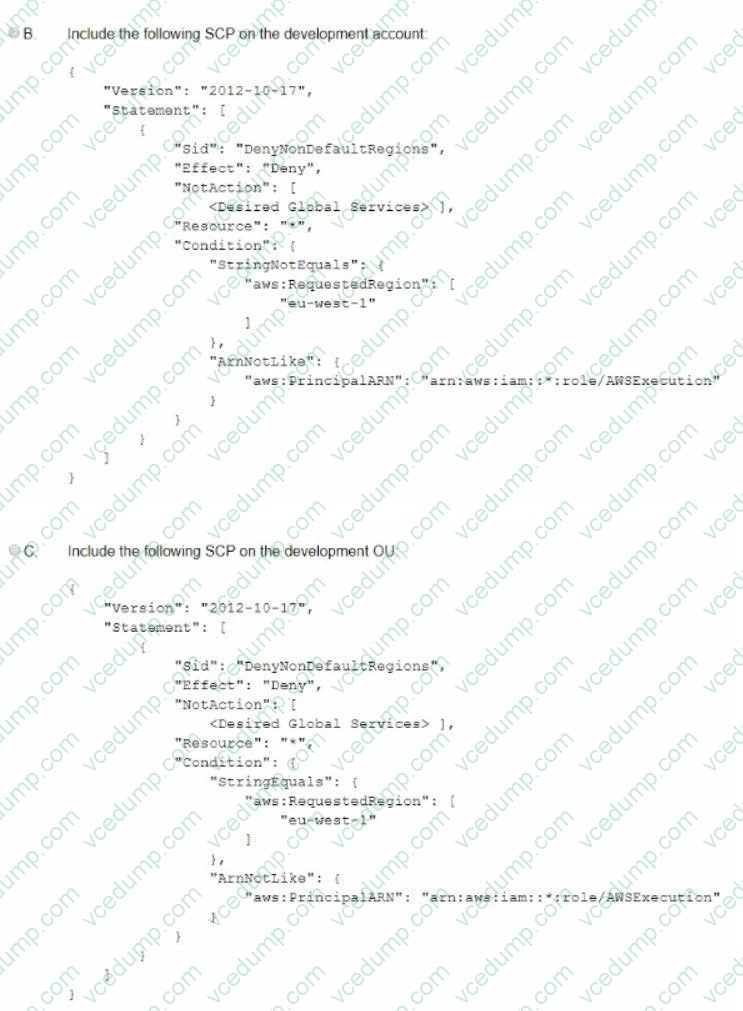
A company is using IAM Organizations. The company wants to restrict IAM usage to the eu-west-1 Region for all accounts under an OU that is named "development." The solution must persist restrictions to existing and new IAM accounts under the development OU.
Which solution meets these requirements?
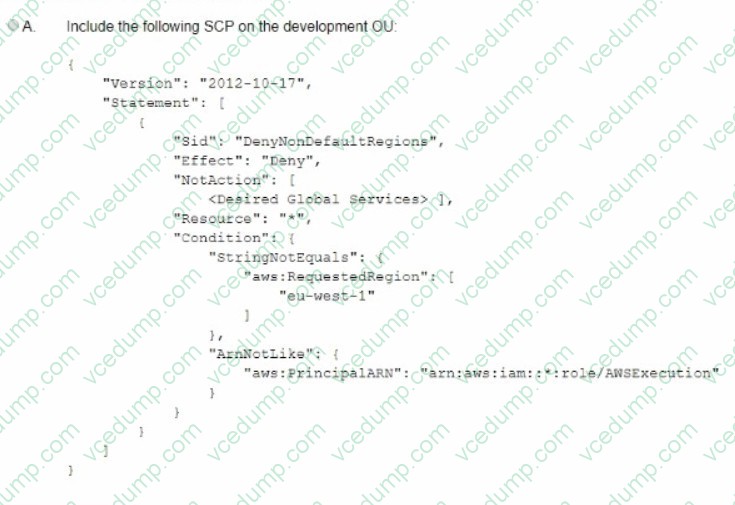
A. Option A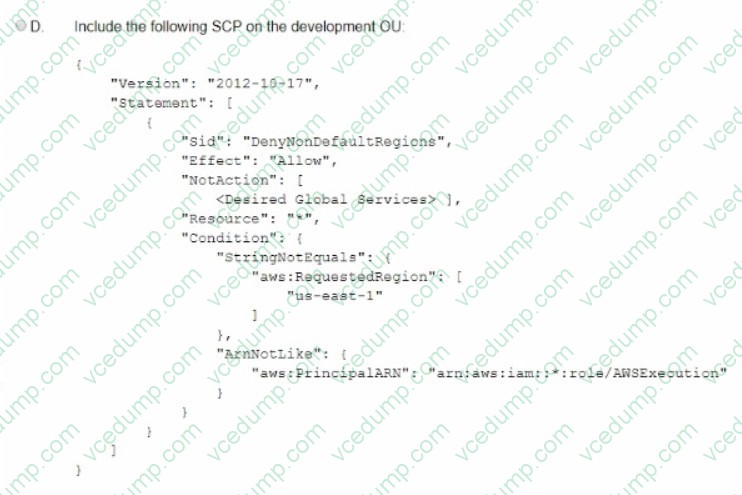
B. Option B
C. Option C
D. Option D -
Question 400:
Which of the following are valid event sources that are associated with web access control lists that trigger IAM WAF rules? (Choose two.)
A. Amazon S3 static web hosting
B. Amazon CloudFront distribution
C. Application Load Balancer
D. Amazon Route 53
E. VPC Flow Logs
Related Exams:
-
AIF-C01
Amazon AWS Certified AI Practitioner (AIF-C01) -
AIP-C01
AWS Certified Generative AI Developer - Professional -
ANS-C00
AWS Certified Advanced Networking - Specialty (ANS-C00) -
ANS-C01
AWS Certified Advanced Networking - Specialty (ANS-C01) -
AXS-C01
AWS Certified Alexa Skill Builder - Specialty (AXS-C01) -
BDS-C00
AWS Certified Big Data - Speciality (BDS-C00) -
CLF-C02
AWS Certified Cloud Practitioner (CLF-C02) -
DAS-C01
AWS Certified Data Analytics - Specialty (DAS-C01) -
DATA-ENGINEER-ASSOCIATE
AWS Certified Data Engineer - Associate (DEA-C01) -
DBS-C01
AWS Certified Database - Specialty (DBS-C01)
Tips on How to Prepare for the Exams
Nowadays, the certification exams become more and more important and required by more and more enterprises when applying for a job. But how to prepare for the exam effectively? How to prepare for the exam in a short time with less efforts? How to get a ideal result and how to find the most reliable resources? Here on Vcedump.com, you will find all the answers. Vcedump.com provide not only Amazon exam questions, answers and explanations but also complete assistance on your exam preparation and certification application. If you are confused on your SCS-C02 exam preparations and Amazon certification application, do not hesitate to visit our Vcedump.com to find your solutions here.