SCS-C02 Exam Details
-
Exam Code
:SCS-C02 -
Exam Name
:AWS Certified Security - Specialty (SCS-C02) -
Certification
:Amazon Certifications -
Vendor
:Amazon -
Total Questions
:851 Q&As -
Last Updated
:Jul 12, 2026
Amazon SCS-C02 Online Questions & Answers
-
Question 411:
An international company wants to combine AWS Security Hub findings across all the company's AWS Regions and from multiple accounts. In addition, the company wants to create a centralized custom dashboard to correlate these findings with operational data for deeper analysis and insights. The company needs an analytics tool to search and visualize Security Hub findings.
Which combination of steps will meet these requirements? (Select THREE.)
A. Designate an AWS account as a delegated administrator for Security Hub. Publish events to Amazon CloudWatch from the delegated administrator account, all member accounts, and required Regions that are enabled for Security Hub findings.
B. Designate an AWS account in an organization in AWS Organizations as a delegated administrator for Security Hub. Publish events to Amazon EventBridge from the delegated administrator account, all member accounts, and required Regions that are enabled for Security Hub findings.
C. In each Region, create an Amazon EventBridge rule to deliver findings to an Amazon Kinesis data stream. Configure the Kinesis data streams to output the logs to a single Amazon S3 bucket.
D. In each Region, create an Amazon EventBridge rule to deliver findings to an Amazon Kinesis Data Firehose delivery stream. Configure the Kinesis Data Firehose delivery streams to deliver the logs to a single Amazon S3 bucket.
E. Use AWS Glue DataBrew to crawl the Amazon S3 bucket and build the schema. Use AWS Glue Data Catalog to query the data and create views to flatten nested attributes. Build Amazon QuickSight dashboards by using Amazon Athena.
F. Partition the Amazon S3 data. Use AWS Glue to crawl the S3 bucket and build the schema. Use Amazon Athena to query the data and create views to flatten nested attributes. Build Amazon QuickSight dashboards that use the Athena views. -
Question 412:
A company recently adopted new compliance standards that require all user actions in AWS to be logged. The user actions must be logged for all accounts that belong to an organization in AWS Organizations. The company needs to set alarms that respond when specified actions occur. The alarms must forward alerts to an email distribution list. The alerts must occur in as close to real time as possible.
Which solution will meet these requirements?
A. Implement an AWS CloudTrail trail as an organizational trail. Configure the trail with Amazon CloudWatch Logs forwarding. In CloudWatch Logs, set a metric filter for any user action events that the company specifies. Create an Amazon CloudWatch alarm to provide alerts for occurrences within a reported period and to publish messages to an Amazon Simple Notification Service (Amazon SNS) topic.
B. Implement an AWS CloudTrail trail. Configure the trail with Amazon CloudWatch Logs forwarding. In CloudWatch Logs, set a metric filter for any user action events that the company specifies. Create an Amazon CloudWatch alarm to provide alerts for occurrences within a reported period and to send messages to an Amazon Simple Queue Service (Amazon SQS) queue.
C. Implement an AWS CloudTrail trail as an organizational trail. Configure the trail to store logs in an Amazon S3 bucket. Configure an Amazon EC2 instance to mount the S3 bucket as a file system to ingest new log files that are pushed to the S3 bucket. Configure the EC2 instance also to publish a message to an Amazon Simple Notification Service (Amazon SNS) topic when one of the specified actions is found in the logs.
D. Implement an AWS CloudTrail trail. Configure the trail to store logs in an Amazon S3 bucket. Each hour, create an AWS Glue Data Catalog that references the S3 bucket. Configure Amazon Athena to initiate queries against the Data Catalog to identify the specified actions in the logs. -
Question 413:
A company has a guideline that mandates the encryption of all Amazon S3 bucket data in transit. A security engineer must implement an S3 bucket policy that denies any S3 operations if data is not encrypted. Which S3 bucket policy will meet this requirement?
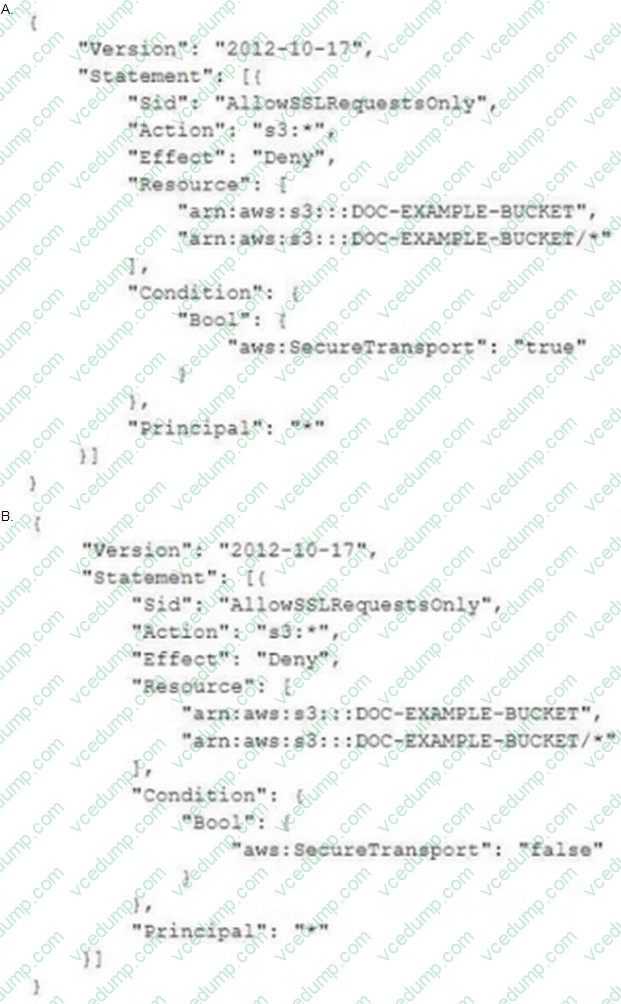
A. Option A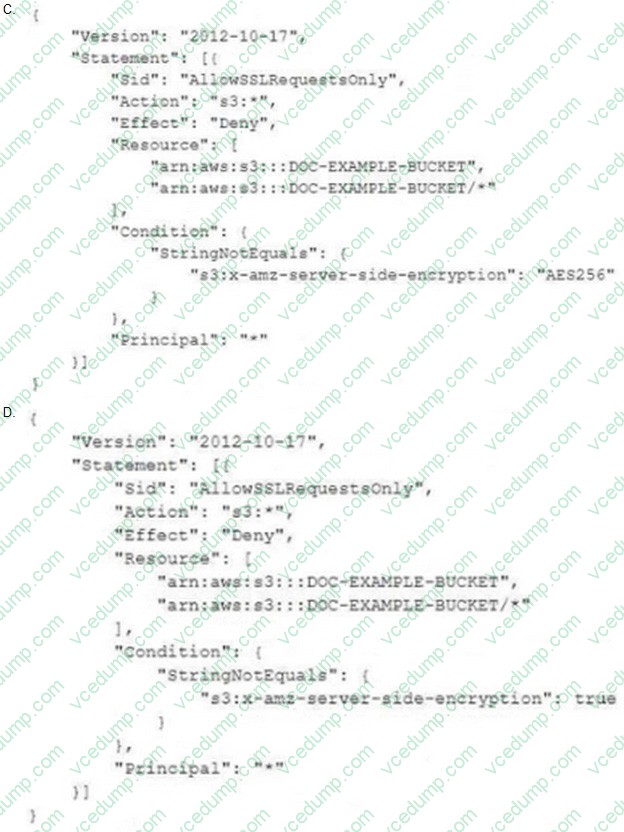
B. Option B
C. Option C
D. Option D -
Question 414:
A company is using CloudTrail to log all IAM API activity for all regions in all of its accounts. The CISO has asked that additional steps be taken to protect the integrity of the log files.
What combination of steps will protect the log files from intentional or unintentional alteration? Choose 2 answers from the options given below
A. Create an S3 bucket in a dedicated log account and grant the other accounts write only access. Deliver all log files from every account to this S3 bucket.
B. Write a Lambda function that queries the Trusted Advisor Cloud Trail checks. Run the function every 10 minutes.
C. Enable CloudTrail log file integrity validation
D. Use Systems Manager Configuration Compliance to continually monitor the access policies of S3 buckets containing Cloud Trail logs.
E. Create a Security Group that blocks all traffic except calls from the CloudTrail service. Associate the security group with) all the Cloud Trail destination S3 buckets. -
Question 415:
A company has Windows Amazon EC2 instances in a VPC that are joined to on-premises Active Directory servers for domain services. The security team has enabled Amazon GuardDuty on the IAM account to alert on issues with the instances. During a weekly audit of network traffic, the Security Engineer notices that one of the EC2 instances is attempting to communicate with a known command-and-control server but failing. This alert does not show up in GuardDuty.
Why did GuardDuty fail to alert to this behavior?
A. GuardDuty did not have the appropriate alerts activated.
B. GuardDuty does not see these DNS requests.
C. GuardDuty only monitors active network traffic flow for command-and-control activity.
D. GuardDuty does not report on command-and-control activity. -
Question 416:
A website currently runs on Amazon EC2 with mostly static content on the site. Recently, the site was subjected to a DDoS attack, and a Security Engineer was tasked with redesigning the edge security to help mitigate this risk in the future.
What are some ways the Engineer could achieve this? (Select THREE )
A. Use IAM X-Ray to inspect the traffic going to the EC2 instances
B. Move the state content to Amazon S3 and font this with an Amazon CloudFront distribution
C. Change the security group configuration to block the source of the attack traffic
D. Use IAM WAF security rules to inspect the inbound traffic
E. Use Amazon inspector assessment templates to inspect the inbound traffic
F. Use Amazon Route 53 to distribute traffic -
Question 417:
A company discovers a billing anomaly in its AWS account. A security consultant investigates the anomaly and discovers that an employee who left the company 30 days ago still has access to the account.
The company has not monitored account activity in the past.
The security consultant needs to determine which resources have been deployed or reconfigured by the employee as quickly as possible.
Which solution will meet these requirements?
A. In AWS Cost Explorer, filter chart data to display results from the past 30 days. Export the results to a data table. Group the data table by re-source.
B. Use AWS Cost Anomaly Detection to create a cost monitor. Access the detec-tion history. Set the time frame to Last 30 days. In the search area, choose the service category.
C. In AWS CloudTrail, filter the event history to display results from the past 30 days. Create an Amazon Athena table that contains the data. Parti-tion the table by event source.
D. Use AWS Audit Manager to create an assessment for the past 30 days. Apply a usage- based framework to the assessment. Configure the assessment to as-sess by resource. -
Question 418:
A security engineer needs to build a solution to turn AWS CloudTrail back on in multiple AWS Regions in case it is ever turned off.
What is the MOST efficient way to implement this solution?
A. Use AWS Config with a managed rule to initiate the AWS-EnableCloudTrail remediation.
B. Create an Amazon EventBridge event with a cloudtrail.amazonaws.com event source and a StartLogging event name to invoke an AWS Lambda function to call the StartLogging API.
C. Create an Amazon CloudWatch alarm with a cloudtrail.amazonaws.com event source and a StopLoggmg event name to invoke an AWS Lambda function to call the StartLogging API.
D. Monitor AWS Trusted Advisor to ensure CloudTrail logging is enabled. -
Question 419:
A company's Security Team received an email notification from the Amazon EC2 Abuse team that one or more of the company's Amazon EC2 instances may have been compromised
Which combination of actions should the Security team take to respond to (be current modem? (Select TWO.)
A. Open a support case with the IAM Security team and ask them to remove the malicious code from the affected instance
B. Respond to the notification and list the actions that have been taken to address the incident
C. Delete all IAM users and resources in the account
D. Detach the internet gateway from the VPC remove aft rules that contain 0.0.0.0V0 from the security groups, and create a NACL rule to deny all traffic Inbound from the internet
E. Delete the identified compromised instances and delete any associated resources that the Security team did not create. -
Question 420:
A company wants to establish separate IAM Key Management Service (IAM KMS) keys to use for different IAM services. The company's security engineer created the following key policy lo allow the infrastructure deployment team to create encrypted Amazon Elastic Block Store (Amazon EBS) volumes by assuming the InfrastructureDeployment IAM role: The security engineer recently discovered that IAM roles other than the InfrastructureDeployment role used this key (or other services.
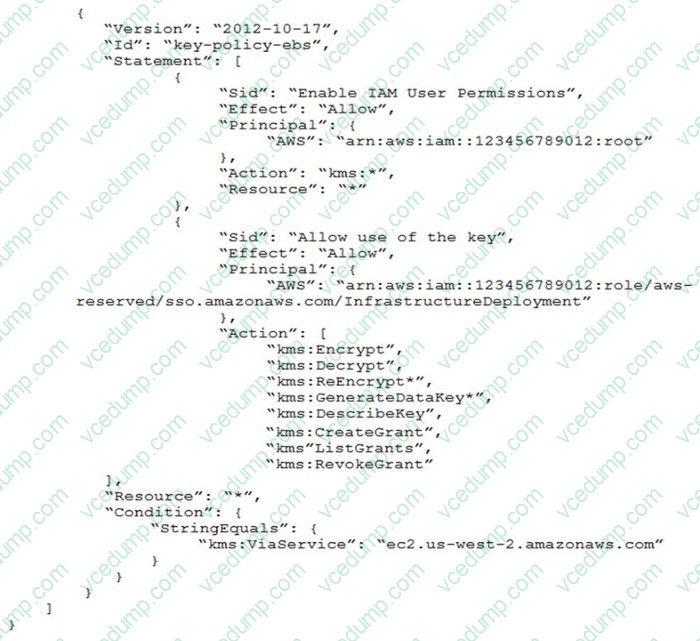
Which change to the policy should the security engineer make to resolve these issues?
A. In the statement block that contains the Sid "Allow use of the key", under the "Condition" block, change StringEquals to StringLike.
B. In the policy document, remove the statement Dlock that contains the Sid "Enable IAM User Permissions". Add key management policies to the KMS policy.
C. In the statement block that contains the Sid "Allow use of the Key", under the "Condition" block, change the Kms:ViaService value to ec2.us-east-1 .amazonIAM com.
D. In the policy document, add a new statement block that grants the kms:Disable' permission to the security engineer's IAM role.
Related Exams:
-
AIF-C01
Amazon AWS Certified AI Practitioner (AIF-C01) -
AIP-C01
AWS Certified Generative AI Developer - Professional -
ANS-C00
AWS Certified Advanced Networking - Specialty (ANS-C00) -
ANS-C01
AWS Certified Advanced Networking - Specialty (ANS-C01) -
AXS-C01
AWS Certified Alexa Skill Builder - Specialty (AXS-C01) -
BDS-C00
AWS Certified Big Data - Speciality (BDS-C00) -
CLF-C02
AWS Certified Cloud Practitioner (CLF-C02) -
DAS-C01
AWS Certified Data Analytics - Specialty (DAS-C01) -
DATA-ENGINEER-ASSOCIATE
AWS Certified Data Engineer - Associate (DEA-C01) -
DBS-C01
AWS Certified Database - Specialty (DBS-C01)
Tips on How to Prepare for the Exams
Nowadays, the certification exams become more and more important and required by more and more enterprises when applying for a job. But how to prepare for the exam effectively? How to prepare for the exam in a short time with less efforts? How to get a ideal result and how to find the most reliable resources? Here on Vcedump.com, you will find all the answers. Vcedump.com provide not only Amazon exam questions, answers and explanations but also complete assistance on your exam preparation and certification application. If you are confused on your SCS-C02 exam preparations and Amazon certification application, do not hesitate to visit our Vcedump.com to find your solutions here.