SCS-C02 Exam Details
-
Exam Code
:SCS-C02 -
Exam Name
:AWS Certified Security - Specialty (SCS-C02) -
Certification
:Amazon Certifications -
Vendor
:Amazon -
Total Questions
:851 Q&As -
Last Updated
:Jul 12, 2026
Amazon SCS-C02 Online Questions & Answers
-
Question 321:
A security engineer needs to create an Amazon S3 bucket policy to grant least privilege read access to IAM user accounts that are named User=1, User2. and User3. These IAM user accounts are members of the AuthorizedPeople IAM group. The security engineer drafts the following S3 bucket policy:
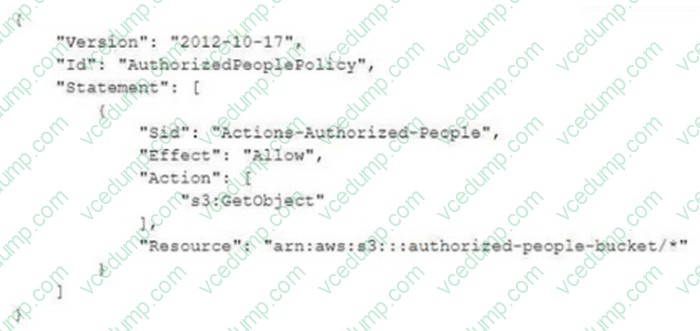
When the security engineer tries to add the policy to the S3 bucket, the following error message appears: "Missing required field Principal." The security engineer is adding a Principal element to the policy. The addition must provide read access to only User1. User2, and User3. Which solution meets these requirements?
A. Option A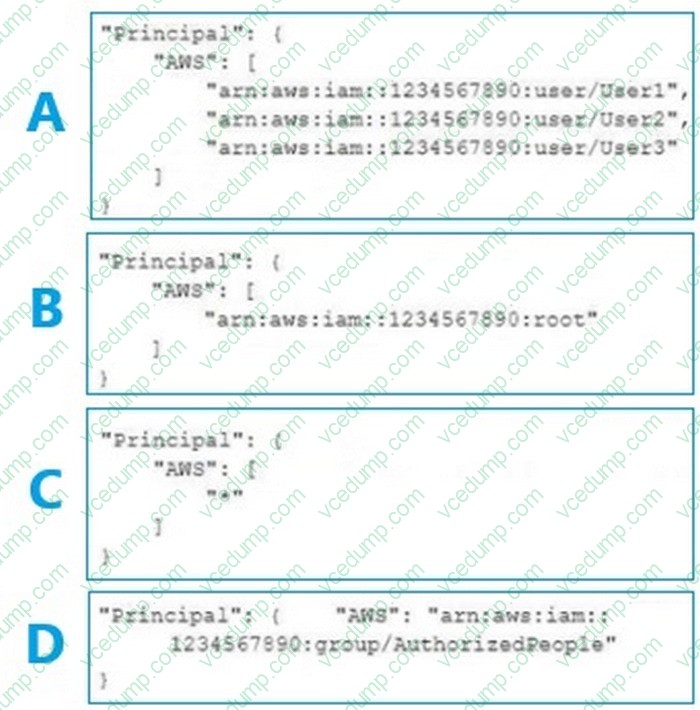
B. Option B
C. Option C
D. Option D -
Question 322:
The CFO of a company wants to allow one of his employees to view only the IAM usage report page. Which of the below mentioned IAM policy statements allows the user to have access to the IAM usage report page?
A. "Effect": "Allow". "Action": ["Describe"], "Resource": "Billing"
B. "Effect": "Allow", "Action": ["AccountUsage], "Resource": "*"
C. "Effect': "Allow", "Action": ["IAM-portal:ViewUsage"," IAM-portal:ViewBilling"], "Resource": "*"
D. "Effect": "Allow", "Action": ["IAM-portal: ViewBilling"], "Resource": "*" -
Question 323:
A company has two AWS accounts. One account is for development workloads. The other account is for production workloads. For compliance reasons the production account contains all the AWS Key Management. Service (AWS KMS) keys that the company uses for encryption.
The company applies an IAM role to an AWS Lambda function in the development account to allow secure access to AWS resources. The Lambda function must access a specific KMS customer managed key that exists in the production account to encrypt the Lambda function's data.
Which combination of steps should a security engineer take to meet these requirements? (Select TWO.)
A. Configure the key policy for the customer managed key in the production account to allow access to the Lambda service.
B. Configure the key policy for the customer managed key in the production account to allow access to the IAM role of the Lambda function in the development account.
C. Configure a new IAM policy in the production account with permissions to use the customer managed key. Apply the IAM policy to the IAM role that the Lambda function in the development account uses.
D. Configure a new key policy in the development account with permissions to use the customer managed key. Apply the key policy to the IAM role that the Lambda function in the development account uses.
E. Configure the IAM role for the Lambda function in the development account by attaching an IAM policy that allows access to the customer managed key in the production account. -
Question 324:
You want to track access requests for a particular S3 bucket. How can you achieve this in the easiest possible way?
A. Enable server access logging for the bucket
B. Enable Cloudwatch metrics for the bucket
C. Enable Cloudwatch logs for the bucket
D. Enable IAM Config for the S3 bucket -
Question 325:
Two Amazon EC2 instances in different subnets should be able to connect to each other but cannot. It has been confirmed that other hosts in the same subnets are able to communicate successfully, and that security groups have valid ALLOW rules in place to permit this traffic.
Which of the following troubleshooting steps should be performed?
A. Check inbound and outbound security groups, looking for DENY rules.
B. Check inbound and outbound Network ACL rules, looking for DENY rules.
C. Review the rejected packet reason codes in the VPC Flow Logs.
D. Use IAM X-Ray to trace the end-to-end application flow -
Question 326:
A customer has an instance hosted in the IAM Public Cloud. The VPC and subnet used to host the Instance have been created with the default settings for the Network Access Control Lists. They need to provide an IT Administrator secure access to the underlying instance. How can this be accomplished?
A. Ensure the Network Access Control Lists allow Inbound SSH traffic from the IT Administrator's Workstation
B. Ensure the Network Access Control Lists allow Outbound SSH traffic from the IT Administrator's Workstation
C. Ensure that the security group allows Inbound SSH traffic from the IT Administrator's Workstation
D. Ensure that the security group allows Outbound SSH traffic from the IT Administrator's Workstation -
Question 327:
A security engineer recently rotated the host keys for an Amazon EC2 instance. The security engineer is trying to access the EC2 instance by using the EC2 Instance. Connect feature. However, the security engineer receives an error (or failed host key validation. Before the rotation of the host keys EC2 Instance Connect worked correctly with this EC2 instance.
What should the security engineer do to resolve this error?
A. Import the key material into AWS Key Management Service (AWS KMS).
B. Manually upload the new host key to the AWS trusted host keys database.
C. Ensure that the AmazonSSMManagedInstanceCore policy is attached to the EC2 instance profile.
D. Create a new SSH key pair for the EC2 instance. -
Question 328:
A company has a few dozen application servers in private subnets behind an Elastic Load Balancer (ELB) in an IAM Auto Scaling group. The application is accessed from the web over HTTPS. The data must always be encrypted in transit. The Security Engineer is worried about potential key exposure due to vulnerabilities in the application software.
Which approach will meet these requirements while protecting the external certificate during a breach?
A. Use a Network Load Balancer (NLB) to pass through traffic on port 443 from the internet to port 443 on the instances.
B. Purchase an external certificate, and upload it to the IAM Certificate Manager (for use with the ELB) and to the instances. Have the ELB decrypt traffic, and route and re-encrypt with the same certificate.
C. Generate an internal self-signed certificate and apply it to the instances. Use IAM Certificate Manager to generate a new external certificate for the ELB. Have the ELB decrypt traffic, and route and re-encrypt with the internal certificate.
D. Upload a new external certificate to the load balancer. Have the ELB decrypt the traffic and forward it on port 80 to the instances. -
Question 329:
A company has a new web-based account management system for an online game. Players create a unique username and password to log in to the system.
The company has implemented an AWS WAF web ACL for the system. The web ACL includes the core rule set (CRS) AWS managed rule group on the Application Load Balancer that serves the system.
The company's security team finds that the system was the target of a credential stuffing attack. Credentials that were exposed in other breaches were used to try to log in to the system.
The security team must implement a solution to reduce the chance of a successful credential stuffing attack in the future. The solution also must minimize impact on legitimate users of the system.
Which combination of actions will meet these requirements? (Choose two.)
A. Create an Amazon CloudWatch custom metric to analyze the number of successful login responses from a single IP address.
B. Add the account takeover prevention (ATP) AWS managed rule group to the web ACL. Configure the rule group to inspect login requests to the system. Block any requests that have the awswaf:managed:aws:atp:signal:credential_compromised label.
C. Configure a default web ACL action that requires all users to solve a CAPTCHA puzzle when they log in.
D. Implement IP-based match rules in the web ACL for any IP addresses that generate many successful login responses. Block any IP addresses that generate many successful logins.
E. Create a custom block response that redirects users to a secure workflow to reset their password inside the system. -
Question 330:
A company uses Amazon Cognito for external user authentication for a web application. External users report that they can no longer log in to the application. What is the FIRST step that a security engineer should take to troubleshoot the problem?
A. Review AWS CloudTrail togs to identify authentication errors that relate to Cognito users.
B. Use AWS Identity and Access Management Access Analyzer to delete all unused IAM roles and users
C. Review any recent changes in Cognito configuration, IAM policies, and role trust policies to identify issues.
D. Write a script that uses CLI commands to reset all user passwords in the Cognito user pool.
Related Exams:
-
AIF-C01
Amazon AWS Certified AI Practitioner (AIF-C01) -
AIP-C01
AWS Certified Generative AI Developer - Professional -
ANS-C00
AWS Certified Advanced Networking - Specialty (ANS-C00) -
ANS-C01
AWS Certified Advanced Networking - Specialty (ANS-C01) -
AXS-C01
AWS Certified Alexa Skill Builder - Specialty (AXS-C01) -
BDS-C00
AWS Certified Big Data - Speciality (BDS-C00) -
CLF-C02
AWS Certified Cloud Practitioner (CLF-C02) -
DAS-C01
AWS Certified Data Analytics - Specialty (DAS-C01) -
DATA-ENGINEER-ASSOCIATE
AWS Certified Data Engineer - Associate (DEA-C01) -
DBS-C01
AWS Certified Database - Specialty (DBS-C01)
Tips on How to Prepare for the Exams
Nowadays, the certification exams become more and more important and required by more and more enterprises when applying for a job. But how to prepare for the exam effectively? How to prepare for the exam in a short time with less efforts? How to get a ideal result and how to find the most reliable resources? Here on Vcedump.com, you will find all the answers. Vcedump.com provide not only Amazon exam questions, answers and explanations but also complete assistance on your exam preparation and certification application. If you are confused on your SCS-C02 exam preparations and Amazon certification application, do not hesitate to visit our Vcedump.com to find your solutions here.