SCS-C02 Exam Details
-
Exam Code
:SCS-C02 -
Exam Name
:AWS Certified Security - Specialty (SCS-C02) -
Certification
:Amazon Certifications -
Vendor
:Amazon -
Total Questions
:851 Q&As -
Last Updated
:Jul 12, 2026
Amazon SCS-C02 Online Questions & Answers
-
Question 311:
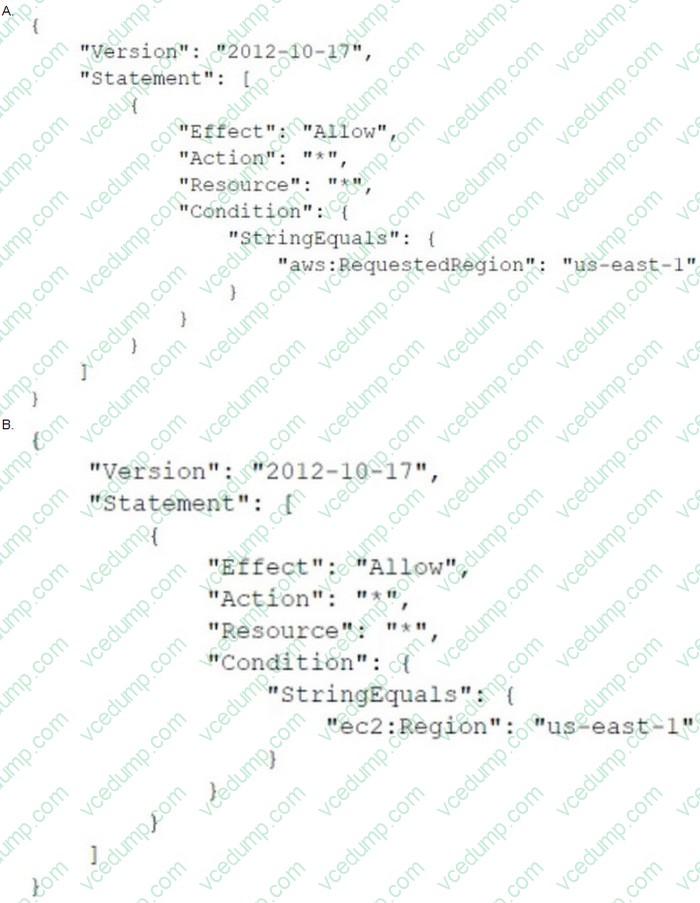
To meet regulatory requirements, a security engineer needs to implement an IAM policy that restricts the use of AWS services to the us-east-1 Region.
What policy should the Engineer implement?
A. Option A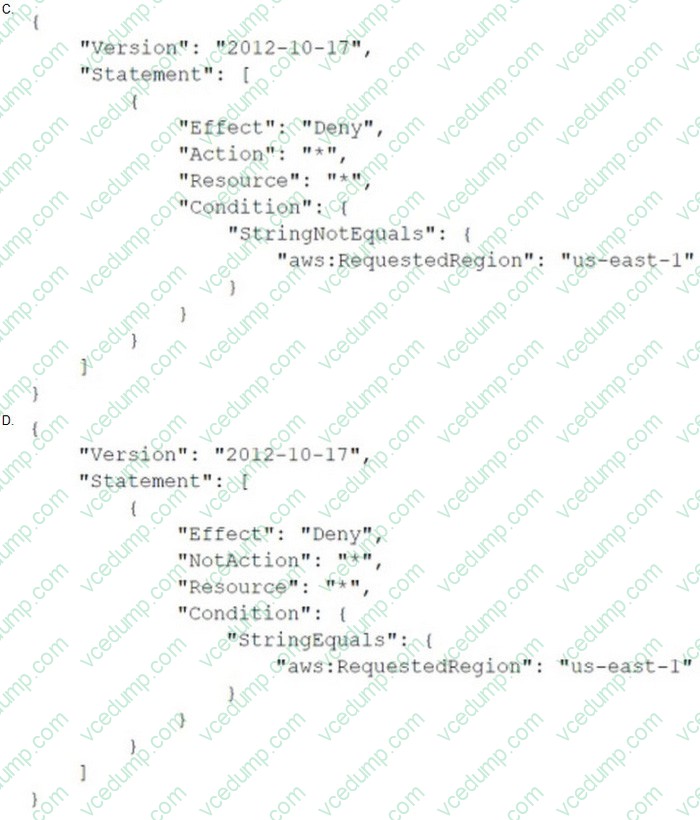
B. Option B
C. Option C
D. Option D -
Question 312:
A company has a web server in the AWS Cloud. The company will store the content for the web server in an Amazon S3 bucket. A security engineer must use an Amazon CloudFront distribution to speed up delivery of the content. None of the files can be publicly accessible from the S3 bucket direct.
Which solution will meet these requirements?
A. Configure the permissions on the individual files in the S3 bucket so that only the CloudFront distribution has access to them.
B. Create an origin access identity (OAI). Associate the OAI with the CloudFront distribution. Configure the S3 bucket permissions so that only the OAI can access the files in the S3 bucket.
C. Create an S3 role in AWS Identity and Access Management (IAM). Allow only the CloudFront distribution to assume the role to access the files in the S3 bucket.
D. Create an S3 bucket policy that uses only the CloudFront distribution ID as the principal and the Amazon Resource Name (ARN) as the target. -
Question 313:
Your company uses IAM to host its resources. They have the following requirements
1) Record all API calls and Transitions 2) Help in understanding what resources are there in the account 3) Facility to allow auditing credentials and logins
Which services would suffice the above requirements?
A. IAM Inspector, CloudTrail, IAM Credential Reports
B. CloudTrail. IAM Credential Reports, IAM SNS
C. CloudTrail, IAM Config, IAM Credential Reports
D. IAM SQS, IAM Credential Reports, CloudTrail -
Question 314:
Within a VPC, a corporation runs an Amazon RDS Multi-AZ DB instance. The database instance is connected to the internet through a NAT gateway via two subnets.
Additionally, the organization has application servers that are hosted on Amazon EC2 instances and use the RDS database. These EC2 instances have been deployed onto two more private subnets inside the same VPC. These EC2 instances connect to the internet through a default route via the same NAT gateway. Each VPC subnet has its own route table.
The organization implemented a new security requirement after a recent security examination. Never allow the database instance to connect to the internet. A security engineer must perform this update promptly without interfering with the network traffic of the application servers.
How will the security engineer be able to comply with these requirements?
A. Remove the existing NAT gateway. Create a new NAT gateway that only the application server subnets can use.
B. Configure the DB instanceTMs inbound network ACL to deny traffic from the security group ID of the NAT gateway.
C. Modify the route tables of the DB instance subnets to remove the default route to the NAT gateway.
D. Configure the route table of the NAT gateway to deny connections to the DB instance subnets. -
Question 315:
Your company has a set of EC2 Instances defined in IAM. These Ec2 Instances have strict security groups attached to them. You need to ensure that changes to the Security groups are noted and acted on accordingly. How can you achieve this?
A. Use Cloudwatch logs to monitor the activity on the Security Groups. Use filters to search for the changes and use SNS for the notification.
B. Use Cloudwatch metrics to monitor the activity on the Security Groups. Use filters to search for the changes and use SNS for the notification.
C. Use IAM inspector to monitor the activity on the Security Groups. Use filters to search for the changes and use SNS f the notification.
D. Use Cloudwatch events to be triggered for any changes to the Security Groups. Configure the Lambda function for email notification as well. -
Question 316:
A security engineer must troubleshoot an administrator's inability to make an existing Amazon S3 bucket public in an account that is part of an organization n IAM Organizations. The administrator switched the role from the master account to a member account and then attempted to make one S3 bucket public. This action was immediately denied
Which actions should the security engineer take to troubleshoot the permissions issue? (Select TWO.)
A. Review the cross-account role permissions and the S3 bucket policy Verify that the Amazon S3 block public access option in the member account is deactivated.
B. Review the role permissions in the master account and ensure it has sufficient privileges to perform S3 operations
C. Filter IAM CloudTrail logs for the master account to find the original deny event and update the cross-account role in the member account accordingly Verify that the Amazon S3 block public access option in the master account is deactivated.
D. Evaluate the SCPs covering the member account and the permissions boundary of the role in the member account for missing permissions and explicit denies.
E. Ensure the S3 bucket policy explicitly allows the s3 PutBucketPublicAccess action for the role in the member account -
Question 317:
Which of the following is the most efficient way to automate the encryption of IAM CloudTrail logs using a Customer Master Key (CMK) in IAM KMS?
A. Use the KMS direct encrypt function on the log data every time a CloudTrail log is generated.
B. Use the default Amazon S3 server-side encryption with S3-managed keys to encrypt and decrypt the CloudTrail logs.
C. Configure CloudTrail to use server-side encryption using KMS-managed keys to encrypt and decrypt CloudTrail logs.
D. Use encrypted API endpoints so that all IAM API calls generate encrypted CloudTrail log entries using the TLS certificate from the encrypted API call. -
Question 318:
A company has a requirement that no Amazon EC2 security group can allow SSH access from the CIDR block 0.0.0.0/0. The company wants to monitor compliance with this requirement at all times and wants to receive a near-real-time notification if any security group is noncompliant.
A security engineer has configured AWS Config and will use the restricted-ssh managed rule to monitor the security groups.
What should the security engineer do next to meet these requirements?
A. Configure AWS Config to send its configuration snapshots to an Amazon S3 bucket. Create an AWS Lambda function to run on a PutEvent to the S3 bucket. Configure the Lambda function to parse the snapshot for a compliance change to the restricted-ssh managed rule. Configure the Lambda function to send a notification to an Amazon Simple Notification Service (Amazon SNS) topic if a change is discovered.
B. Configure an Amazon EventBridge event rule that is invoked by a compliance change event from AWS Config for the restricted-ssh managed rule. Configure the event rule to target an Amazon Simple Notification Service (Amazon SNS) topic that will provide a notification.
C. Configure AWS Config to push all its compliance notifications to Amazon CloudWatch Logs. Configure a CloudWatch Logs metric filter on the AWS Config log group to look for a compliance notification change on the restricted-ssh managed rule. Create an Amazon CloudWatch alarm on the metric filter to send a notification to an Amazon Simple Notification Service (Amazon SNS) topic if the alarm is in the ALARM state.
D. Configure an Amazon CloudWatch alarm on the CloudWatch metric for the restricted-ssh managed rule. Configure the CloudWatch alarm to send a notification to an Amazon Simple Notification Service (Amazon SNS) topic if the alarm is in the ALARM state. -
Question 319:
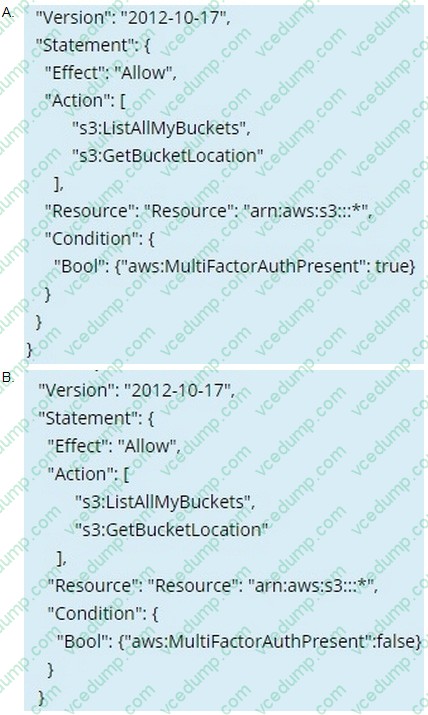
You are designing a custom IAM policy that would allow uses to list buckets in S3 only if they are MFA authenticated. Which of the following would best match this requirement?
A. Option A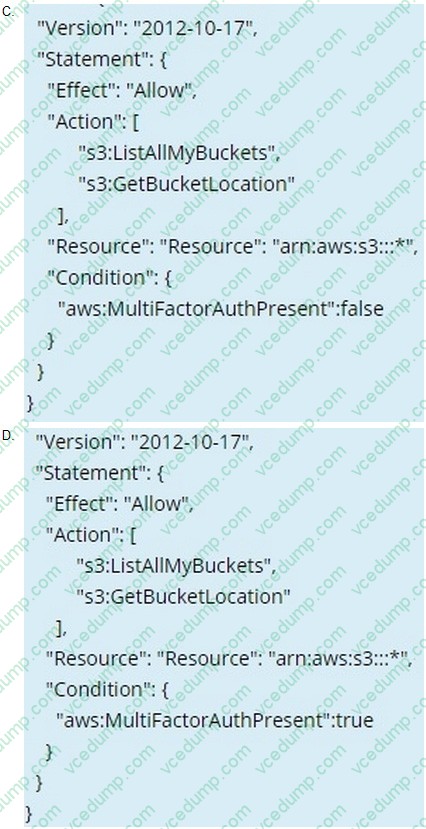
B. Option B
C. Option C
D. Option D -
Question 320:
A company wants to implement host-based security for Amazon EC2 instances and containers in Amazon Elastic Container Registry (Amazon ECR). The company has deployed AWS Systems Manager Agent (SSM Agent) on the EC2 instances. All the company's AWS accounts are in one organization in AWS Organizations. The company will analyze the workloads for software vulnerabilities and unintended network exposure. The company will push any findings to AWS Security Hub, which the company has configured for the organization.
The company must deploy the solution to all member accounts, including new accounts, automatically. When new workloads come online, the solution must scan the workloads.
Which solution will meet these requirements?
A. Use SCPs to configure scanning of EC2 instances and ECR containers for all accounts in the organization.
B. Configure a delegated administrator for Amazon GuardDuty for the organization. Create an Amazon EventBridge rule to initiate analysis of ECR containers
C. Configure a delegated administrator for Amazon Inspector for the organization. Configure automatic scanning for new member accounts.
D. Configure a delegated administrator for Amazon Inspector for the organization. Create an AWS Config rule to initiate analysis of ECR containers.
Related Exams:
-
AIF-C01
Amazon AWS Certified AI Practitioner (AIF-C01) -
AIP-C01
AWS Certified Generative AI Developer - Professional -
ANS-C00
AWS Certified Advanced Networking - Specialty (ANS-C00) -
ANS-C01
AWS Certified Advanced Networking - Specialty (ANS-C01) -
AXS-C01
AWS Certified Alexa Skill Builder - Specialty (AXS-C01) -
BDS-C00
AWS Certified Big Data - Speciality (BDS-C00) -
CLF-C02
AWS Certified Cloud Practitioner (CLF-C02) -
DAS-C01
AWS Certified Data Analytics - Specialty (DAS-C01) -
DATA-ENGINEER-ASSOCIATE
AWS Certified Data Engineer - Associate (DEA-C01) -
DBS-C01
AWS Certified Database - Specialty (DBS-C01)
Tips on How to Prepare for the Exams
Nowadays, the certification exams become more and more important and required by more and more enterprises when applying for a job. But how to prepare for the exam effectively? How to prepare for the exam in a short time with less efforts? How to get a ideal result and how to find the most reliable resources? Here on Vcedump.com, you will find all the answers. Vcedump.com provide not only Amazon exam questions, answers and explanations but also complete assistance on your exam preparation and certification application. If you are confused on your SCS-C02 exam preparations and Amazon certification application, do not hesitate to visit our Vcedump.com to find your solutions here.