SC-300 Exam Details
-
Exam Code
:SC-300 -
Exam Name
:Microsoft Identity and Access Administrator -
Certification
:Microsoft Certifications -
Vendor
:Microsoft -
Total Questions
:465 Q&As -
Last Updated
:Jul 17, 2026
Microsoft SC-300 Online Questions & Answers
-
Question 131:
HOTSPOT
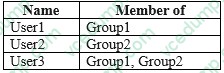
You have a Microsoft Entra tenant that contains the users shown in the following table.
You have a user risk policy that has the following settings:
Assignments:
Include: Group1
Exclude: Group2
Sign-in risk: Medium and above Access controls: Grant access: Require password change
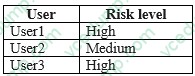
When the users attempt to sign in, user risk levels are detected as shown in the following table.
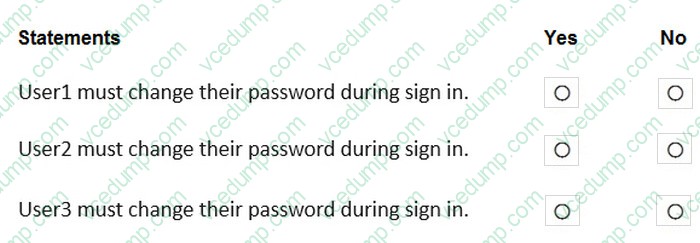
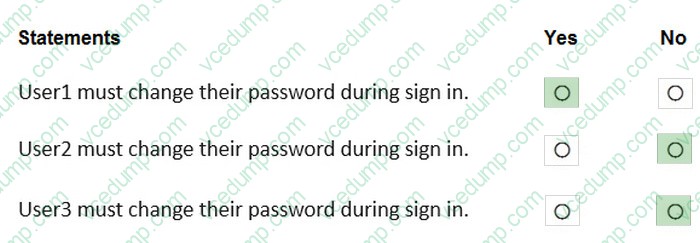
For each of the following statements, select Yes if the statement is true. Otherwise, select No.
NOTE: Each correct selection is worth one point.
-
Question 132:
You have an Azure AD tenant that contains the users shown in the following table.
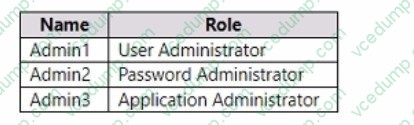
You need to compare the role permissions of each user. The solution must minimize administrative effort.
What should you use?
A. the Microsoft 365 Defender portal
B. the Microsoft 365 admin center
C. the Microsoft Entra admin center
D. the Microsoft Purview compliance portal -
Question 133:
HOTSPOT
You have an Azure subscription named Sub1 that contains a resource group named RG1. RG1 contains two Azure key vaults named KV1 and KV2 that use Azure role-based access control (Azure RBAC). The subscription contains the users shown in the following table.
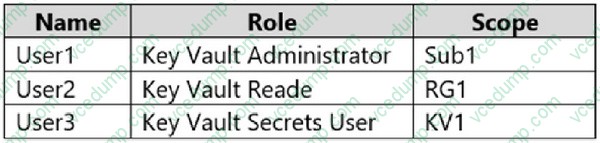
KV1 contains a secret named Secret1. KV2 contains a secret named Secret2.
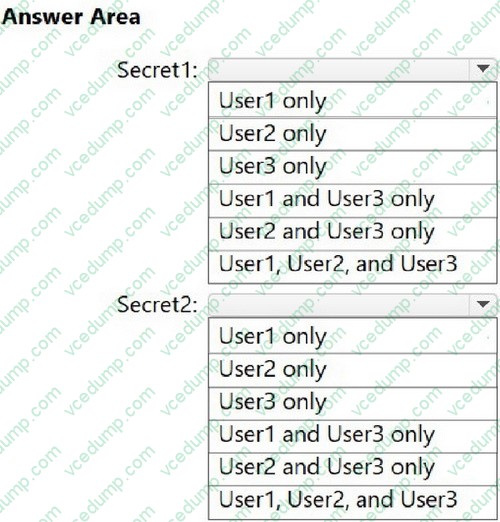
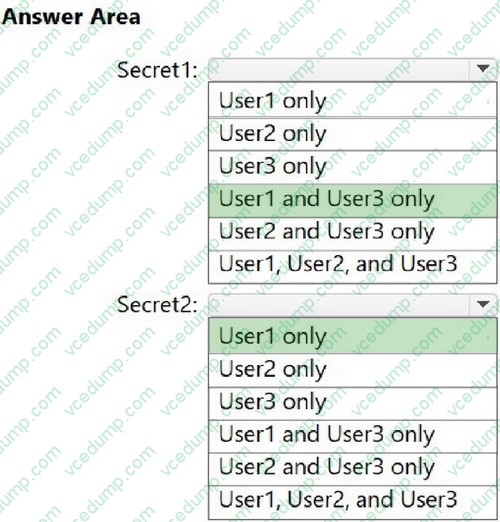
Which users can read the values of each secret? To answer, select the appropriate options in the answer area.
NOTE: Each correct selection is worth one point.
-
Question 134:
You have a Microsoft Entra tenant.
You have the end-user desktop environments shown in the following table.
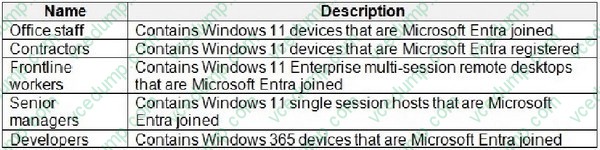
You need to deploy Global Secure Access.
In which environments can you install the Global Secure Access client?
A. Contractors, Developers, Frontline workers, Office staff, and Senior managers
B. Frontline workers and Senior managers only
C. Contractors and Office staff only
D. Developers, Office staff, and Senior managers only -
Question 135:
You need to resolve the issue of IT_Group1.
What should you do first?
A. ecreate the IT_Group1 group
B. Change the membership type of IT_Group1 to Dynamic Device.
C. Add an owner to IT_Group1.
D. Change the membership type of IT_Group1 to Dynamic User. -
Question 136:
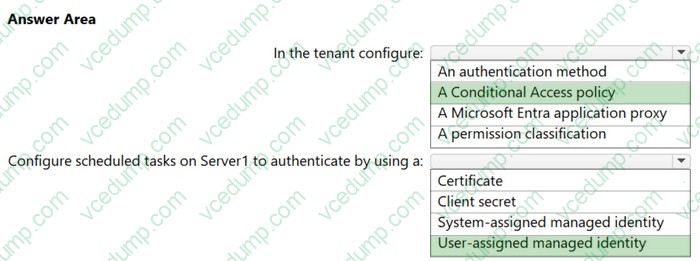
HOTSPOT
You have an on-premises server named Server1 that runs Windows Server.
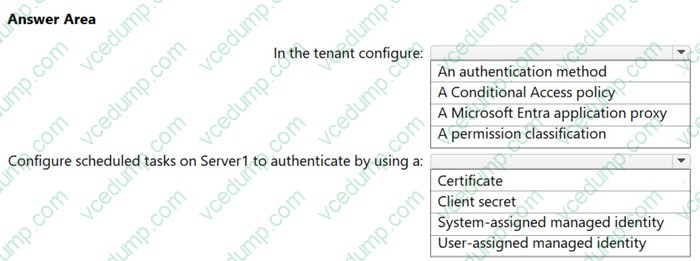
You have a Microsoft Entra tenant that contains an app registration named App1. App1 has Microsoft Graph application permissions.
You need to configure the environment to support App1. The solution must meet the following requirements:
1. App1 must be accessible only from the corporate network.
2. The credentials for App1 must NOT be stored as plain text.
3. Non-interactive scheduled tasks on Server1 must be able to authenticate to App1.
What should you do? To answer, select the appropriate options in the answer area.
NOTE: Each correct selection is worth one point.
-
Question 137:
You have a Microsoft Entra tenant.
You need to identify sign-in patterns and authentication success rates.
Which report should you use?
A. Audit logs
B. Sign-in logs
C. Access reviews
D. Usage reports -
Question 138:
You have a Microsoft Entra ID tenant that contains a user named User1.
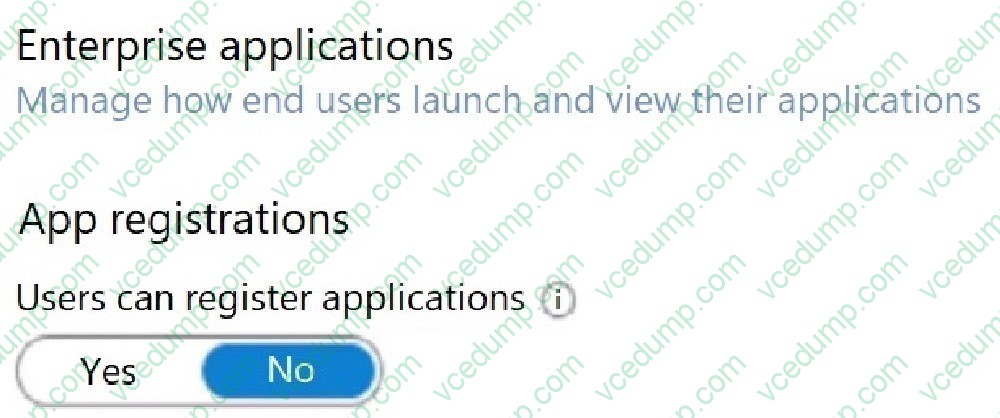
The App registration settings for the tenant are configured as shown in the following exhibit.
User1 builds an ASP.NET web app named App1.
You need to ensure that User1 can register App1. The solution must use the principle of least privilege.
Which role should you assign to User1?
A. Application Developer
B. Cloud App Security Administrator
C. Cloud Application Administrator
D. Application Administrator -
Question 139:
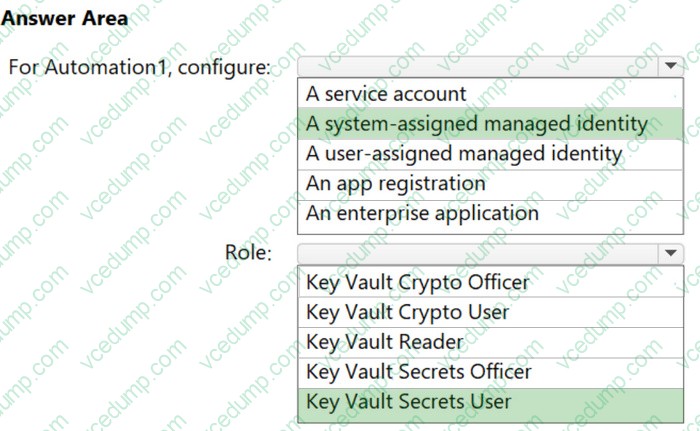
HOTSPOT
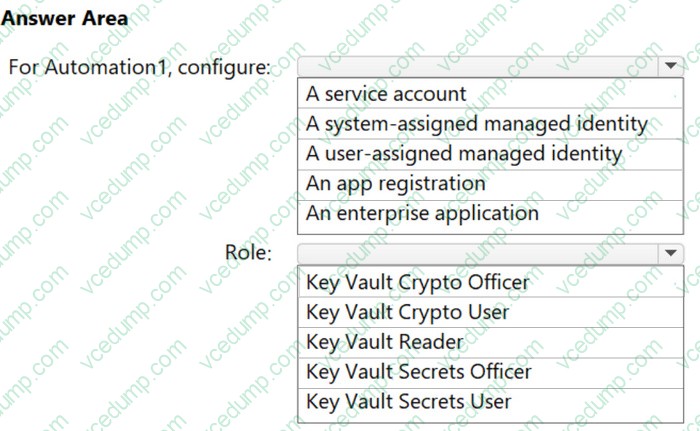
You have an Azure subscription named Sub1 that contains an Azure key vault named Vault1 and an Azure Automation account named Automation1.
You need to ensure that Automation1 can access Vault1. The solution1 must meet the following requirements:
1. Ensure that if Automation1 is deleted, the permissions granted for Vault1 will be removed automatically.
2. Ensure that runbooks created in Automation1 can read secret values stored in Vault1.
3. Follow the principle of least privilege.
What should you configure for Automation1, and which built-in role should Automation1 use to access Vault1? To answer, select the appropriate options in the answer area.
NOTE: Each correct answer is worth one point.
-
Question 140:
Your company has a Microsoft Entra tenant that contains a user named User1.
The company has two departments named marketing and finance.
You need to grant permissions to User1 to manage only the users in the marketing department. The solution must ensure that User1 does NOT have permissions to manage the users in the finance department.
What should you create first?
A. a management group
B. an administrative unit
C. a resource group
D. a Microsoft 365 group
Related Exams:
-
62-193
Technology Literacy for Educators -
70-243
Administering and Deploying System Center 2012 Configuration Manager -
70-355
Universal Windows Platform – App Data, Services, and Coding Patterns -
77-420
Excel 2013 -
77-427
Excel 2013 Expert Part One -
77-725
Word 2016 Core Document Creation, Collaboration and Communication -
77-726
Word 2016 Expert Creating Documents for Effective Communication -
77-727
Excel 2016 Core Data Analysis, Manipulation, and Presentation -
77-728
Excel 2016 Expert: Interpreting Data for Insights -
77-731
Outlook 2016 Core Communication, Collaboration and Email Skills
Tips on How to Prepare for the Exams
Nowadays, the certification exams become more and more important and required by more and more enterprises when applying for a job. But how to prepare for the exam effectively? How to prepare for the exam in a short time with less efforts? How to get a ideal result and how to find the most reliable resources? Here on Vcedump.com, you will find all the answers. Vcedump.com provide not only Microsoft exam questions, answers and explanations but also complete assistance on your exam preparation and certification application. If you are confused on your SC-300 exam preparations and Microsoft certification application, do not hesitate to visit our Vcedump.com to find your solutions here.