SC-100 Exam Details
-
Exam Code
:SC-100 -
Exam Name
:Microsoft Cybersecurity Architect -
Certification
:Microsoft Certifications -
Vendor
:Microsoft -
Total Questions
:350 Q&As -
Last Updated
:Jul 12, 2026
Microsoft SC-100 Online Questions & Answers
-
Question 281:
You have a Microsoft 365 subscription that contains a group named Group1. The subscription contains 1,000 Windows devices that are joined to a Microsoft Entra tenant and managed by using Microsoft Intune. All users sign in to the devices by using standard user accounts.
You plan to deploy a new app named App1 to the members of Group1. The Group1 members must have administrative rights to install new versions of App1.
You need to ensure that the Group1 members can install new versions of App1. The solution must follow the principles of Zero Trust.
What should you implement?
A. Microsoft Local Administrator Password Solution (Microsoft LAPS)
B. Endpoint Privilege Management (EPM)
C. Privileged Identity Management (PIM)
D. Microsoft Entra entitlement management -
Question 282:
You have a Microsoft Entra tenant named contoso.com.
You have an external partner that has a Microsoft Entra tenant named fabnkam.com.
You need to recommend an identity governance solution for contoso.com that meets the following requirements:
1. Enables the users in contoso.com and fabrikam.com to communicate by using shared Microsoft Teams channels
2. Manages access to shared Teams channels in contoso.com by using groups in fabrikam.com
3. Supports single sign-on (SSO)
4. Minimizes administrative effort
5. Maximizes security
What should you include in the recommendation?
A. Cross-tenant synchronization
B. Microsoft Entra B2B collaboration
C. B2B direct connect
D. Microsoft Entra Connect Sync -
Question 283:
HOTSPOT
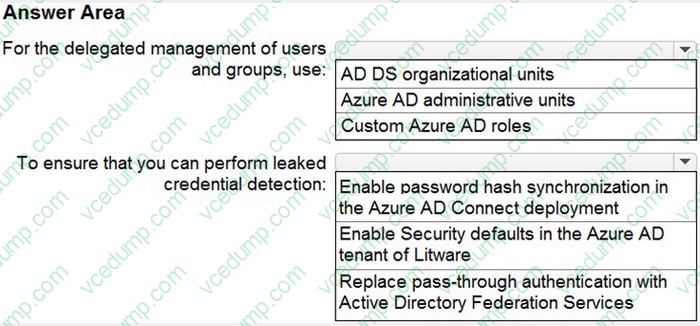
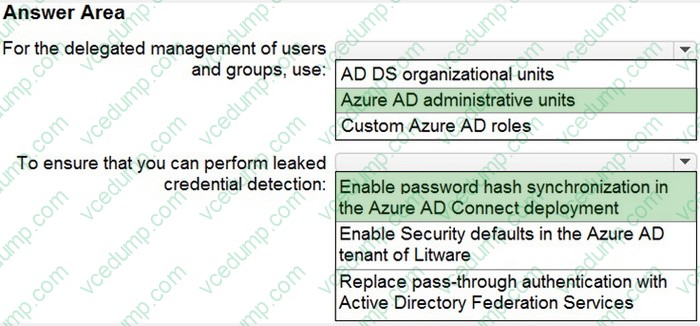
You need to recommend an identity security solution for the Azure AD tenant of Litware. The solution must meet the identity requirements and the regulatory compliance requirements.
What should you recommend? To answer, select the appropriate options in the answer area.
NOTE: Each correct selection is worth one point.
-
Question 284:
Note: This section contains one or more sets of questions with the same scenario and problem. Each question presents a unique solution to the problem. You must determine whether the solution meets the stated goals. More than one solution in the set might solve the problem. It is also possible that none of the solutions in the set solve the problem.
After you answer a question in this section, you will NOT be able to return. As a result, these questions do not appear on the Review Screen.
You have a Microsoft 365 subscription that uses Microsoft Defender XDR. The subscription contains 500 devices that are enrolled in Microsoft Intune. The subscription contains 500 users that connect to external software as a service (SaaS) apps by using the devices.
You need to implement a solution that meets the following requirements:
Allows user access to SaaS apps that Microsoft has identified as low risk.
Blocks user access to Saas apps that Microsoft has identified as high risk.
Solution: From Microsoft Defender for Cloud Apps, you configure a cloud discovery policy and unsanction risky apps.
Does this meet the goal?
A. Yes
B. No -
Question 285:
HOTSPOT
You have a Microsoft 365 subscription that is protected by using Microsoft 365 Defender.
You are designing a security operations strategy that will use Microsoft Sentinel to monitor events from Microsoft 365 and Microsoft 365 Defender.
You need to recommend a solution to meet the following requirements:
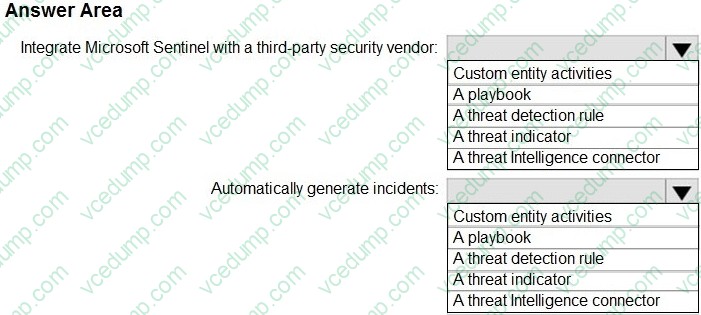
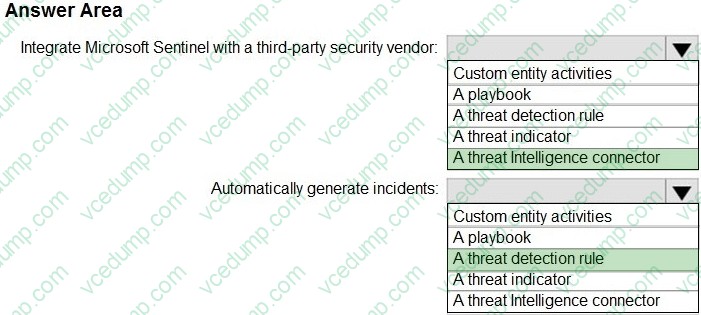
1. Integrate Microsoft Sentinel with a third-party security vendor to access information about known malware.
2. Automatically generate incidents when the IP address of a command-and-control server is detected in the events.
What should you configure in Microsoft Sentinel to meet each requirement? To answer, select the appropriate options in the answer area.
NOTE: Each correct selection is worth one point.
-
Question 286:
You have a Microsoft 365 E5 subscription.
You are designing a solution to protect confidential data in Microsoft SharePoint Online sites that contain more than one million documents.
You need to recommend a solution to prevent Personally Identifiable Information (Pll) from being shared.
Which two components should you include in the recommendation? Each correct answer presents part of the solution.
NOTE: Each correct selection is worth one point.
A. data loss prevention (DLP) policies
B. retention label policies
C. eDiscovery cases
D. sensitivity label policies -
Question 287:
Your company is moving all on-premises workloads to Azure and Microsoft 365.
You need to design a security orchestration, automation, and response (SOAR) strategy in Microsoft Sentinel that meets the following requirements:
1. Minimizes manual intervention by security operation analysts
2. Supports triaging alerts within Microsoft Teams channels
What should you include in the strategy?
A. KQL
B. playbooks
C. data connectors
D. KQLworkbooks -
Question 288:
HOTSPOT
Your company wants to optimize using Azure to protect its resources from ransomware.
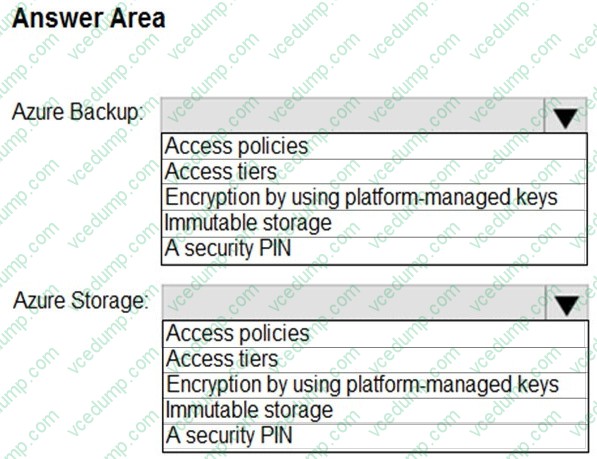
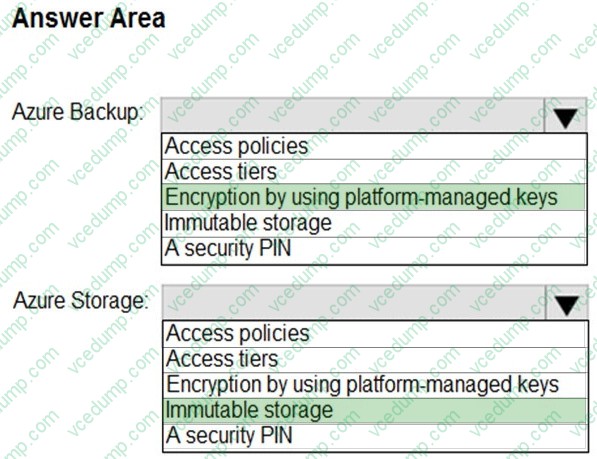
You need to recommend which capabilities of Azure Backup and Azure Storage provide the strongest protection against ransomware attacks. The solution must follow Microsoft Security Best Practices.
What should you recommend? To answer, select the appropriate options in the answer area.
NOTE: Each correct selection is worth one point.
-
Question 289:
You have an Azure subscription and an Azure DevOps organization.
You need to recommend a solution for connecting Azure DevOps pipelines to the resources in the subscription by using Azure Resource Manager (ARM) service connections. The solution must align with Microsoft Cloud Adoption Framework for Azure best practices, including the principle of least privilege.
What should you include in the recommendation?
A. workload identity federation and system-assigned managed identities
B. service principals and secrets
C. workload identity federation and user-assigned managed identities
D. workload identity federation and service principals -
Question 290:
You have a Microsoft Entra tenant that syncs with an Active Directory Domain Services (AD DS) domain. Client computers run Windows and are hybrid-joined to Microsoft Entra.
You are designing a strategy to protect endpoints against ransomware. The strategy follows Microsoft Security Best Practices.
You plan to remove all the domain accounts from the Administrators groups on the Windows computers.
You need to recommend a solution that will provide users with administrative access to the Windows computers only when access is required. The solution must minimize the lateral movement of ransomware attacks if an administrator account on a computer is compromised.
What should you include in the recommendation?
A. Local Administrator Password Solution (LAPS)
B. Azure AD Identity Protection
C. Azure AD Privileged Identity Management (PIM)
D. Privileged Access Workstations (PAWs)
Related Exams:
-
62-193
Technology Literacy for Educators -
70-243
Administering and Deploying System Center 2012 Configuration Manager -
70-355
Universal Windows Platform – App Data, Services, and Coding Patterns -
77-420
Excel 2013 -
77-427
Excel 2013 Expert Part One -
77-725
Word 2016 Core Document Creation, Collaboration and Communication -
77-726
Word 2016 Expert Creating Documents for Effective Communication -
77-727
Excel 2016 Core Data Analysis, Manipulation, and Presentation -
77-728
Excel 2016 Expert: Interpreting Data for Insights -
77-731
Outlook 2016 Core Communication, Collaboration and Email Skills
Tips on How to Prepare for the Exams
Nowadays, the certification exams become more and more important and required by more and more enterprises when applying for a job. But how to prepare for the exam effectively? How to prepare for the exam in a short time with less efforts? How to get a ideal result and how to find the most reliable resources? Here on Vcedump.com, you will find all the answers. Vcedump.com provide not only Microsoft exam questions, answers and explanations but also complete assistance on your exam preparation and certification application. If you are confused on your SC-100 exam preparations and Microsoft certification application, do not hesitate to visit our Vcedump.com to find your solutions here.