SC-100 Exam Details
-
Exam Code
:SC-100 -
Exam Name
:Microsoft Cybersecurity Architect -
Certification
:Microsoft Certifications -
Vendor
:Microsoft -
Total Questions
:350 Q&As -
Last Updated
:Jul 12, 2026
Microsoft SC-100 Online Questions & Answers
-
Question 271:
You have an Azure subscription.
You intend to deploy enterprise-scale landing zones using the Microsoft Cloud Adoption Framework for Azure.
The deployment will consist of a single platform landing zone for all shared services, as well as three application landing zones, each dedicated to hosting a distinct Azure application.
You are tasked with recommending which resources should be deployed to each landing zone.
The solution must adhere to the best-practice recommendations outlined in the Cloud Adoption Framework for enterprise-scale landing zones.
What resources should you recommend for deployment?
A. an Azure firewall
B. an Azure virtual network gateway
C. an Azure Private DNS zone
D. an Azure key vault -
Question 272:
HOTSPOT
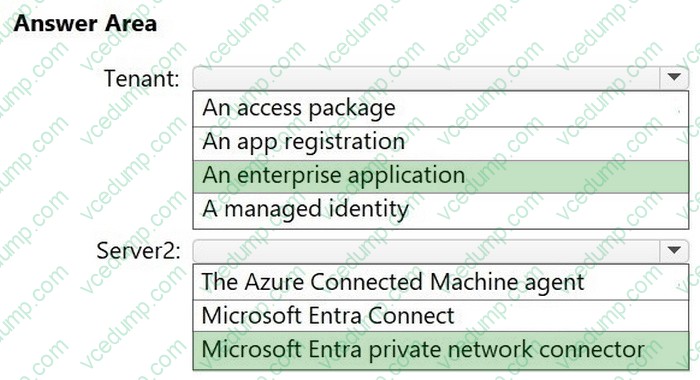
You have two on-premises servers, Server1 and Server2, that run Windows Server. Server1 contains an app named App1 and is isolated from the internet.
You have a Microsoft Entra tenant, and you plan to deploy Global Secure Access to provide remote access to App1.
You need to configure the tenant and Server2 to support the planned deployment. The solution must ensure that when users attempt to access App1, they must authenticate using their Microsoft Entra credentials.
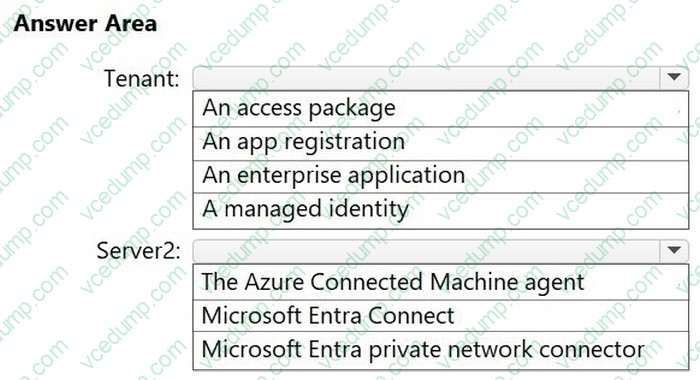
What should you create in the tenant, and what should you install on Server2?
To answer, select the appropriate options in the answer area.
-
Question 273:
You have two Azure subscriptions named Sub1 and Sub2 that contain the vaults shown in the following table.
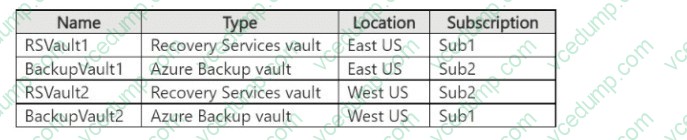
You need to design a multi-user authorization (MUA) solution for security operations on the vaults. The solution must meet the following requirements:
RSVault1 and RSVault2 must require MUA for disabling soft delete, removing MUA protection, and disabling immutability.
BackupVault1 and BackupVault2 must require MUA for disabling soft delete and removing MUA protection.
What is the minimum number of Resource Guard resources required?
A. 1
B. 2
C. 3
D. 4 -
Question 274:
You have a Microsoft 365 subscription that contains 500 users. Each user is assigned a Microsoft 365 E5 license and uses a Windows device.
Microsoft Purview data loss prevention (DLP) policies are applied to Microsoft Exchange Online email and SharePoint Online sites.
You plan to monitor the usage of third-party generative AI apps by using Microsoft Purview Data Security Posture Management for AI (DSPM for AI).
What should you do first?
A. Enable Microsoft Purview insider risk management for all the users.
B. Onboard all endpoint devices to Microsoft Purview.
C. Configure Microsoft Purview data connectors for the generative AI apps.
D. License all the users for Microsoft 365 Copilot. -
Question 275:
HOTSPOT
You have a Microsoft 365 subscription.
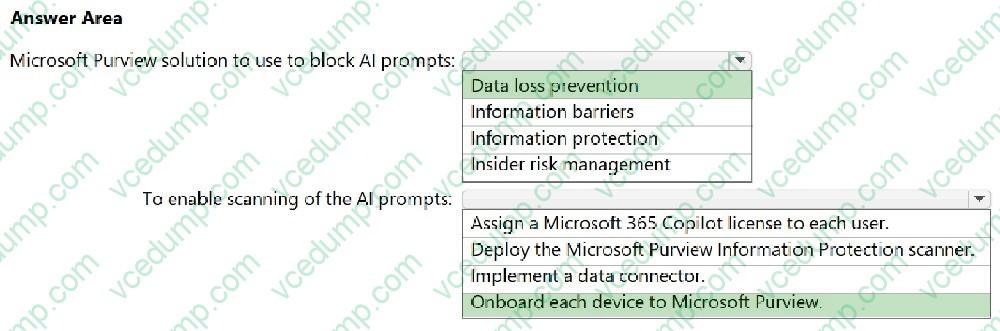
Microsoft Purview is configured to protect data in only Microsoft Exchange Online and SharePoint Online. Custom sensitive information types (SITs) have been created to identify confidential data.
You discover that users access third-party generative AI websites from their Windows devices.
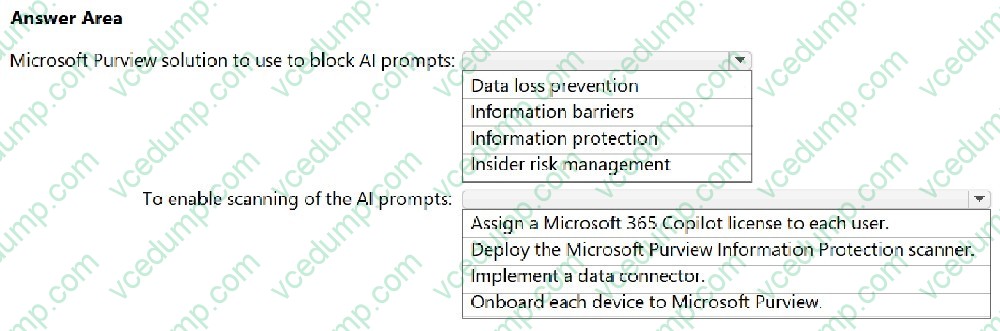
You need to recommend a solution to block AI prompts that contain confidential data and scan the AI prompts submitted to the third-party websites.
What should you recommend for each requirement? To answer, select the appropriate options in the answer area.
NOTE: Each correct selection is worth one point.
-
Question 276:
You have an Azure Kubernetes Service (AKS) cluster that hosts Linux nodes.
You need to recommend a solution to ensure that deployed worker nodes have the latest kernel updates.
The solution must minimize administrative effort.
What should you recommend?
A. The nodes must restart after the updates are applied.
B. The updates must first be applied to the image used to provision the nodes.
C. The AKS cluster version must be upgraded. -
Question 277:
HOTSPOT
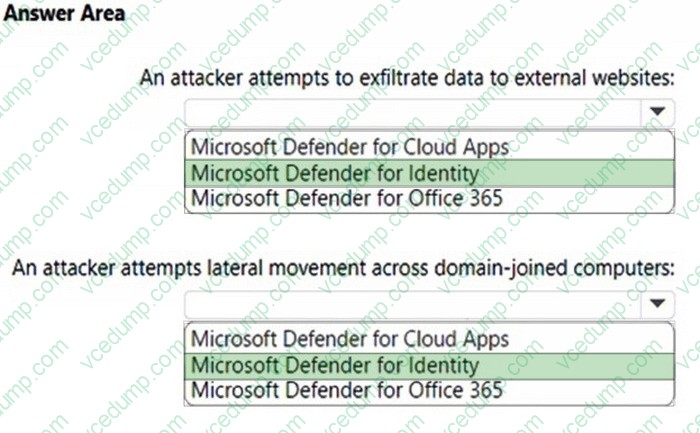
For a Microsoft cloud environment, you are designing a security architecture based on the Microsoft Cybersecurity Reference Architectures (MCRA).
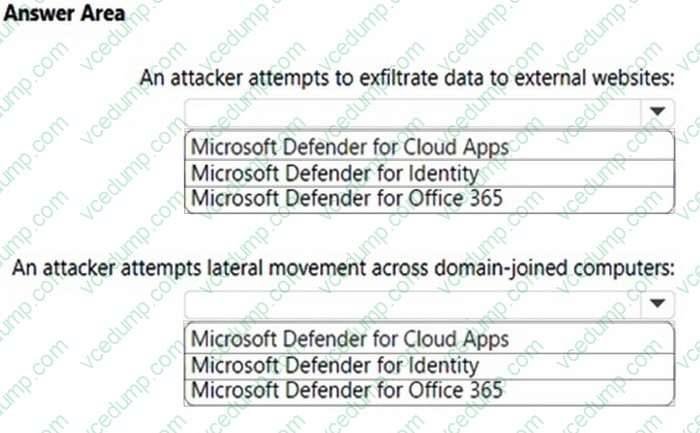
You need to protect against the following external threats of an attack chain:
1. An attacker attempts to exfiltrate data to external websites.
2. An attacker attempts lateral movement across domain-joined computers.
What should you include in the recommendation for each threat? To answer, select the appropriate options in the answer area.
NOTE: Each correct selection is worth one point.
-
Question 278:
You are designing a security operations strategy based on the Zero Trust framework.
You need to minimize the operational load on Tier 1 Microsoft Security Operations Center (SOC) analysts.
What should you do?
A. Enable built-in compliance policies in Azure Policy.
B. Enable self-healing in Microsoft 365 Defender.
C. Automate data classification.
D. Create hunting queries in Microsoft 365 Defender. -
Question 279:
Note: This question is part of a series of questions that present the same scenario. Each question in the series contains a unique solution that might meet the stated goals. Some question sets might have more than one correct solution, while others might not have a correct solution.
After you answer a question in this section, you will NOT be able to return to it. As a result, these questions will not appear in the review screen. You are designing a security strategy for providing access to Azure App Service web apps through an Azure Front Door instance.
You need to recommend a solution to ensure that the web apps only allow access through the Front Door instance.
Solution: You recommend configuring gateway-required virtual network integration.
Does this meet the goal?
A. Yes
B. No -
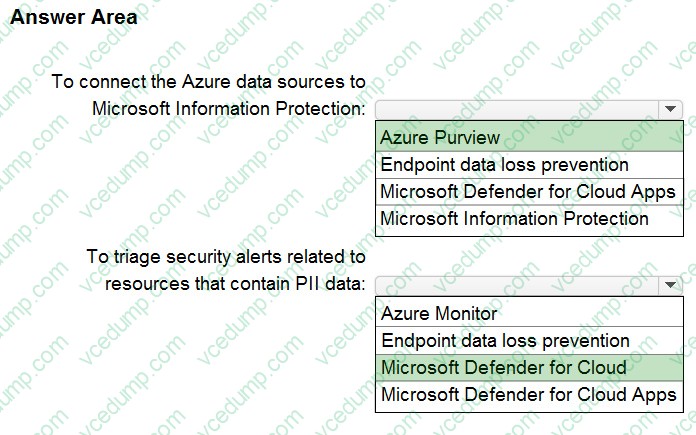
Question 280:
HOTSPOT
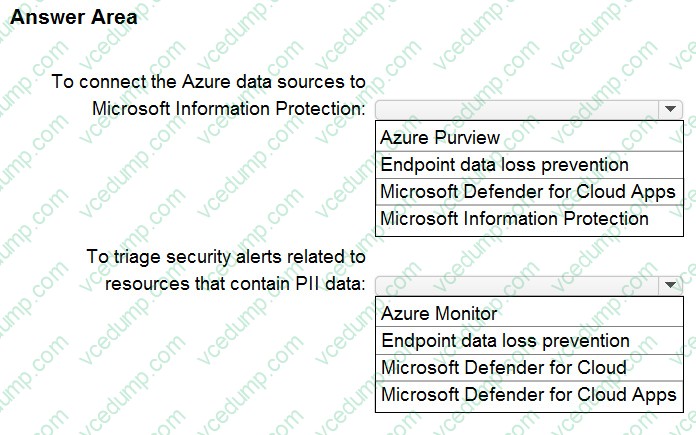
Your company is migrating data to Azure. The data contains Personally Identifiable Information (PII).
The company plans to use Microsoft Information Protection for the PII data store in Azure.
You need to recommend a solution to discover PII data at risk in the Azure resources.
What should you include in the recommendation? To answer, select the appropriate options in the answer area.
NOTE: Each correct selection is worth one point.
Related Exams:
-
62-193
Technology Literacy for Educators -
70-243
Administering and Deploying System Center 2012 Configuration Manager -
70-355
Universal Windows Platform – App Data, Services, and Coding Patterns -
77-420
Excel 2013 -
77-427
Excel 2013 Expert Part One -
77-725
Word 2016 Core Document Creation, Collaboration and Communication -
77-726
Word 2016 Expert Creating Documents for Effective Communication -
77-727
Excel 2016 Core Data Analysis, Manipulation, and Presentation -
77-728
Excel 2016 Expert: Interpreting Data for Insights -
77-731
Outlook 2016 Core Communication, Collaboration and Email Skills
Tips on How to Prepare for the Exams
Nowadays, the certification exams become more and more important and required by more and more enterprises when applying for a job. But how to prepare for the exam effectively? How to prepare for the exam in a short time with less efforts? How to get a ideal result and how to find the most reliable resources? Here on Vcedump.com, you will find all the answers. Vcedump.com provide not only Microsoft exam questions, answers and explanations but also complete assistance on your exam preparation and certification application. If you are confused on your SC-100 exam preparations and Microsoft certification application, do not hesitate to visit our Vcedump.com to find your solutions here.