S90-09A Exam Details
-
Exam Code
:S90-09A -
Exam Name
:SOA Design & Architecture Lab (S90-09A) -
Certification
:SOA Certifications -
Vendor
:SOA -
Total Questions
:40 Q&As -
Last Updated
:Jul 10, 2026
SOA S90-09A Online Questions & Answers
-
Question 31:
Service A is an entity service that provides a Get capability that returns a data value that is frequently changed.
Service Consumer A invokes Service A in order to request this data value (1). For Service A to carry out this request, it must invoke Service B (2), a utility service that interacts (3.4) with the database in which the data value is stored. Regardless of whether the data value changed, Service B returns the latest value to Service A (5), and Service A returns the latest value to Service Consumer A (6).
The data value is changed when the legacy client program updates the database (7) When this change happens is not predictable. Note also that Service A and Service B are not always available at the same time.
Any time the data value changes. Service Consumer A needs to receive it as soon as possible. Therefore, Service Consumer A initiates the message exchange shown in the Figure several times a day. When it receives the same data value as before, the response from Service A is ignored. When Service A provides an updated data value, Service Consumer A can process it to carry out its task.
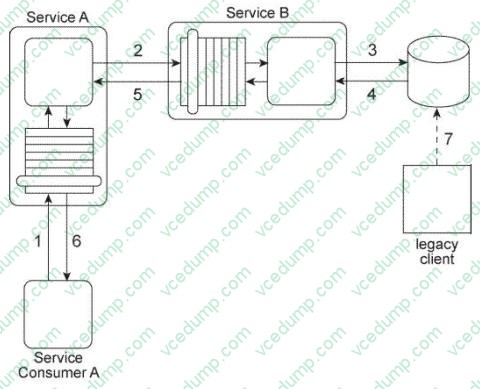
The current service composition architecture is using up too many resources due to the repeated invocation of Service A by Service Consumer A and the resulting message exchanges that occur with each invocation. What steps can be taken to solve this problem?
A. The Event-Driven Messaging pattern can be applied by establishing a subscriber- publisher relationship between Service A and Service B . This way, every time the data value is updated, an event is triggered and Service B, acting as the publisher, can notify Service A, which acts as the subscriber. The Asynchronous Queuing pattern can be applied between Service A and Service B so that the event notification message sent out by Service B will be received by Service A, even when Service A is unavailable.
B. The Event-Driven Messaging pattern can be applied by establishing a subscriber- publisher relationship between Service Consumer A and Service A . This way, every time the data value is updated, an event is triggered and Service A, acting as the publisher, can notify Service Consumer A, which acts as the subscriber. The Asynchronous Queuing pattern can be applied between Service Consumer A and Service A so that the event notification message sent out by Service A will be received by Service Consumer A, even when Service Consumer A is unavailable.
C. The Asynchronous Queuing pattern can be applied so that messaging queues are established between Service A and Service B and between Service Consumer A and Service A . This way, messages are never lost due to the unavailability of Service A or Service B.
D. None of the above. -
Question 32:
Services A, B, and C are non-agnostic task services. Service A and Service B use the same shared state database to defer their state data at runtime.
An assessment of these three services reveals that each contains some agnostic logic, but because it is bundled together with the non-agnostic logic, the agnostic logic cannot be made available for reuse.
The assessment also determines that because Service A and Service B and the shared state database are each located in physically separate environments, the remote communication required for Service A and Service B to interact with the shared state database is causing an unreasonable decrease in runtime performance.
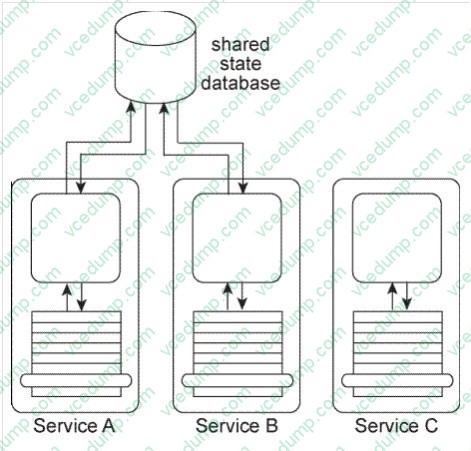
How can the application of the Orchestration pattern improve this architecture?
A. The application of the Orchestration pattern will result in an environment whereby the State Repository and Service Data Replication patterns are naturally applied, allowing the shared state database to be replicated for Services A and B so that each task service can have its own dedicated state database. The Process Centralization pattern can also be applied to Services A and B, so that their logic is physically centralized, turning them into orchestrated task services.
B. The application of the Orchestration pattern will result in an environment whereby the Process Abstraction and Process Centralization patterns are naturally applied to Services A, B, and C, resulting in a clean separation of non-agnostic task services from newly designed agnostic services with reuse potential. Also, the State Repository pattern can be applied by the availability of a central state database that can be shared by Services A and
C. This database can be made available as a local part of the environment so that Services A and B can avoid remote communication.
D. The application of the Orchestration pattern will result in an environment whereby the Compensating Service Transaction is naturally applied, resulting in the opportunity to create sophisticated exception logic that can be used to compensate for the performance problems caused by Services A and B having to remotely access the state database. The Process Abstraction and Service Broker patterns are also naturally applied, enabling the separation of non-agnostic logic and agnostic logic while providing common transformation functions required to overcome any disparity in the service contracts that will need to be created for the new agnostic services.
E. None of the above. -
Question 33:
When Service A receives a message from Service Consumer A(1),the message is processed by Component A. This component first invokes Component B (2), which uses values from the message to query Database A in order to retrieve
additional data. Component B then returns the additional data to Component A.
Component A then invokes Component C (3), which interacts with the API of a legacy system to retrieve a new data value. Component C then returns the data value back to Component A.
Next, Component A sends some of the data it has accumulated to Component D (4), which writes the data to a text file that is placed in a specific folder. Component D then waits until this file is imported into a different system via a regularly
scheduled batch import. Upon completion of the import, Component D returns a success or failure code back to Component A.
Component A finally sends a response to Service Consumer A (5) containing all of the data collected so far and Service Consumer A writes all of the data to Database B (6). Components A, B, C. and D belong to the Service A service architecture. Database A, the legacy system, and the file folders are shared resources within the IT enterprise.
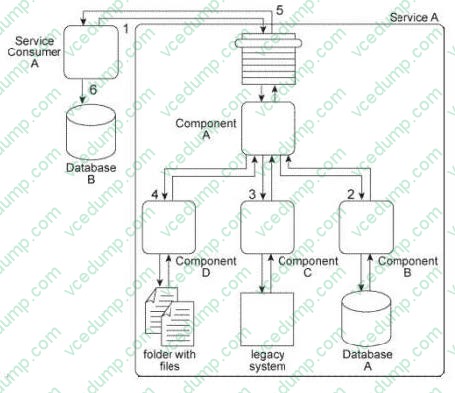
Service A is a task service that completes an entire business task on its own without having to compose other services. However, you have received many complaints about the reliability of Service A . Specifically, it has three problems. First, when Component B accesses Database A, it may not receive a response for several minutes when the database is being accessed by other applications in the IT enterprise. Secondly, the legacy system accessed by Component C frequently crashes and therefore becomes unavailable for extended periods of time. Third, for Component D to respond to Component A, it must first wait for the batch import of the files to occur. This can take several minutes during which Service Consumer A remains stateful and consumes excessive memory. What steps can be taken to address these three problems?
A. The Legacy Wrapper pattern can be applied so that Component B is separated to wrap the shared database, thereby allowing Component A to interact with this new service instead of directly interacting with the database. The Legacy Wrapper pattern can be applied again so that Component C is separated into a separate service that acts as a wrapper of the legacy system API. Component D can then be separated into a separate service and the Event-Driven Messaging pattern can be applied to establish a publisher- subscriber relationship between this new service and Component A and between Service A and Service Consumer A. The interaction between Service Consumer A and Component A is then redesigned so that Component A issues a message back to Service Consumer A when the event related to the batch import is triggered.
B. The Service Data Replication pattern can be applied so that Component B can access a replicated database instead of having to access the shared Database A directly. The Legacy Wrapper pattern can be applied so that Component C is separated into a separate service that acts as a wrapper of the legacy system API. Next, the Reliable Messaging pattern can be applied so that acknowledgements are issued from the new wrapper service to Component A, thereby enabling notifying Component A during times when the legacy system is unavailable. Finally, Component D is separated into a separate service and the Event-Driven Messaging pattern is applied to establish a publisher-subscriber relationship between this new service and Component A. The interaction between Service Consumer A and Component A is then redesigned so that Component A first interacts with Component B and the new wrapper service. Service A then issues a final message back to Service Consumer A.
C. The Service Data Replication pattern can be applied so that Component B can access a replicated database instead of having to access the shared Database A directly. The Legacy Wrapper pattern can be applied so that Component C is separated into a separate service that acts as a wrapper of the legacy system API. Next, the Asynchronous Queuing pattern can be applied so that a messaging queue is positioned between Component A and the new wrapper service, thereby enabling communication during times when the legacy system is unavailable. Finally, Component D is separated into a new service and the Event-Driven Messaging pattern is applied to establish a publisher-subscriber relationship between this service and Component A and between Service A and Service Consumer A. The interaction logic is redesigned as follows: Component A interacts with Component B, the new wrapper service, and then issues a request to the new event-driven service. Upon receiving a response triggered by the event related to the batch import, Service A responds to Service Consumer A.
D. None of the above. -
Question 34:
Service A. Service B. and Service C are each designed to access the same shared legacy system. The service contracts for Service A, Service B, and Service C are standardized and decoupled from the underlying service logic. Service A and Service B are agnostic services that are frequently reused by different service compositions. Service C is a non- agnostic task service that requires access to the legacy system in order to retrieve business rules required for the service to make runtime decisions that determine its service composition logic. The legacy system uses a proprietary file format that Services A, B, and C need to convert to and from.
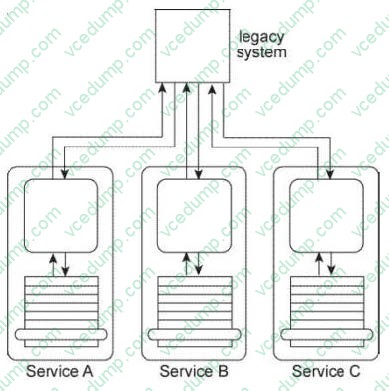
You are told that additional services need to be created, all of which need access to the legacy system. You are also told that the legacy system may be replaced in the near future. What steps can be taken to ensure that the replacement of the legacy system has a minimal impact on Services A, B, and C and any future services that are designed to rely upon it?
A. The Legacy Wrapper pattern can be applied together with the Standardized Service Contract principle to position a standardized service contract between the legacy system and any services that require access to it. This effectively establishes a new utility service dedicated to the encapsulation of the legacy system. When the legacy system is replaced, the utility service can keep its standardized service contract. To build the utility service, the Data Format Transformation pattern is applied to convert between the proprietary legacy system file format and the XML format used in the standardized service contract.
B. The Legacy Wrapper pattern can be applied together with the Official Endpoint pattern so that the Service A service contract is positioned as the sole access point for the legacy system. The Data Format Transformation pattern is applied to enable the conversion between the proprietary legacy system file format and the XML format used in the Service A service contract. Finally, the Contract Centralization pattern is applied so that Service A is forced to only access the legacy system via its published standardized service contract.
C. The Legacy Wrapper pattern can be applied together with the Data Format Transformation pattern and the Standardized Service Contract principle in order to establish an intermediate layer of standardized transformation logic that is positioned between the legacy system and Services A, B, and C. This way, if the legacy system is replaced, the services will not be affected because of the abstraction established by the standardized transformation layer.
D. None of the above. -
Question 35:
Service A is an entity service with a functional context dedicated to invoice-related processing. Service B is a utility service that provides generic data access to a database.
In this service composition architecture, Service Consumer A sends a SOAP message containing an invoice XML document to Service A(1). Service A then sends the invoice XML document to Service B (2), which then writes the invoice document to a database.
The data model used by Service Consumer A to represent the invoice document is based on XML Schema A. The service contract of Service A is designed to accept invoice documents based on XML Schema B. The service contract for Service B is designed to accept invoice documents based on XML Schema A. The database to which Service B needs to write the invoice record only accepts entire business documents in Comma Separated Value (CSV) format.
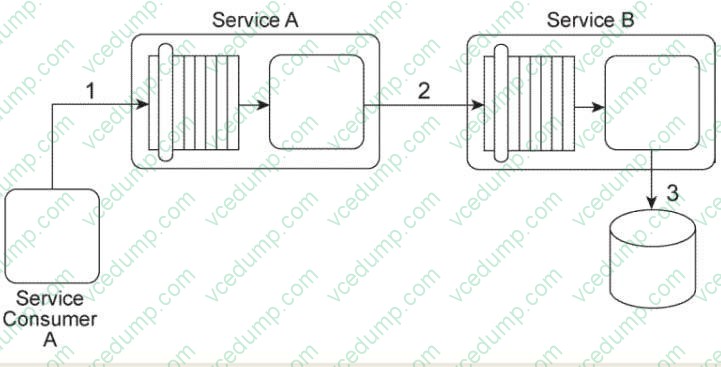
Due to the incompatibility of the XML schemas used by the services, the sending of the invoice document from Service Consumer A through to Service B cannot be accomplished using the services as they currently exist. Assuming that the Contract Centralization pattern is being applied and that the Logic Centralization is not being applied, what steps can be taken to enable the sending of the invoice document from Service Consumer A to the database without adding logic that will increase the runtime performance requirements of the service composition?
A. Service Consumer A can be redesigned to use XML Schema B so that the SOAP message it sends is compliant with the service contract of Service A . The Data Model Transformation pattern can then be applied to transform the SOAP message sent by Service A so that it conforms to the XML Schema A used by Service B. The Standardized Service Contract principle must then be applied to Service B and Service Consumer A so that the invoice XML document is optimized to avoid unnecessary validation.
B. The service composition can be redesigned so that Service Consumer A sends the invoice document directly to Service B. Because Service Consumer A and Service B use XML Schema A, the need for transformation logic is avoided. This naturally applies the Service Loose Coupling principle because Service Consumer A is not required to send the invoice document in a format that is compliant with the database used by Service B.
C. Service Consumer A can be redesigned to write the invoice document directly to the database. This reduces performance requirements by avoiding the involvement of Service A and Service B . It further supports the application of the Service Abstraction principle by ensuring that Service Consumer A hides the details of the data access logic required to write to the database.
D. None of the above. -
Question 36:
Service A is an entity service that provides a Get capability that returns a data value that is frequently changed.
Service Consumer A invokes Service A in order to request this data value (1). For Service A to carry out this request, it must invoke Service B (2), a utility service that interacts (3.4) with the database in which the data value is stored, Regardless of whether the data value changed. Service B returns the latest value to Service A (5), and Service A returns the latest value to Service Consumer A (6).
The data value is changed when the legacy client program updates the database (7). When this change happens is not predictable. Note also that Service A and Service B are not always available at the same time.
Any time the data value changes. Service Consumer A needs to receive it as soon as possible. Therefore, Service Consumer A initiates the message exchange shown in the Figure several times a day. When it receives the same data value as before, the response from Service A is ignored. When Service A provides an updated data value, Service Consumer A can process it to carry out its task.
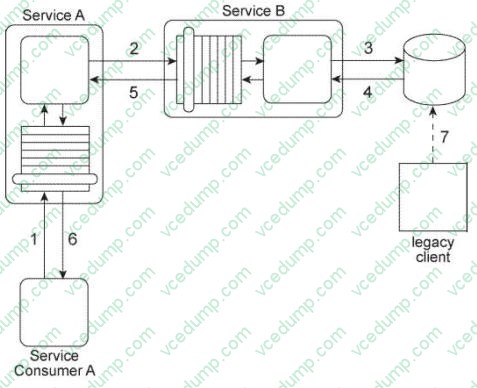
Because Service A and Service B are not always available at the same times, messages are getting lost and several invocation attempts by Service Consumer A fail. What steps can be taken to solve this problem?
A. The Asynchronous Queuing pattern can be applied so that messaging queues are established between Service A and Service B and between Service Consumer A and Service A . This way, messages are never lost due to the unavailability of Service A or Service B .
B. The Asynchronous Queuing pattern can be applied so that a messaging queue is established between Service A and Service B . This way, messages are never lost due to the unavailability of Service A or Service B . The Service Agent pattern can be further applied to establish a service agent that makes a log entry and issues a notification when re-transmission attempts by the messaging queue exceeds a pre-determined quantity.
C. The Asynchronous Queuing pattern can be applied so that a messaging queue is established between Service Consumer A and Service A. This way, messages are never lost due to the unavailability of Service A or Service B. The Service Agent pattern can be further applied to establish a service agent that makes a log entry each time a runtime exception occurs.
D. None of the above. -
Question 37:
Upon reviewing these requirements it becomes evident to you that the Orchestration compound pattern will need to be applied. However, there are additional requirements that need to be fulfilled. To build this service composition architecture, which patterns that is not associated with the Orchestration compound pattern need to also be applied? (Be sure to choose only those patterns that relate directly to the requirements described above. Patterns associated with the Orchestration compound pattern include both the required or core patterns that are part of the basic compound pattern and the optional patterns that can extend the basic compound pattern.)
A. Atomic Service Transaction
B. Compensating Service Transaction
C. Data Format Transformation
D. Data Model Transformation
E. Event-Driven Messaging
F. Intermediate Routing
G. Policy Centralization
H. Process Centralization
I. Protocol Bridging
J. Redundant Implementation -
Question 38:
The architecture for Service A displayed in the Figure shows how the core logic of Service A has expanded over time to connect to a database and a proprietary legacy system (1) and to support two separate service contracts (2) that are accessed by different service consumers.
The service contracts are fully decoupled from the service logic. The service logic is therefore coupled to the service contracts and to the underlying implementation resources (the database and the legacy system).
Service A currently has three service consumers. Service Consumer A and Service Consumer B access Service A's two service contracts (3, 4). Service Consumer C bypasses the service contracts and accesses the service logic directly (5).
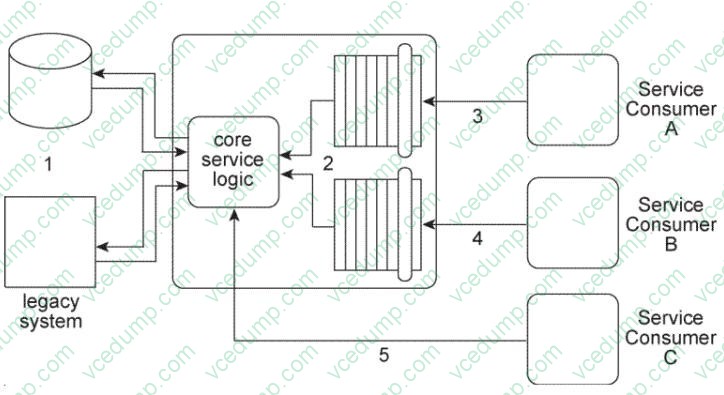
You are told that the database and legacy system that are currently being used by Service A are being replaced with different products. The two service contracts are completely decoupled from the core service logic, but there is still a concern that the introduction of the new products will cause the core service logic to behave differently than before. What steps can be taken to change the Service A architecture in preparation for the introduction of the new products so that the impact on Service Consumers A, B, and C is minimized?
A. The Service Abstraction principle can be applied to hide the implementation details from the core service logic of Service A, thereby shielding this logic from changes to the implementation. In support of this, the Service Facade pattern can be applied to position Facade components between the core service logic and Service Consumers A and B. These Facade components will be designed to regulate the behavior of Service A . The Contract Centralization pattern can be applied to force Service Consumer C to access Service A via one of its existing service contracts.
B. A third service contract can be added together with the application of the Contract Centralization pattern. This will force Service Consumer C to access Service A via the new service contract. The Service Facade pattern can be applied to position a Facade component between the new service contract and Service Consumer C in order to regulate the behavior of Service A . The Service Abstraction principle can be applied to hide the implementation details of Service A so that no future service consumers are designed to access any of Service A's underlying resources directly.
C. The Service Facade pattern can be applied to position Facade components between the core service logic and the two service contracts. These Facade components will be designed to regulate the behavior of Service A . The Contract Centralization pattern can also be applied to force Service Consumer C to access Service A via one of its existing service contracts.
D. None of the above. -
Question 39:
Service A is an entity service with a functional context dedicated to invoice-related processing. Service B is a utility service that provides generic data access to a database.
In this service composition architecture, Service Consumer A sends a SOAP message containing an invoice XML document to Service A(1). Service A then sends the invoice XML document to Service B (2), which then writes the invoice document to a database.
The data model used by Service Consumer A to represent the invoice document is based on XML Schema A. The service contract of Service A is designed to accept invoice documents based on XML Schema B. The service contract for Service B is designed to accept invoice documents based on XML Schema A. The database to which Service B needs to write the invoice record only accepts entire business documents in Comma Separated Value (CSV) format.
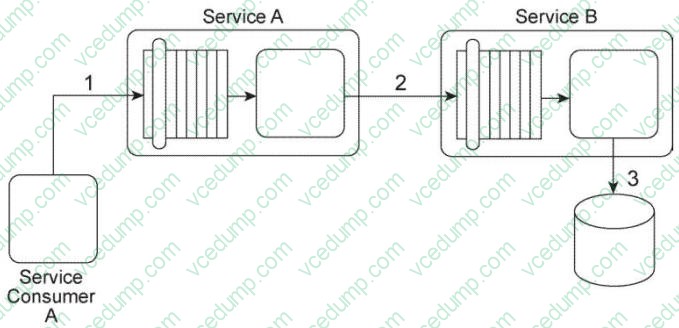
Due to the incompatibility of XML schemas used by the services, the sending of the invoice document from Service Consumer A through to Service B cannot be accomplished using the services as they currently exist. Assuming that the Contract Centralization and Logic Centralization patterns are being applied, what steps can be taken to enable the sending of the invoice document from Service Consumer A to the database without adding logic that will increase the runtime performance of the service composition?
A. The Data Model Transformation pattern can be applied so that the invoice document sent by Service Consumer A is transformed into an invoice document that is compliant with the XML Schema B used by Service A . The Data Model Transformation pattern can be applied again to ensure that the invoice document sent by Service A is compliant with XML Schema A used by Service B.
B. The service composition can be redesigned so that Service Consumer A sends the invoice document directly to Service B. Because Service Consumer A and Service B use XML Schema A, the need for transformation logic is avoided. This naturally applies the Service Loose Coupling principle because Service Consumer A is not required to send the invoice document in a format that is compliant with the database used by Service B.
C. The Standardized Service Contract principle can be applied to the service contract of Service A so that it is redesigned to use XML Schema A. This would make it capable of receiving the invoice document from Service Consumer A and sending the invoice document to Service B without the need to further apply the Data Model Transformation pattern.
D. None of the above. -
Question 40:
Service Consumer A sends Service A a message containing a business document (1). The business document is received by Component A, which keeps the business document in memory and forwards a copy to Component B (3). Component B first writes portions of the business document to Database A (4).
Component B writes the entire business document to Database B and then uses some of the data values from the business document as query parameters to retrieve new data from Database B (5).
Next, Component B returns the new data back to Component A (6), which merges it together with the original business document it has been keeping in memory and then writes the combined data to Database C (7). The Service A service capability invoked by Service Consumer A requires a synchronous request-response data exchange. Therefore, based on the outcome of the last database update, Service A returns a message with a success or failure code back to Service Consumer A (8).
Databases A and B are shared and Database C is dedicated to the Service A service architecture.
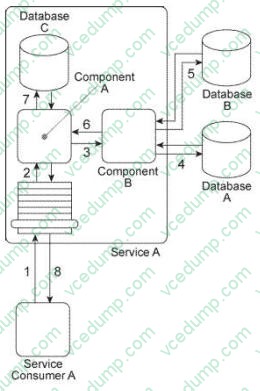
There are several problems with this architecture: First, the response time of Database A is often poor, resulting in Component B taking too much time to provide a response to Component A. This results in Component A consuming too many runtime resources while it holds the business document in memory and it also causes unreasonable delays in responding to Service Consumer A. Additionally, Database B is being replaced with a different database product that supports a proprietary file format. This will disable the current interaction between Component B and the new Database B. What steps can be taken to solve these problems?
A. The State Repository pattern is applied so that Component A can defer the business document data to a state database while it waits for a response from Component B. The Service Data Replication pattern is applied so that Component B can interact with a database that is replicated from the shared Database A. This will improve performance and reliability that will affect both Component A and Service Consumer A. Finally, the Legacy Wrapper pattern is applied so that Database B is wrapped in a standardized contract. This will establish a new wrapper utility service that will allow Database B to be replaced with a different database product without affecting Service A . Furthermore, the Data Format Transformation pattern can be applied within the new wrapper utility service to enable it to convert to and from the new proprietary file format.
B. The State Repository pattern is applied so that Component A can defer the business document data to a state database while it waits for a response from Component B. The Asynchronous Queuing pattern can be applied so that a messaging queue is established between Service Consumer A and Service A, thereby guaranteeing delivery and avoiding Service Consumer A from being tied up too long waiting for Service A to respond. Finally, the Data Format Transformation pattern can be applied to enable Component B to convert to and from the new proprietary file format introduced by the database product that is replacing Database B.
C. The Legacy Wrapper pattern is applied so that Database B is wrapped in a standardized contract. This will establish a new wrapper utility service that will allow Database B to be replaced with a different database product without affecting Service A . The Data Format Transformation pattern can be applied within the new wrapper utility service to enable it to convert to and from the new proprietary file format. The Service Data Replication pattern is applied so that Component B can interact with a database that is replicated from the shared Database B, regardless of what database product is used to replace Database B. The Service Abstraction principle can be further applied to hide the implementation details, including the changes mentioned in this solution, from Service Consumer A.
D. None of the above.
Related Exams:
-
S90-01A
Fundamental SOA & Service-Oriented Computing (S90-01A) -
S90-02A
SOA Technology Concepts (S90-02A) -
S90-03A
SOA Design & Architecture (S90-03A) -
S90-08A
Advanced SOA Design & Architecture (S90-08A) -
S90-09A
SOA Design & Architecture Lab (S90-09A) -
S90.08B
SOA Design & Architecture Lab with Services & Microservices
Tips on How to Prepare for the Exams
Nowadays, the certification exams become more and more important and required by more and more enterprises when applying for a job. But how to prepare for the exam effectively? How to prepare for the exam in a short time with less efforts? How to get a ideal result and how to find the most reliable resources? Here on Vcedump.com, you will find all the answers. Vcedump.com provide not only SOA exam questions, answers and explanations but also complete assistance on your exam preparation and certification application. If you are confused on your S90-09A exam preparations and SOA certification application, do not hesitate to visit our Vcedump.com to find your solutions here.