S90-09A Exam Details
-
Exam Code
:S90-09A -
Exam Name
:SOA Design & Architecture Lab (S90-09A) -
Certification
:SOA Certifications -
Vendor
:SOA -
Total Questions
:40 Q&As -
Last Updated
:Jul 10, 2026
SOA S90-09A Online Questions & Answers
-
Question 11:
Our service inventory contains the following three services that provide invoice-related data access capabilities: Invoice, InvProc, and Proclnv. These services were created at different times by different project teams and were not required to comply to any design standards. Therefore each of these services has a different data model for representing invoice data.
Currently each of these three services has one service consumer: Service Consumer A accesses the Invoice service(1). Service Consumer B (2) accesses the InvProc service, and Service Consumer C (3) accesses the Proclnv service. Each service consumer invokes a data access capability of an invoice-related service, requiring that service to interact with the shared accounting database that is used by all invoice-related services (4, 5, 6).
Additionally, Service Consumer D was designed to access invoice data from the shared accounting database directly (7). (Within the context of this architecture. Service Consumer D is labeled as a service consumer because it is accessing a resource that is related to the illustrated service architectures.)
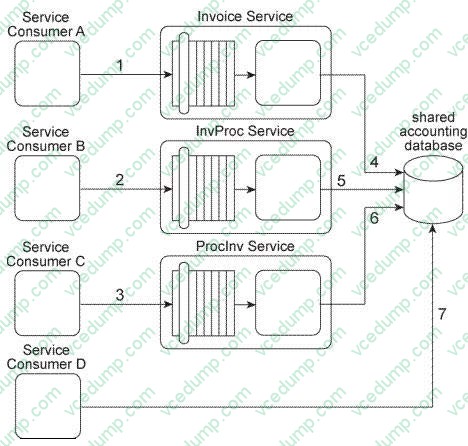
A project team recently proclaimed that it has successfully applied the Contract Centralization pattern to the service inventory in which the Invoice service, InvProc service, and ProcInv service reside. Upon reviewing the previously described architecture you have doubts that this is true. After voicing your doubts to a manager, you are asked to provide specific evidence as to why the Contract Centralization is not currently fully applied. Which of the following statements provides this evidence?
A. The Contract Centralization pattern is not fully applied to the Invoice, InvProc, and ProcInv services because they are being accessed by different service consumers and because they have redundant logic that introduces denormalization into the service inventory.
B. The Contract Centralization pattern is not fully applied because Service Consumer D is accessing the shared accounting database directly.
C. The Contract Centralization pattern is not fully applied because none of the invoice- related services are carrying out data access logic via a centralized and standardized invoice service. This is primarily because the Standardized Service Contract principle was not consistently applied during the delivery processes of the individual services.
D. None of the above. -
Question 12:
Service Consumer A sends a message to Service A. There are currently three duplicate implementations of Service A (Implementation 1, Implementation 2, Implementation 3). The message sent by Service Consumer A is intercepted by Service Agent A (1), which determines at runtime which implementation of Service A to forward the message to. All three implementations of Service A reside on the same physical server.
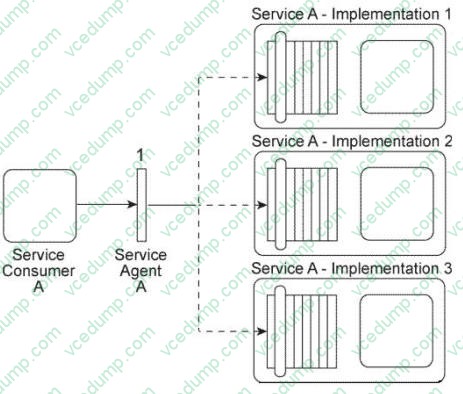
You are told that despite the fact that duplicate implementations of Service A exist, performance is still poor at times. Also, you are informed that a new service capability will soon need to be added to Service A that will introduce functionality that will require access to a shared database that is used by many other clients and applications in the IT enterprise. This is expected to add further performance demands on Service A . How can this service architecture be changed to improve performance in preparation for the addition of the new service capability?
A. The Standardized Service Contract principle is applied to ensure that the new service capability extends the existing service contract in a manner that is compliant with current design standards. The Redundant Implementation pattern is applied to establish separate implementations of Service A that include duplicate databases with copies of the data that Service A requires from the shared database.
B. The Service Autonomy principle is applied to further isolate the individual implementations of Service A by separating them onto different physical servers. When the new service capability is added, the Service Data Replication pattern is applied to give each implementation of Service A its own copy of the data it requires from the shared database.
C. The Service Loose Coupling principle is applied together with the Standardized Service Contract principle to ensure that Service Consumer A is not indirectly coupled to the shared database after the new service capability is added to the service contract. The Legacy Wrapper pattern can be applied to establish a new utility service that will provide standardized data access service capabilities for the shared database.
D. None of the above. -
Question 13:
Service Consumer A sends a message to Service A. Before the message arrives with Service A, it is intercepted by Service Agent A (1). which checks the message for compliance to Policy A that is required by Service A. If the message fails compliance, Service Agent A will not allow it to proceed and will instead write the message contents to a log. If the message does comply to the policy, it continues to be transmitted toward Service A, but before it arrives it is intercepted by Service Agent B (2), which validates the security credentials in the message header. If the security credential validation fails, the message is rejected and a runtime exception is raised. If the security credentials are validated, the message is sent to Service A.
Upon receiving the message, Service A retrieves a data value from a database and populates the message header with this data value (3) prior to forwarding the message to Service B. Before the message arrives at Service B. it is intercepted by Service Agent C (4) which checks the message for compliance with two policies: Policy B and Policy C. Policy B is identical to Policy A that was checked by Service Agent A. To check for compliance to Policy C. Service Agent C uses the data value added by Service A. If the message complies with both of the policies, it is forwarded to Service B (5), which stores the message contents in its own database.
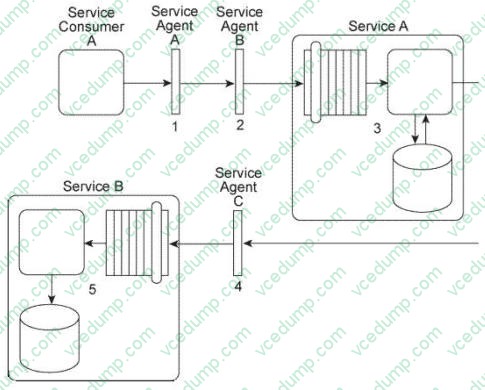
You are told that Policy B and Policy C have changed. Also, in order to carry out the compliance check of Policy C, Service Agent C will now require a new data value from the Service B database. How can this service composition architecture be changed to fulfill these new requirements?
A. The Policy Centralization pattern can be applied so that only one service agent is used to enforce Policy A and Policy B. Service A is redesigned to first query Service B for the value required by Service Agent C to check the compliance of the updated Policy C. If the compliance check is successful, the message is sent to Service B .
B. The Policy Centralization pattern can be applied so that only one service agent is used to enforce Policy A and Policy B. Service Consumer A is redesigned to first query Service B for the value required by Service Agent C. This way, Service Consumer A can include this value in the message header prior to sending the message to Service A .
C. The Policy Centralization pattern can be applied so that only one service agent is used to enforce Policy A and Policy B. The policy enforcement logic for Policy C is removed from Service Agent C and instead embedded within the logic of Service B . This way, Service B can itself retrieve the value required to check compliance with Policy C. If the message received is not in compliance, Service B will reject it.
D. None of the above. -
Question 14:
Service A is a task service that is required to carry out a series of updates to a set of databases in order to complete a task. To perform the database updates Service A must interact with three other services, each of which provides standardized data access capabilities.
Service A sends its first update request message to Service B (1), which then responds with a message containing a success or failure code (2). Service A then sends its second update request message to Service C (3), which also responds with a message containing a success or failure code (4). Finally, Service A sends a request message to Service D (5), which responds with its own message containing a success or failure code (6).
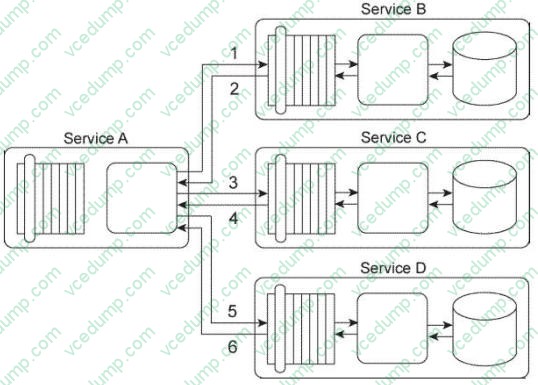
You've been asked to change this service composition architecture in order to fulfill a set of new requirements: First, if the database update performed by Service B fails, then it must be logged by Service A. Secondly, if the database update performed by Service C fails, then a notification e-mail must be sent out to a human administrator. Third, if the database update performed by either Service C or Service D fails, then both of these updates must be reversed so that the respective databases are restored back to their original states. What steps can be taken to fulfill these requirements?
A. Service A is updated to perform a logging routine when Service A receives a response message from Service B containing a failure code. Service A is further updated to send an e-mail notification to a human administrator if Service A receives a response message from Service C containing a failure code. The Atomic Service Transaction pattern is applied so that Services A, C, and D are encompassed in the scope of a transaction that will guarantee that if the database updates performed by either Service C or Service D fails, then both updates will be rolled back.
B. The Compensating Service Transaction pattern is applied to Service B so that it invokes exception handling logic that logs failed database updates before responding with a failure code back to Service A . Similarly, the Compensating Service Transaction pattern is applied to Service C so that it issues an e-mail notification to a human administrator when a database update fails. The Atomic Service Transaction pattern is applied so that Services A, C, and D are encompassed in the scope of a transaction that will guarantee that if the database updates performed by either Service C or Service D fails, then both updates will be rolled back. The Service Autonomy principle is further applied to Service A to ensure that it remains consistently available to carry out this sequence of actions.
C. The Atomic Service Transaction pattern is applied so that Services A, C, and D are encompassed in the scope of a transaction that will guarantee that if the database updates performed by either Service C or Service D fails, then both updates will be rolled back. The Compensating Service Transaction pattern is then applied to all services so that the scope of the compensating transaction includes the scope of the atomic transaction. The compensating exception logic that is added to Service D automatically invokes Service B to log the failure condition and Service C to issue the e-mail notification to the human administrator. This way, it is guaranteed that the compensating logic is always executed together with the atomic transaction logic.
D. None of the above. -
Question 15:
Service A is an orchestrated task service that is invoked by a separate composition initiator (1) and then sends a request message to Service C (2). Service C queries Database B to retrieve a large data record (3) and provides this data in a response message that is sent back to Service A. Service A temporarily stores this data in a central state database (4) and then sends a request message to Service D (5), which accesses a legacy system API to retrieve a data value (6). Service D then sends this data value in a response message back to Service A. The data in the state database is subsequently retrieved by Service A (7) and merged with the newly received data value. This combined data is written to Database A (8), which triggers an event that results in the invocation of Service B (9).
Service B is an orchestrated task service that sends a request message to Service D (10). which accesses a legacy system API to retrieve a data value (11) and then sends this data value in a response message back to Service B. Service B temporarily stores this data in a central state database (12) and then sends a request message to Service E (13), which performs a runtime calculation and then responds with the calculated data value back to Service B. The data in the state database is then retrieved by Service B (14) and merged with the calculated data value. Service B then uses the merged data to complete its business task.
The following specific problems and requirements exist:
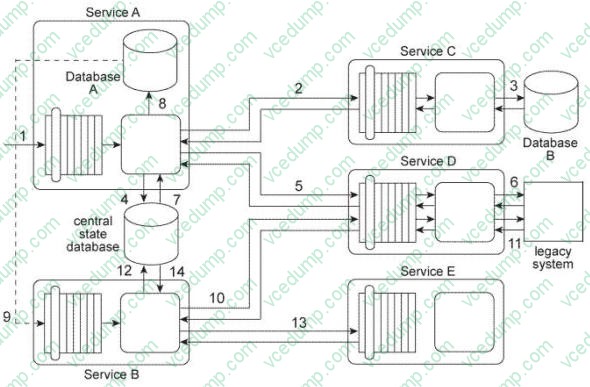
Upon reviewing these requirements it becomes evident to you that the Enterprise Service Bus compound pattern will need to be applied. However, there are additional requirements that need to be fulfilled. To build this service composition architecture, which patterns that is not associated with the Enterprise Service Bus compound pattern need to also be applied? (Be sure to choose only those patterns that relate directly to the requirements described above. Patterns associated with the Enterprise Service Bus compound pattern include both the required or core patterns that are part of the basic compound pattern and the optional patterns that can extend the basic compound pattern.)
A. Atomic Service Transaction
B. Compensating Service Transaction
C. Data Format Transformation
D. Data Model Transformation
E. Event-Driven Messaging
F. Intermediate Routing
G. Policy Centralization
H. Process Centralization
I. Protocol Bridging
J. Redundant Implementation -
Question 16:
Service Consumer A sends a message to Service A (1), which then forwards the message to Service B (2). Service B forwards the message to Service C (3), which finally forwards the message to Service D (4).
Services A, B, and C each contain logic that reads the content of the message and, based on this content, determines which service to forward the message to. As a result, what is shown in the Figure is one of several possible runtime scenarios.
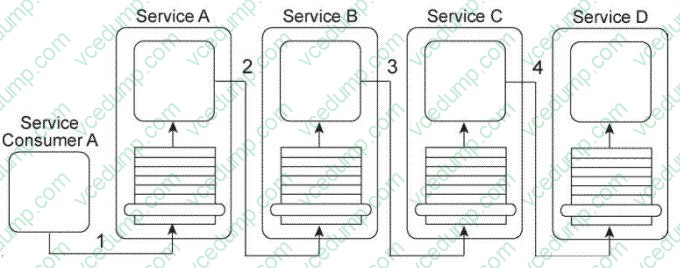
You are told that the current service composition architecture is having performance problems because of two specific reasons. First, too many services need to be explicitly invoked in order for the message to arrive at its destination. Secondly, because each of the intermediary services is required to read the entire message contents in order to determine where to forward the message to, it is taking too long for the overall task to complete. What steps can be taken to solve these problems without sacrificing any of the functionality that currently exists?
A. The Intermediate Routing pattern can be applied together with the Service Agent pattern in order to establish a set of service agents capable of intercepting and forwarding the message based on pre-defined routing logic. To avoid the need for service agents to read the entire message contents, the Messaging Metadata pattern can be applied so that content relevant to the routing logic is placed in the header of a message. This way, only the message header content needs to be read by the service agents.
B. The Intermediate Routing pattern can be applied together with the Service Agent pattern in order to establish a set of service agents capable of intercepting and forwarding the message based on pre-defined routing logic. To avoid the need for service agents to read the entire message contents, the Rules Centralization pattern can be applied so that content relevant to the routing logic is isolated into a separate Rules service. This way, service agents are only required to access the Rules service in order to determine where to forward messages to. The Standardized Service Contract principle will need to be applied to ensure that the new Rules service and the new service agents provide service contracts that are compliant to existing design standards.
C. The Intermediate Routing pattern can be applied together with the Service Agent pattern in order to establish a set of service agents capable of intercepting and forwarding the message based on pre-defined routing logic. The Service Discoverability principle can be applied to improve the communications quality of message contents, which will reduce the time required by service agents to read the message contents at runtime.
D. None of the above. -
Question 17:
Service A. Service B. and Service C are each designed to access the same shared legacy system. The service contracts for Service A, Service B, and Service C are standardized and decoupled from the underlying service logic. Service A and Service B are agnostic services that are frequently reused by different service compositions. Service C is a non- agnostic task service that requires access to the legacy system in order to retrieve business rules required for the service to make runtime decisions that determine its service composition logic. The legacy system uses a proprietary file format that Services A, B, and C need to convert to and from.
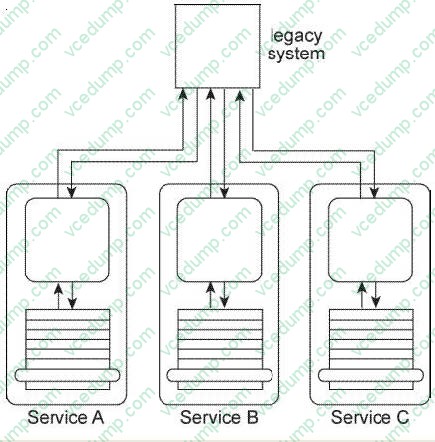
Service A is an agnostic utility service that is used by other services to gain access to the legacy system. Services B and C were not designed to access the legacy system via Service A because the Service A service contract was derived from the legacy system API and is therefore not standardized and exhibits negative contract-to-implementation coupling. You are told that additional services need to be created, all of which need access to the legacy system. You are also told that the legacy system may be replaced in the near future. What steps can be taken to ensure that the replacement of the legacy system has a minimal impact on Services B and C and any future services that are designed to rely upon it?
A. The Service Abstraction, Service Reusability, and Service Autonomy principles need to be applied in order to support the application of the Official Endpoint pattern to Service A . This would position Service A as the official utility service through which the legacy system can be accessed. Service B will need to be redesigned to access Service A instead of accessing the legacy system directly. Due to the dependency on business rules embedded within the legacy system the option of applying the Rules Centralization pattern is not available. Service C will therefore need to continue accessing the legacy system directly.
B. The Standardized Service Contract and Service Loose Coupling principles can be applied in order to establish a standardized service contract for Service A that will eliminate its negative contract coupling. Service B will need to be redesigned to access Service A instead of accessing the legacy system directly. Due to the dependency on business rules embedded within the legacy system the option of applying the Rules Centralization pattern is not available. Service C will therefore need to continue accessing the legacy system directly.
C. The Legacy Wrapper pattern can be applied together with the Standardized Service Contract principle in order to establish a standardized service contract for Service A that will eliminate its negative contract coupling. The Official Endpoint pattern can then be applied to position Service A as the official utility service through which the legacy system can be accessed. Services B and C will need to be redesigned to access Service A instead of accessing the legacy system directly.
D. None of the above. -
Question 18:
Service Consumer A sends Service A a message containing a business document (1). The business document is received by Component A, which keeps the business document in memory and forwards a copy to Component B (3). Component B first writes portions of the business document to Database A (4).
Component B writes the entire business document to Database B and then uses some of the data values from the business document as query parameters to retrieve new data from Database B (5).
Next, Component B returns the new data back to Component A (6), which merges it together with the original business document it has been keeping in memory and then writes the combined data to Database C (7). The Service A service capability invoked by Service Consumer A requires a synchronous request-response data exchange. Therefore, based on the outcome of the last database update, Service A returns a message with a success or failure code back to Service Consumer A (8).
Databases A and B are shared and Database C is dedicated to the Service A service architecture.
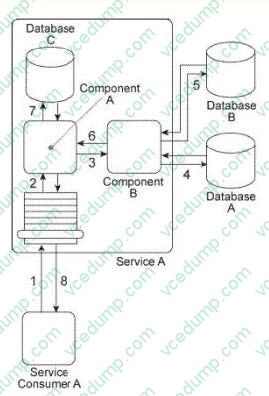
There are several problems with this architecture: The business document that Component A is required to keep in memory (while it waits for Component B to complete its processing) can be very large. Especially when Service A is concurrently invoked by multiple service consumers, the amount of runtime resources it uses to keep this data in memory can decrease the overall performance of all service instances. Additionally, because Database A is a shared database that sometimes takes a long time to respond to Component B, Service A can take a long time to respond back to Service Consumer A . Currently, Service Consumer A will wait for a response for up to 30 seconds after which it will assume the request to Service A has failed and any subsequent response messages from Service A will be rejected. What steps can be taken to solve these problems?
A. The Service Statelessness principle can be applied together with the State Repository pattern in order to extend Database C so that it also becomes a state database allowing Component A to temporarily defer the business document data while it waits for a response from Component B. The Service Autonomy principle is applied together with the Legacy Wrapper pattern to isolate Database A so that it is encapsulated by a separate wrapper utility service. The Compensating Service Transaction pattern is applied so that if the response time of Service A exceeds 30 seconds, a notification is sent to a human administrator to raise awareness of the fact that the eventual response of Service A will be rejected by Service Consumer A.
B. The Service Autonomy principle can be applied together with Service Abstraction principle, the Legacy Wrapper pattern, and the Service Facade pattern in order to isolate Database A so that it is encapsulated by a separate wrapper utility service and to hide the Database A implementation from Service A and to position a Facade component between Component B and the new wrapper service. This Facade component will be responsible for compensating the unpredictable behavior of Database A.
C. The Asynchronous Queuing pattern can be applied to establish a messaging queue between Service Consumer A and Service A so that Service Consumer A does not need to remain stateful while it waits for a response from Service A .
D. The Service Statelessness principle can be applied together with the State Repository pattern in order to establish a state database that Component A can defer the business document data to while it waits for a response from Component
E. None of the above. -
Question 19:
Services A, B, and C are non-agnostic task services. Service A and Service B use the same shared state database to defer their state data at runtime.
An assessment of these three services reveals that each contains some agnostic logic, but because it is bundled together with the non-agnostic logic, the agnostic logic cannot be made available for reuse.
The assessment also determines that because Service A and Service B and the shared state database are each located in physically separate environments, the remote communication required for Service A and Service B to interact with the shared state database is causing an unreasonable decrease in runtime performance.
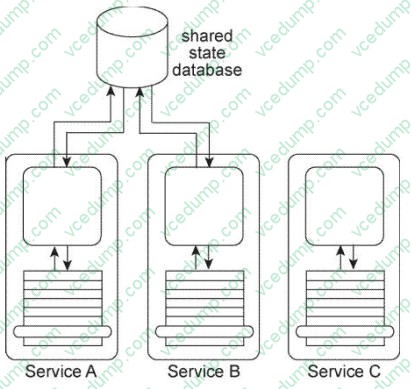
You are asked to redesign this architecture in order to increase the opportunity for agnostic service logic to be reused and in order to decrease the runtime processing demands so that performance can be improved. What steps can be taken to achieve these goals?
A. The Enterprise Service Bus pattern can be applied to establish an environment whereby the Process Abstraction and Process Centralization patterns are naturally applied, resulting in a clean separation of non-agnostic task services from newly designed agnostic services that are further shaped into reusable services by the application of the Service Reusability principle.
B. The Process Centralization pattern can be applied, resulting in a redesign effort where agnostic logic is removed from the three task services so that they only encapsulate non- agnostic logic. The agnostic logic is then moved to one or more new agnostic services that are shaped into reusable services by the application of the Service Reusability principle. The Process Abstraction pattern is then applied to the redesigned task services Service A and Service B, so that their logic is physically centralized, turning them into orchestrated task services.
C. The Process Abstraction pattern can be applied, resulting in a redesign effort where agnostic logic is removed from the three task services so that they only encapsulate non- agnostic logic. The agnostic logic is then moved to one or more new agnostic services that are shaped into reusable services by the application of the Service Reusability principle. The Orchestration pattern can be further applied to establish an environment whereby the Process Centralization pattern is naturally applied to Services A and B and the State Repository pattern in naturally applied to further help avoid remote communication by providing a local and centralized state database that can be shared by both services.
D. None of the above. -
Question 20:
Service A is a utility service that provides generic data access logic to a database that contains data that is periodically replicated from a shared database (1). Because the Standardized Service Contract principle was applied to the design of Service A, its service contract has been fully standardized.
The service architecture of Service A is being accessed by three service consumers. Service Consumer A accesses a component that is part of the Service A implementation by invoking it directly (2). Service Consumer B invokes Service A by accessing its service contract (3). Service Consumer C directly accesses the replicated database that is part of the Service A implementation (4).
You've been told that the shared database will soon be replaced with a new database product that will have new data models and new replication technology. How can the Service A architecture be changed to avoid negative impacts that may result from the replacement of the database and to establish a service architecture in which negative forms of coupling can be avoided in the future?
A. The Contract Centralization pattern can be applied to force all service consumers to access the Service A architecture via its published service contract. This will prevent negative forms of coupling that could lead to problems when the database is replaced. The Service Abstraction principle can then be applied to hide underlying service implementation details so that future service consumers cannot be designed to access any part of the underlying service implementation.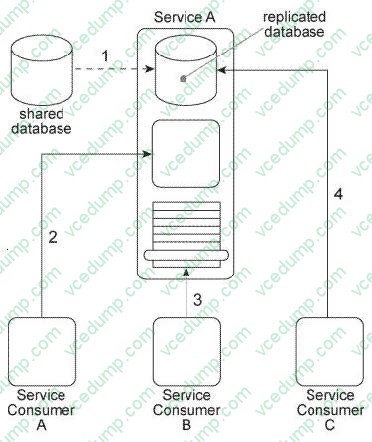
B. The Contract Centralization pattern can be applied to force Service Consumer C to access the Service A architecture via its published service contract. This will prevent Service Consumer A from being negatively impacted when the database is replaced in the future.
C. The Standardized Service Contract principle can be applied to force Service Consumer B to comply to the standardized service contract of Service A. As a result, the coupling between Service Consumer B and Service A is reduced. The Logic Centralization pattern can then be applied to position the logic provided by Service A as a primary access point for the database. As a result, the component within the Service A architecture abstracts the proprietary details of the database, thereby shielding Service Consumer A (and any future service consumers) from changes made to the database.
D. None of the above.
Related Exams:
-
S90-01A
Fundamental SOA & Service-Oriented Computing (S90-01A) -
S90-02A
SOA Technology Concepts (S90-02A) -
S90-03A
SOA Design & Architecture (S90-03A) -
S90-08A
Advanced SOA Design & Architecture (S90-08A) -
S90-09A
SOA Design & Architecture Lab (S90-09A) -
S90.08B
SOA Design & Architecture Lab with Services & Microservices
Tips on How to Prepare for the Exams
Nowadays, the certification exams become more and more important and required by more and more enterprises when applying for a job. But how to prepare for the exam effectively? How to prepare for the exam in a short time with less efforts? How to get a ideal result and how to find the most reliable resources? Here on Vcedump.com, you will find all the answers. Vcedump.com provide not only SOA exam questions, answers and explanations but also complete assistance on your exam preparation and certification application. If you are confused on your S90-09A exam preparations and SOA certification application, do not hesitate to visit our Vcedump.com to find your solutions here.