PW0-104 Exam Details
-
Exam Code
:PW0-104 -
Exam Name
:Wireless LAN Administration Exam -
Certification
:CWNP Certifications -
Vendor
:CWNP -
Total Questions
:125 Q&As -
Last Updated
:Dec 08, 2021
CWNP PW0-104 Online Questions & Answers
-
Question 31:
When a client station sends a broadcast probe request frame with a wildcard SSID, how do APs respond?
A. After waiting a SIFS, all APs reply at the same time with a probe response.
B. After waiting a SIFS, a designated AP sends an ACK, and then replies with a probe response.
C. Each AP sends its own ACK, and then follows the ACK with a probe response.
D. For each probe request frame, only one AP may reply with a probe response.
E. Each AP responds in turn after preparing a probe response and winning contention. -
Question 32:
What statements describe industry practices for communication protocols between WLAN controllers and controller-based APs? (Choose two)
A. All vendors use the same protocol so that APs will interoperate with WLAN controllers from other vendors.
B. Some vendors use proprietary protocols, and some vendors use protocols based on public standards like RFCs.
C. For most vendors, the controller-based APs maintain data and control tunnels with at least two controllers for immediate failover and redundancy.
D. All vendors support at least one L2 or L3 broadcast protocol for controller discovery by controller- based APs.
E. All vendors recommend using L2 (instead of L3) controller discovery and tunneling protocols in large enterprises. -
Question 33:
In an infrastructure Basic Service Set (BSS), how does the passive scanning process occur?
A. Access points broadcast Beacons on all channels of each radio within the regulatory domain. Nearby client stations record information found in the Beacons for use in the association process.
B. Client stations broadcast Probe Request frames on all supported channels in the regulatory domain. Nearby access points respond with Probe Response frames. Client stations record information in the Probe Response frames for use in the association process.
C. Client stations broadcast Probe Request frames on the single channel for which they are programmed. Nearby access points respond on that channel with Probe Response frames. Clientstations record information found in the Probe Response frames for use in the association process.
D. Access points broadcast Beacons on a single channel for which it is programmed. Nearby client stations listen for Beacon frames and record information found in the Beacons for use in the association process. -
Question 34:
ABC Company has thousands of Wi-Fi users accessing their network on a daily basis. Their WLAN consists of 700 access points, 6 WLAN controllers, and a wireless network management system. What network functions are performed by the enterprise-class WNMS? (Choose three)
A. RF pre-deployment planning and post-deployment reporting of access point locations on a floor plan
B. Performance and security monitoring of WLAN controllers with alarms and notifications for administrative staff
C. Radio management, fast roaming, key caching, and other centralized control plane operations
D. Centralized bridging of guest data traffic and application of firewall and QoS policies to data
E. Management of WLAN controller configuration and provisioning of firmware updates
F. Generating, encrypting, and decrypting 802.11 frames and collecting RF radio data. -
Question 35:
In a long-distance RF link, what statement about Fade Margin is true?
A. Fade Margin is an additional pad of signal strength designed into the RF system to compensate for unpredictable signal fading.
B. The Fade Margin of a long-distance radio link should be equivalent to the receiver's antenna gain.
C. A Fade Margin is unnecessary on a long-distance RF link if more than 80% of the first Fresnel zone is clear of obstructions.
D. The Fade Margin is a measurement of signal loss through free space, and is a function of frequency and distance. -
Question 36:
Given:
Network users and IT personnel at a large machinery manufacturer have been discussing the potential uses and benefits of implementing an indoor WLAN. The network administrator and network manager have requested a meeting of senior
management personnel to discuss a WLAN implementation before taking any site survey or implementation steps. The first order of discussion in the meeting is corporate policy concerning implementation and use of WLAN technology.
What specific topics are appropriate in this policy meeting? (Choose two)
A. Vendor hardware recommendations
B. Business justification
C. User productivity impact
D. Antenna types
E. Obtaining permits and zoning requirements -
Question 37:
What type of RF transmitter is shown in both of the spectrum analysis exhibits?
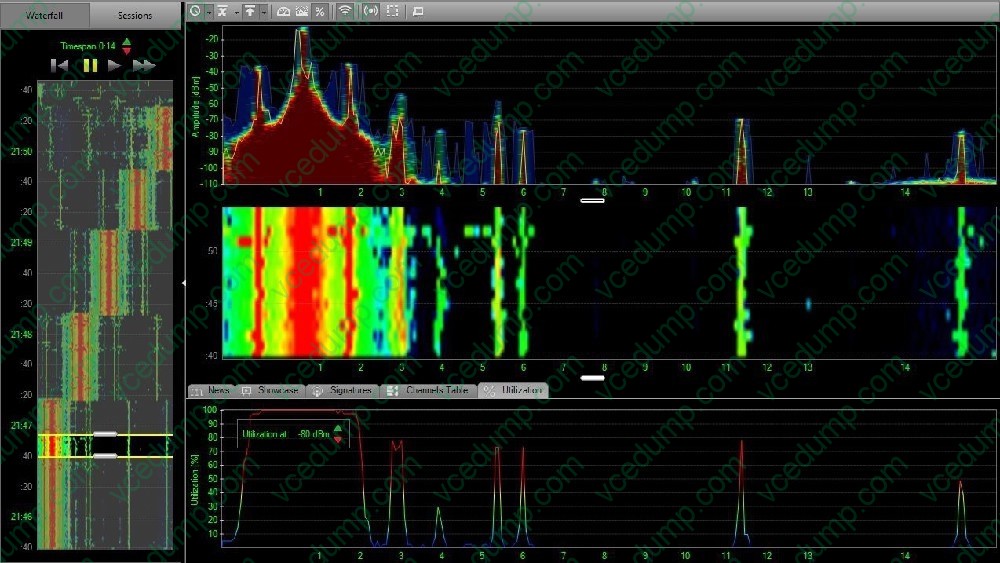
A. Military radar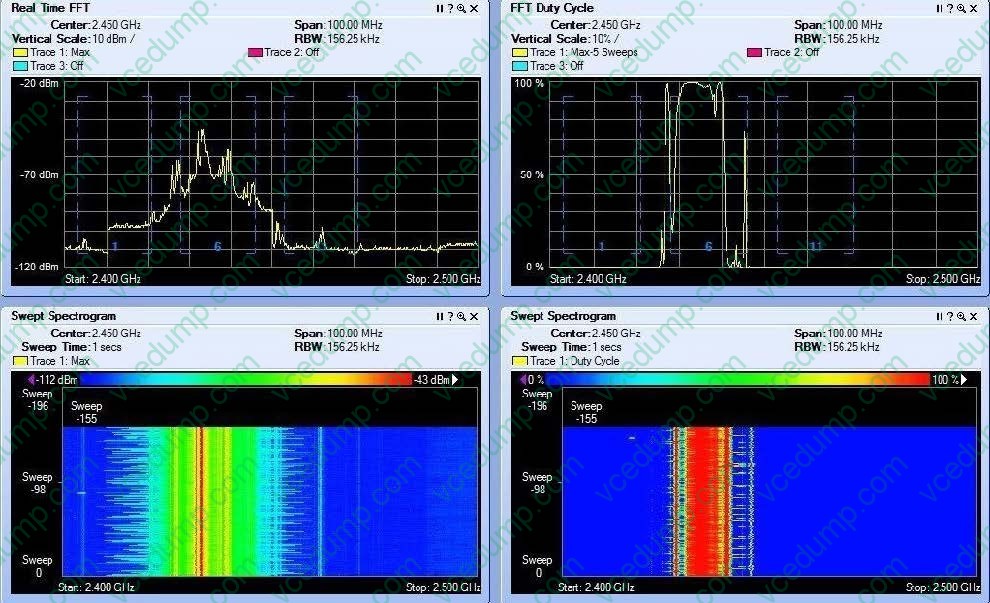
B. Bluetooth mouse
C. Microwave oven
D. Wireless video camera
E. WIPS sensor -
Question 38:
In an 802.11b/g system, what channels are considered non-overlapping? (Choose two)
A. Channels 5 and 10
B. Channels 1 and 5
C. Channels 3 and 7
D. Channels 2 and 8
E. Channels 8 and 11
F. Channels 10 and 13 -
Question 39:
Given:
ABC Company has hired you to perform an indoor site survey of their 7-story facility. ABC Company owns the building and rents out unused floors (floors 2 and 4) to other companies, and the other companies use 802.11 WLANs already.
ABC Company wants all of the offices they occupy to be surveyed as part of the project.
What actions should be recommended as part of the site survey project? (Choose two)
A. Verify that RF signals from ABC's APs are not penetrating outside the perimeter of the building.
B. Determine how much signal strength is bleeding between floors.
C. Locate wiring closets on each floor occupied by ABC Company.
D. Identify security best practice violations on neighboring WLANs.
E. Verify that ABC's APs are not directly above or below APs on adjacent floors. -
Question 40:
What problems may exist for a multiple channel architecture (MCA) WLAN when its APs are all operating at full power (typically 100mW)? (Choose two)
A. Wi-Fi enabled voice handsets with low transmit power can experience asynchronous downlink and uplink performance.
B. WLAN client stations can experience the hidden node problem when located near each other within the same cell.
C. The mismatched power between WLAN client stations and APs violates regulatory and IEEE signal quality requirements.
D. Cell size may be too large, causing co-channel interference to adjacent cells and reducing system capacity.
E. APs operating in the 2.4 GHz band would prevent microwave ovens and analog video cameras from functioning.
Related Exams:
-
CWAP-402
Certified Wireless Analysis Professional -
CWAP-403
Certified Wireless Analysis Professional -
CWAP-404
Certified Wireless Analysis Professional -
CWAP-405
Certified Wireless Analysis Professional -
CWDP-303
Certified Wireless Design Professional -
CWDP-304
Certified Wireless Design Professional -
CWDP-305
Certified Wireless Design Professional -
CWISA-102
Certified Wireless IoT Solutions Administrator -
CWISA-103
Social Media Strategist -
CWNA-106
Certified Wireless Network Administrator
Tips on How to Prepare for the Exams
Nowadays, the certification exams become more and more important and required by more and more enterprises when applying for a job. But how to prepare for the exam effectively? How to prepare for the exam in a short time with less efforts? How to get a ideal result and how to find the most reliable resources? Here on Vcedump.com, you will find all the answers. Vcedump.com provide not only CWNP exam questions, answers and explanations but also complete assistance on your exam preparation and certification application. If you are confused on your PW0-104 exam preparations and CWNP certification application, do not hesitate to visit our Vcedump.com to find your solutions here.