PW0-104 Exam Details
-
Exam Code
:PW0-104 -
Exam Name
:Wireless LAN Administration Exam -
Certification
:CWNP Certifications -
Vendor
:CWNP -
Total Questions
:125 Q&As -
Last Updated
:Dec 08, 2021
CWNP PW0-104 Online Questions & Answers
-
Question 21:
What term correctly completes the following sentence?
802.11a/b/g used a mandatory 800ns guard interval. 802.11n introduces an optional short 400ns guard interval. Guard intervals (GI) are necessary in OFDM to reduce the likelihood of interference between two consecutive ____________.
A. Frames
B. Packets
C. Segments
D. Bits
E. Bytes
F. Symbols -
Question 22:
ABC Company has a 2.4 and 5 GHz WLAN deployment supporting four bands in the 5 GHz range (UNII 1, UNII 2, UNII 2e, and UNII 3). DFS functionality is enabled as required by the regulatory domain. Band steering is also enabled to encourage dual-band clients to use frequency bands with more capacity.
Your performance analysis shows that many dual-band VoWiFi client devices will move back and forth between 2.4 and 5 GHz as the user roams throughout the building. All APs have 2.4 and 5 GHz radios enabled. This "band hopping" behavior is viewed by network staff to be undesirable. What is the most likely cause of the unpredictable client band selection behavior?
A. Interference from 5 GHz radar sources has increased frame corruption and retries on channels 36-48 in UNII 1.
B. 5 GHz frequencies offer better RF penetration than 2.4 GHz, but 2.4 GHz offers more voice call capacity and lower latency than 5 GHz.
C. The voice client does not support DFS, and therefore experiences some 5 GHz coverage holes as it moves through the network.
D. The client's band selection algorithm prefers 5 GHz, but band steering behavior usually steers 75- 85% of client devices to 2.4 GHz. -
Question 23:
Using the exhibit as a reference,
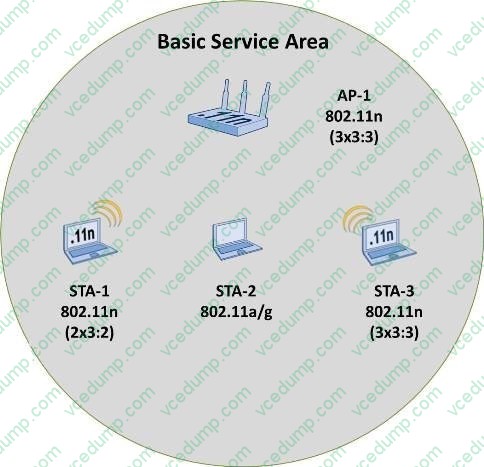
what is the maximum number of spatial streams that could be used for a downlink HT-OFDM transmission from AP-1 to STA-3?
A. One spatial stream, because the BSS must maintain backwards compatibility with STA-2, which supports only 802.11g (ERP) without MIMO or multiple spatial streams.
B. Two spatial streams, because the number of spatial streams for an HT-OFDM transmission is limited to the capabilities of the least capable HT station in the BSS.
C. Two spatial streams, because the third transmit chain in the HT AP must be used simultaneously for protection mechanisms with the 802.11g (ERP) station.
D. Three spatial streams, because HT-OFDM transmissions will be preceded with protection mechanisms using a basic data rate for STA-2 and possibly STA-1. -
Question 24:
In addition to throughput enhancements, what other improvements does 802.11n provide when compared with 802.11a/g? (Choose 2)
A. Introduces "fast transition" roaming protocols for VoWiFi phones
B. Better link reliability between 802.11a/b/g client devices and 802.11n APs
C. Improves service quality for real-time applications at greater distances
D. Increases in receive sensitivity enhance RTLS location accuracy
E. Stronger security with more robust encryption modes. -
Question 25:
What statement about 802.3af Power over Ethernet (802.3, Clause 33) is true?
A. If a dual-radio access point requires 12W to operate, a PoE power source supplies 15.4W to the powered interface.
B. 802.3af-compliant endpoint and midspan PSE devices support 10/100 as well as Gigabit (1000Base- T) data rates.
C. Class 1 powered devices may use a maximum of 29W of power.
D. 802.3af-compliant Ethernet switches must be able to simultaneously support class 3 powered devices on every powered interface.
E. There are two classes of 802.3af PSEs: Type A supports up to 7W and Type B supports up to 15W of supplied power. -
Question 26:
Given: Joe runs a small hotel, and as a value added service for his customers he has implemented a Wi- Fi hot-spot. Joe has read news articles about how hackers wait at hot-spots trying to take advantage of unsuspecting users. Joe wants to avoid this problem at his hotel.
What is an efficient and practical step that Joe can take to decrease the likelihood of active attacks on his customers' wireless computers?
A. Implement Network Access Control (NAC) and require antivirus and firewall software along with OS patches
B. Require EAP-FAST authentication and provide customers with a username/password on their receipt
C. Implement an SSL VPN in the WLAN controller that initiates after HTTPS login
D. Enable station-to-station traffic blocking by the access points in the hotel -
Question 27:
Why is it recommended for a wireless network administrator to disable 1 Mbps and 2 Mbps data rates on the WLAN infrastructure? (Choose two) A. To improve capacity in the BSS
B. To reduce the size of the AP's effective service area
C. To prevent 802.11b devices from associating
D. To maximize the range of the highest data rates
E. To prevent VoWiFi multicast frames
F. To enable support for long preambles -
Question 28:
What statement about 802.11 WLAN performance is true?
A. Use of larger frame sizes results in greater throughput in low interference environments.
B. BSS support for 65 KB A-MPDUs will increase the maximum data rate available to client devices.
C. In 802.11n, changing the security mechanism from WPA2-Personal to WPA2-Enterprise will enable the HT MCS rates.
D. Compared to an Independent BSS, an Infrastructure BSS can provide almost twice the throughput between wireless nodes.
E. Use of short guard intervals improves reliability and throughput in high multipath environments -
Question 29:
What term describes the effect of increasing the intensity of an RF wave with an antenna by focusing the energy in a specific direction?
A. Spatial Multiplexing
B. Active Amplification
C. Beam Compression
D. Passive Gain
E. Isotropic Radiation -
Question 30:
What problems may occur when there are hidden nodes in the BSS?
A. Increase in downlink (transmitted by AP) frame retries
B. High retransmission count for a subset of client stations
C. Use of frame fragmentation with fragment bursts
D. Excessive use of null data frames
E. Duration values vary widely in each data frame
Related Exams:
-
CWAP-402
Certified Wireless Analysis Professional -
CWAP-403
Certified Wireless Analysis Professional -
CWAP-404
Certified Wireless Analysis Professional -
CWAP-405
Certified Wireless Analysis Professional -
CWDP-303
Certified Wireless Design Professional -
CWDP-304
Certified Wireless Design Professional -
CWDP-305
Certified Wireless Design Professional -
CWISA-102
Certified Wireless IoT Solutions Administrator -
CWISA-103
Social Media Strategist -
CWNA-106
Certified Wireless Network Administrator
Tips on How to Prepare for the Exams
Nowadays, the certification exams become more and more important and required by more and more enterprises when applying for a job. But how to prepare for the exam effectively? How to prepare for the exam in a short time with less efforts? How to get a ideal result and how to find the most reliable resources? Here on Vcedump.com, you will find all the answers. Vcedump.com provide not only CWNP exam questions, answers and explanations but also complete assistance on your exam preparation and certification application. If you are confused on your PW0-104 exam preparations and CWNP certification application, do not hesitate to visit our Vcedump.com to find your solutions here.