PDII Exam Details
-
Exam Code
:PDII -
Exam Name
:Salesforce Certified Platform Developer II (Plat-Dev-301) -
Certification
:Salesforce Certifications -
Vendor
:Salesforce -
Total Questions
:445 Q&As -
Last Updated
:Jul 30, 2026
Salesforce PDII Online Questions & Answers
-
Question 361:
Refer to the code below:
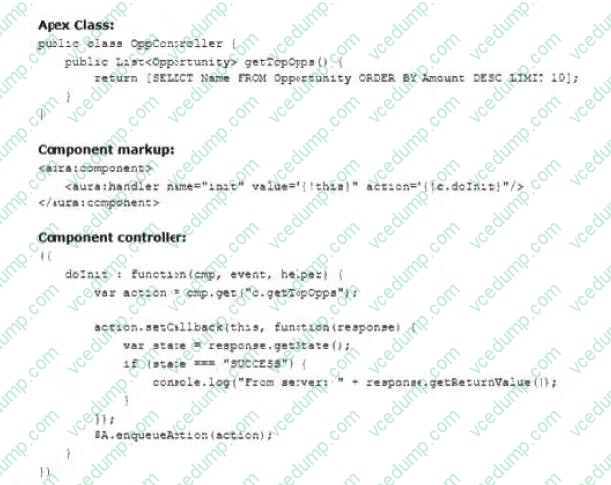
A developer is building this Aura component to display information about top Opportunities in the org.
Which three code changes must be made for the component to work? (Choose Three)
A. Add the static keyword to the Apex method.
B. Set the controller in the component markup.
C. Add the RemoteAction annotation to the Apex method.
D. Add the AuraEnabled annotation to the Apex method.
E. Get the controller action with cmp.get(`'oppController.getTopOpps"). -
Question 362:
A developer must create a way for external partners to submit millions of leads into Salesforce per day. How should the developer meet this requirement?
A. Publicly expose a Visualforce page via Force.com Sites
B. Create a web service on Heroku that uses Heroku Connect
C. Host a Web-to-Lead form on the company website
D. Publicly expose an Apex Web Service via Force.com Sites -
Question 363:
The use of the transient keyword In Visualforce Page Controllers helps with which common performance issued?
A. Reduces View State
B. Improves Query Performance
C. Improves Page Transfers
D. Reduces Load Times -
Question 364:
Universal Containers requested the addition of a third-party Map widget to an existing Lightning web component.
Which two actions should the developer take to implement this requirement? (Choose Two)
A. Import the third-party JavaScript module directly Into the component.
B. Use a content distribution network and Include <script> <script> tags In the component.
C. Import loadscript from lightning platformResourceLoader.
D. Upload the third-party JavaScript library as a static resource that Imports Into the component. -
Question 365:
Universal Containers wants to notify an external system in the event that an unhandled exception occurs when their nightly Apex batch gob runs.
What is the appropriate publish/subscribe logic to meet this requirement?
A. Have the external system subscribe to a standard Platform Event that gets fired with EventBus.publish().
B. Have the external system subscribe to a custom Platform Event that gets fired with addError().
C. Have the external system subscribe to a custom Platform Event that gets fired with EventBus.publish()
D. Have the external system subscribe to a standard Platform Event that gets fired. -
Question 366:
Which use case is an appropriate fit for the @future asynchronous Apex method? (Choose two.)
A. A developer has jobs that need larger query results than regular transactions allow
B. A developer needs to segregate DML operations and bypass the mixed save DML error
C. A developer has long-running jobs with large data volumes that need to be performed in batches
D. A developer has long-running methods and needs to prevent delaying an Apex transaction -
Question 367:
A custom Aura component, AddressValidation.cmp, exists in the system. The Salesforce admin for the organization is unable to find and select the component while creating a quick action for the Account sObject.
What should the developer do to ensure that AddressValidation.cmp can be selected when creating a quick action?
A. Ensure the component implements the lightning:actionOverride interface.
B. Ensure the component implements the force:lightningQuickAction interface.
C. Ensure the access attribute of the aura:component tag is set to GLOBAL.
D. Ensure the component implements the force:hasRecordId interface. -
Question 368:
Consider the following code snippet:
trigger OpportunityTrigger on Opportunity (before insert, before update) {
for(Opportunity opp : Trigger.new){
OpportunityHandler.setPricingStructure(Opp);
}
}
public class OpportunityHandler{
public static void setPricingStructure(Opportunity thisOpp){
Pricing_Structure_c ps = [Select Type_c FROM Pricing_Structure_c WHERE industry_c = :thisOpp.
Account_Industry_c];
thisOpp.Pricing_Structure_c = ps.Type_c;
update thisOpp;
}
}
Which two best practices should the developer Implement to optimize this code? (Choose Two)
A. Use a collection for the DML statement.
B. Query the Pricing_structure__c records outside of the loop.
C. Change the trigger context to after update, after insert.
D. Remove the DML statement. -
Question 369:
In a VisualForce page with a VisualForce component that has rendered set to false when the page loads, how can a developer ensure it will show on a re-render?
A. Set the re-render attribute of the component to true.
B. Perform a full page refresh since rendered elements cannot be re-rendered without refreshing.
C. Set the rendered attribute of the component to true and re-render the component.
D. Set the rendered attribute of the component to true and re-render a parent component. -
Question 370:
Which tag should a developer use to display different text while an <apex:commandButton> is executing versus not executing?
A. <apex:actionStatus>
B. <apex:actionSupport>
C. <apex:pageMessages>
D. <apex:actionPoller>
Related Exams:
-
201-COMMERCIAL-BANKING-FUNCTIONAL
Salesforce enCino 201 Commercial Banking Functional -
ADM-201
Salesforce Certified Platform Administrator (Plat-Admn-201) -
ADM-211
Administration Essentials for Experienced Admin (ADM-211) -
ADM-261
Service Cloud Administration (SU24) -
ADVANCED-ADMINISTRATOR
Salesforce Certified Advanced Administrator -
ADVANCED-CROSS-CHANNEL
Marketing Cloud Advanced Cross Channel Accredited Professional -
ADX-201
Administrative Essentials for New Admins in Lightning Experience -
ADX-271
Salesforce Certified Community Cloud Consultant (ADX-271) -
AGENTFORCE-SPECIALIST
Salesforce Certified Agentforce Specialist (AI-201) -
ALS-CON-201
Salesforce Certified Agentforce Life Sciences Consultant
Tips on How to Prepare for the Exams
Nowadays, the certification exams become more and more important and required by more and more enterprises when applying for a job. But how to prepare for the exam effectively? How to prepare for the exam in a short time with less efforts? How to get a ideal result and how to find the most reliable resources? Here on Vcedump.com, you will find all the answers. Vcedump.com provide not only Salesforce exam questions, answers and explanations but also complete assistance on your exam preparation and certification application. If you are confused on your PDII exam preparations and Salesforce certification application, do not hesitate to visit our Vcedump.com to find your solutions here.