PDII Exam Details
-
Exam Code
:PDII -
Exam Name
:Salesforce Certified Platform Developer II (Plat-Dev-301) -
Certification
:Salesforce Certifications -
Vendor
:Salesforce -
Total Questions
:445 Q&As -
Last Updated
:Jul 30, 2026
Salesforce PDII Online Questions & Answers
-
Question 381:
A developer gets an error saying 'Maximum Trigger Depth Exceeded.' What is a possible reason to get this error message?
A. The SOQL governor limits are being hit.
B. A Process Builder is running that sends mass emails.
C. Trigger is recursively invoked more than 16 times.
D. There are numerous DML operations in the trigger logic. -
Question 382:
A developer created an Opportunity trigger that updates the account rating when an associated opportunity is considered high value. Current criteria for an opportunity to be considered high value is an amount greater than or equal to SI,000,000. However, this criteria value can change over time.
There is a new requirement to also display high value opportunities in a Lightning web component.
Which two actions should the developer take to prevent the business logic that obtains the high value opportunities from being repeated in more than one place?
A. Use custom metadata to hold the high value amount.
B. Call the trigger from the Lightning web component.
C. Leave the business logic code Inside the trigger for efficiency.
D. Create a helper class that fetches the high value opportunities. -
Question 383:
A developer has written the following method:
static void processList(List<sobject> input){
Which code block can be used to call the method?
A. processList (ace)
B. processList ([FIND 'Acme" 'RETURNING Account])
C. processList([SELECT Id, Name FROM sObject WHERE Type = 'Account'])
D. for Account ace : [SELECT Id, Name FROM Account]) -
Question 384:
Consider the following code snippet, depicting an Aura component:
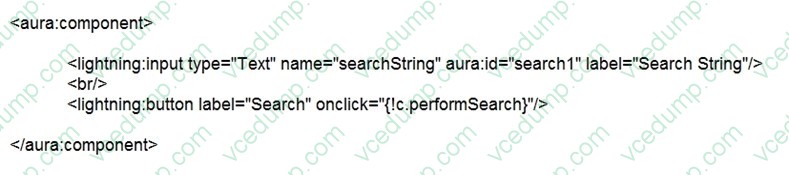
Which two interfaces can the developer implement to make the component available as a quick action? (Choose two.)
A. Force:lightningQuicAction
B. Force:hasRecordId
C. Force hasObjectName
D. Lightning QuickActionAPI
E. Force:lightningQuickActionWithoutHeader -
Question 385:
A developer created a Lightning web component for the Account record page that displays the five most recently contacted Contacts for an Account. The Apex method, getRecentContacts, returns a list of Contacts and will be wired to a property in the component.
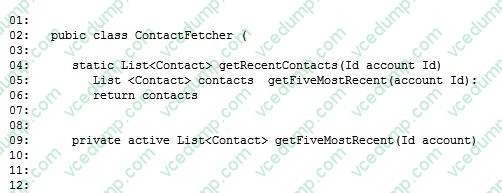
Which two lines must change in the above ode to make the Apex method able to be wired? (Choose Two)
A. Add AuraEnanled(cacheabletrue) to the line 08
B. Remove private from line 09.
C. Add @AuraEnabled (cacheabletrue) to line 03.
D. Add public to line 04. -
Question 386:
A developer must perform a complex SOQL query that joins two objects in a Lightning component. How can the Lightning component execute the query?
A. Use the SaJesforce Streaming API to perform the SOQL query.
B. Create a Process Builder to execute the query and invoke from the Lightning component.
C. Invoke an Apex dass with the method annotated as iraEnabled to perform the query.
D. Write the query in a custom Lightning web component wrapper and invoke from the Lightning component. -
Question 387:
If the "PageReference.setRedirect" Apex function is set to True, what type of request is made?
A. Get request
B. Postback request
C. If PageReference points to the same controller and subset of extensions, postback request, otherwise get request -
Question 388:
A company manages information about their product offerings in custom objects named Catalog and Catalog Item. Catalog Item has a master-detail field to Catalog, and each Catalog may have as many as 100,000 Catalog Items.
Both custom objects have a CurrencyIsoCode Text field that contains the currency code they should use. If a Catalog's CurrencyIsoCode changes, all of its Catalog Items' CurrencyIsoCodes should be changed as well.
What should a developer use to update the CurrencIsoCodes on the Catalog Items when the Catalog's CurrencyIsoCode changes?
A. An after insert trigger on Catalog that updates the Catalog Items if the Catalog's CurrencyIsoCode is different.
B. An after insert trigger on Catalog Item that updates the Catalog Items if the Catalog's CurrencyIsoCode is different.
C. A Database.Schedulable and Database.Batchable class that queries the Catalog object and updates the Catalog Items if the Catalog CurrencyISoCode is different.
D. A Database.Schedulable and Database.Batchable class that queries the Catalog Item object and updates the Catalog Items if the Catalog CurrencyISoCode is different. -
Question 389:
Consider the following code snippet:
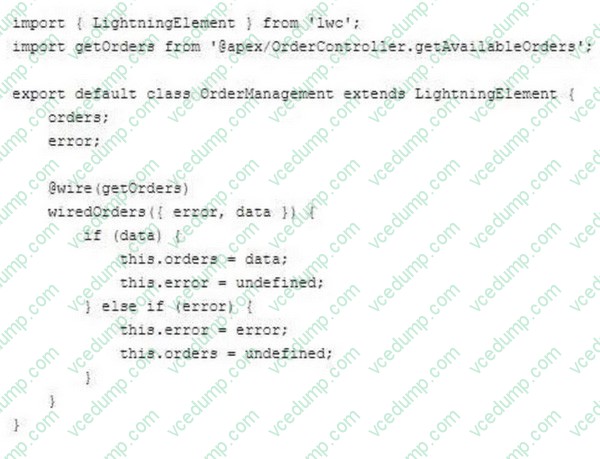
When the component is deployed, an error is reported.
Which two changes should the developer implement in the code to ensure the component deploys successfully? (Choose two.)
A. import getOrders from '@salesforce/apex/OrderController.getAvailableOrders';
B. import { LightningElement, api ) from 'lwc';
C. import getOrders from '@salesforce/apex/c.OrderController.getAvailableOrders';
D. import { LighningElement, wire } from 'lwc'; -
Question 390:
A company has a custom object, Order__c, that has a custom picklist field, Status__c, with values of `New', `In Progress', or `Fulfilled' and a lookup field, Contact__c, to Contact.
Which SOQL query will return a unique list of all the Contact records that have no `Fulfilled' Orders?
A. SELECT Id FROM Contact WHERE Id NOT IN (SELECT Id FROM Order__c WHERE Status__c = `Fulfilled')
B. SELECT Contact__c FROM Order__c WHERE Status__c <> `Fulfilled'
C. SELECT Id FROM Contact WHERE Id NOT IN (SELECT Contact__c FROM Order__c WHERE Status__c = `Fulfilled')
D. SELECT Contact__c FROM Order__c WHERE Id NOT IN (SELECT Id FROM Order__c Where Status__c = `Fulfilled')
Related Exams:
-
201-COMMERCIAL-BANKING-FUNCTIONAL
Salesforce enCino 201 Commercial Banking Functional -
ADM-201
Salesforce Certified Platform Administrator (Plat-Admn-201) -
ADM-211
Administration Essentials for Experienced Admin (ADM-211) -
ADM-261
Service Cloud Administration (SU24) -
ADVANCED-ADMINISTRATOR
Salesforce Certified Advanced Administrator -
ADVANCED-CROSS-CHANNEL
Marketing Cloud Advanced Cross Channel Accredited Professional -
ADX-201
Administrative Essentials for New Admins in Lightning Experience -
ADX-271
Salesforce Certified Community Cloud Consultant (ADX-271) -
AGENTFORCE-SPECIALIST
Salesforce Certified Agentforce Specialist (AI-201) -
ALS-CON-201
Salesforce Certified Agentforce Life Sciences Consultant
Tips on How to Prepare for the Exams
Nowadays, the certification exams become more and more important and required by more and more enterprises when applying for a job. But how to prepare for the exam effectively? How to prepare for the exam in a short time with less efforts? How to get a ideal result and how to find the most reliable resources? Here on Vcedump.com, you will find all the answers. Vcedump.com provide not only Salesforce exam questions, answers and explanations but also complete assistance on your exam preparation and certification application. If you are confused on your PDII exam preparations and Salesforce certification application, do not hesitate to visit our Vcedump.com to find your solutions here.