PCNSE Exam Details
-
Exam Code
:PCNSE -
Exam Name
:Palo Alto Networks Certified Network Security Engineer - PAN-OS 11.x (PCNSE) -
Certification
:Palo Alto Networks Certifications -
Vendor
:Palo Alto Networks -
Total Questions
:860 Q&As -
Last Updated
:Mar 23, 2026
Palo Alto Networks PCNSE Online Questions & Answers
-
Question 401:
Decrypted packets from the website https://www.microsoft.com will appear as which application and service within the Traffic log?
A. web-browsing and 443
B. SSL and 80
C. SSL and 443
D. web-browsing and 80 -
Question 402:
An organization has recently migrated its infrastructure and configuration to NGFWs, for which Panorama manages the devices The organization is coming from a L2-L4 firewall vendor, but wants to use App-ID while identifying policies that are no longer needed.
Which Panorama tool can help this organization?
A. Config Audit
B. Policy Optimizer
C. Application Groups
D. Test Policy Match -
Question 403:
An organization conducts research on the benefits of leveraging the Web Proxy feature of PAN-OS 11.0. What are two benefits of using an explicit proxy method versus a transparent proxy method? (Choose two.)
A. No client configuration is required for explicit proxy, which simplifies the deployment complexity.
B. Explicit proxy allows for easier troubleshooting, since the client browser is aware of the existence of the proxy.
C. Explicit proxy supports interception of traffic using non-standard HTTPS ports.
D. It supports the X-Authenticated-User (XAU) header, which contains the authenticated username in the outgoing request -
Question 404:
An administrator creates an SSL decryption rule decrypting traffic on all ports. The administrator also creates a Security policy rule allowing only the applications DNS, SSL, and web-browsing.
The administrator generates three encrypted BitTorrent connections and checks the Traffic logs. There are three entries. The first entry shows traffic dropped as application Unknown. The next two entries show traffic allowed as application
SSL.
Which action will stop the second and subsequent encrypted BitTorrent connections from being allowed as SSL?
A. Create a decryption rule matching the encrypted BitTorrent traffic with action "No-Decrypt," and place the rule at the top of the Decryption policy.
B. Create a Security policy rule that matches application "encrypted BitTorrent" and place the rule at the top of the Security policy.
C. Disable the exclude cache option for the firewall.
D. Create a Decryption Profile to block traffic using unsupported cyphers, and attach the profile to the decryption rule. -
Question 405:
Which two components are required to configure certificate-based authentication to the web Ul when an administrator needs firewall access on a trusted interface'? (Choose two.)
A. Server certificate
B. SSL/TLS Service Profile
C. Certificate Profile
D. CA certificate -
Question 406:
Which protection feature is available only in a Zone Protection Profile?
A. SYN Flood Protection using SYN Flood Cookies
B. ICMP Flood Protection
C. Port Scan Protection
D. UDP Flood Protections -
Question 407:
An existing NGFW customer requires direct interne! access offload locally at each site and iPSec connectivity to all branches over public internet. One requirement is mat no new SD-WAN hardware be introduced to the environment. What is the best solution for the customer?
A. Configure a remote network on PAN-OS
B. Upgrade to a PAN-OS SD-WAN subscription
C. Deploy Prisma SD-WAN with Prisma Access
D. Configure policy-based forwarding -
Question 408:
Refer to the exhibit.
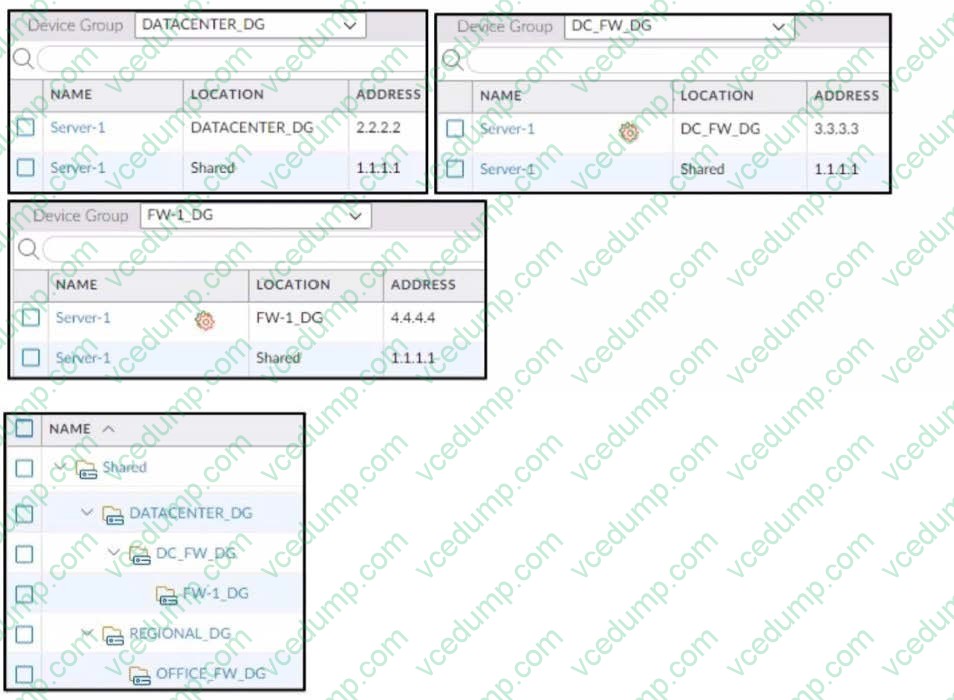
Review the screenshots and consider the following information:
1.FW-1 is assigned to the FW-1_DG device group, and FW-2 is assigned to OFFICE_FW_DG.
2.There are no objects configured in REGIONAL_DG and OFFICE_FW_DG device groups. Which IP address will be pushed to the firewalls inside Address Object Server-1?
A. Server-1 on FW-1 will have IP 1.1.1.1. Server-1 will not be pushed to FW-2.
B. Server-1 on FW-1 will have IP 3.3.3.3. Server-1 will not be pushed to FW-2.
C. Server-1 on FW-1 will have IP 2.2.2.2. Server-1 will not be pushed to FW-2.
D. Server-1 on FW-1 will have IP 4.4.4.4. Server-1 on FW-2 will have IP 1.1.1.1. -
Question 409:
A variable name must start with which symbol?
A. $
B. and
C. !
D. # -
Question 410:
A user at an internal system queries the DNS server for their web server with a private IP of 10 250 241 131 in the. The DNS server returns an address of the web server's public address, 200.1.1.10.
In order to reach the web server, which security rule and U-Turn NAT rule must be configured on the firewall?
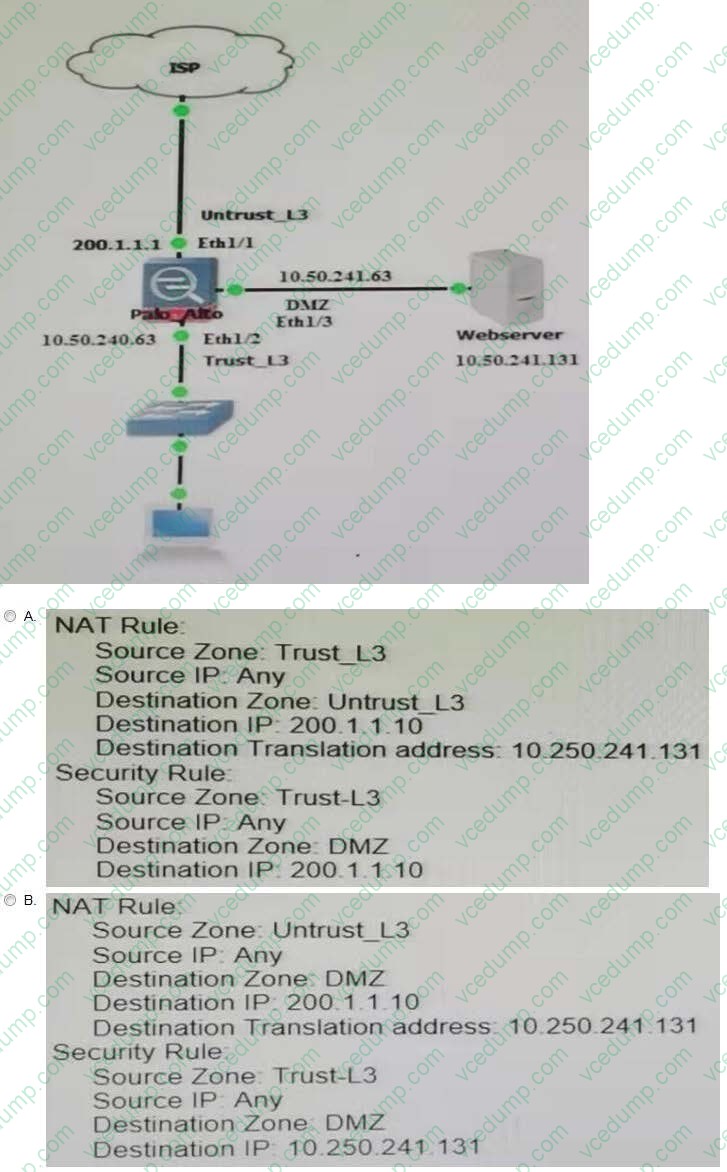
A. Option A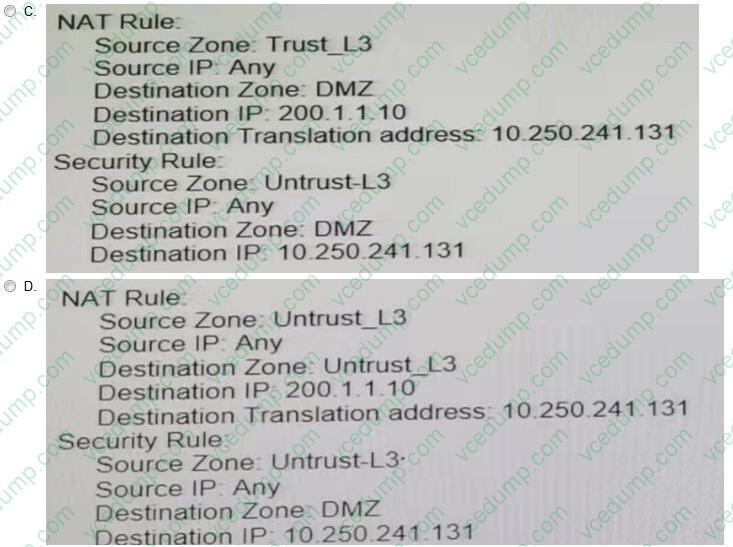
B. Option B
C. Option C
D. Option D
Related Exams:
-
PAN-CSP
Palo Alto Networks Cloud Security Professional -
PAN-NGFE
Palo Alto Networks Network Next-Generation Firewall Engineer -
PAN-NSA
Palo Alto Networks Network Security Analyst -
PAN-NSG
Palo Alto Networks Network Security Professional -
PAN-NSP
Palo Alto Networks Network Security Professional -
PAN-SDWE
Palo Alto Networks SD-WAN Engineer -
PAN-SOP
Palo Alto Networks Security Operations Professional -
PAN-SSEE
Palo Alto Networks Security Service Edge Engineer -
PAN-XDRA
Palo Alto Networks XDR Analyst -
PAN-XDRE
Palo Alto Networks XDR Engineer
Tips on How to Prepare for the Exams
Nowadays, the certification exams become more and more important and required by more and more enterprises when applying for a job. But how to prepare for the exam effectively? How to prepare for the exam in a short time with less efforts? How to get a ideal result and how to find the most reliable resources? Here on Vcedump.com, you will find all the answers. Vcedump.com provide not only Palo Alto Networks exam questions, answers and explanations but also complete assistance on your exam preparation and certification application. If you are confused on your PCNSE exam preparations and Palo Alto Networks certification application, do not hesitate to visit our Vcedump.com to find your solutions here.