PCNSE Exam Details
-
Exam Code
:PCNSE -
Exam Name
:Palo Alto Networks Certified Network Security Engineer - PAN-OS 11.x (PCNSE) -
Certification
:Palo Alto Networks Certifications -
Vendor
:Palo Alto Networks -
Total Questions
:860 Q&As -
Last Updated
:Mar 23, 2026
Palo Alto Networks PCNSE Online Questions & Answers
-
Question 191:
In a firewall, which three decryption methods are valid? (Choose three )
A. SSL Inbound Inspection
B. SSL Outbound Proxyless Inspection
C. SSL Inbound Proxy
D. Decryption Mirror
E. SSH Proxy -
Question 192:
An engineer is designing a deployment of multi-vsys firewalls.
What must be taken into consideration when designing the device group structure?
A. Multiple vsys and firewalls can be assigned to a device group, and a multi-vsys firewall must have all its vsys in a single device group.
B. Only one vsys or one firewall can be assigned to a device group, except for a multi-vsys firewall, which must have all its vsys in a single device group.
C. Multiple vsys and firewalls can be assigned to a device group, and a multi-vsys firewall can have each vsys in a different device group.
D. Only one vsys or one firewall can be assigned to a device group, and a multi-vsys firewall can have each vsys in a different device group. -
Question 193:
An engineer is creating a template and wants to use variables to standardize the configuration across a large number of devices. Which Mo variable types can be defined? (Choose two.)
A. Path group
B. Zone
C. IP netmask
D. FQDN -
Question 194:
When planning to configure SSL Froward Proxy on a PA 5260, a user asks how SSL decryption can be implemented using phased approach in alignment with Palo Alto Networks best practices.
What should you recommend?
A. Enable SSL decryption for known malicious source IP addresses
B. Enable SSL decryption for source users and known malicious URL categories
C. Enable SSL decryption for malicious source users
D. Enable SSL decryption for known malicious destination IP addresses -
Question 195:
The same route appears in the routing table three times using three different protocols. Which mechanism determines how the firewall chooses which route to use?
A. Administrative distance
B. Round Robin load balancing
C. Order in the routing table
D. Metric -
Question 196:
When you configure an active/active high availability pair which two links can you use? (Choose two)
A. HA2 backup
B. HA3
C. Console Backup
D. HSCI-C -
Question 197:
An administrator is tasked to provide secure access to applications running on a server in the company's on-premises datacenter.
What must the administrator consider as they prepare to configure the decryption policy?
A. Ensure HA3 interfaces are configured in a HA pair environment to sync decrypted sessions.
B. Obtain or generate the server certificate and private key from the datacenter server.
C. Obtain or generate the self-signed certificate with private key in the firewall
D. Obtain or generate the forward trust and forward untrust certificate from the datacenter server. -
Question 198:
A firewall has Security policies from three sources
1.locally created policies
2.shared device group policies as pre-rules
3.the firewall's device group as post-rules
How will the rule order populate once pushed to the firewall?
A. shared device group policies, firewall device group policies. local policies.
B. firewall device group policies, local policies. shared device group policies
C. shared device group policies. local policies, firewall device group policies
D. local policies, firewall device group policies, shared device group policies -
Question 199:
After importing a pre-configured firewall configuration to Panorama, what step is required to ensure a commit/push is successful without duplicating local configurations?
A. Ensure Force Template Values is checked when pushing configuration.
B. Push the Template first, then push Device Group to the newly managed firewal.
C. Perform the Export or push Device Config Bundle to the newly managed firewall.
D. Push the Device Group first, then push Template to the newly managed firewall -
Question 200:
A security engineer has configured a GlobalProtect portal agent with four gateways.
Which GlobalProtect Gateway will users connect to based on the chart provided?
A. East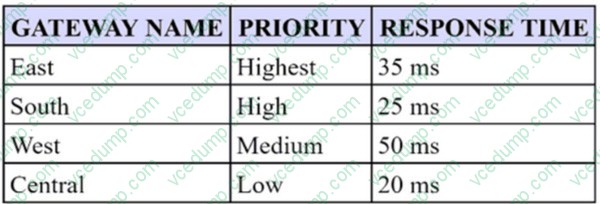
B. South
C. West
D. Central
Related Exams:
-
PAN-CSP
Palo Alto Networks Cloud Security Professional -
PAN-NGFE
Palo Alto Networks Network Next-Generation Firewall Engineer -
PAN-NSA
Palo Alto Networks Network Security Analyst -
PAN-NSG
Palo Alto Networks Network Security Professional -
PAN-NSP
Palo Alto Networks Network Security Professional -
PAN-SDWE
Palo Alto Networks SD-WAN Engineer -
PAN-SOP
Palo Alto Networks Security Operations Professional -
PAN-SSEE
Palo Alto Networks Security Service Edge Engineer -
PAN-XDRA
Palo Alto Networks XDR Analyst -
PAN-XDRE
Palo Alto Networks XDR Engineer
Tips on How to Prepare for the Exams
Nowadays, the certification exams become more and more important and required by more and more enterprises when applying for a job. But how to prepare for the exam effectively? How to prepare for the exam in a short time with less efforts? How to get a ideal result and how to find the most reliable resources? Here on Vcedump.com, you will find all the answers. Vcedump.com provide not only Palo Alto Networks exam questions, answers and explanations but also complete assistance on your exam preparation and certification application. If you are confused on your PCNSE exam preparations and Palo Alto Networks certification application, do not hesitate to visit our Vcedump.com to find your solutions here.