PCNSA Exam Details
-
Exam Code
:PCNSA -
Exam Name
:Palo Alto Networks Certified Network Security Administrator (PCNSA) -
Certification
:Palo Alto Networks Certifications -
Vendor
:Palo Alto Networks -
Total Questions
:443 Q&As -
Last Updated
:Mar 24, 2026
Palo Alto Networks PCNSA Online Questions & Answers
-
Question 241:
Based on the security policy rules shown, ssh will be allowed on which port?
A. 80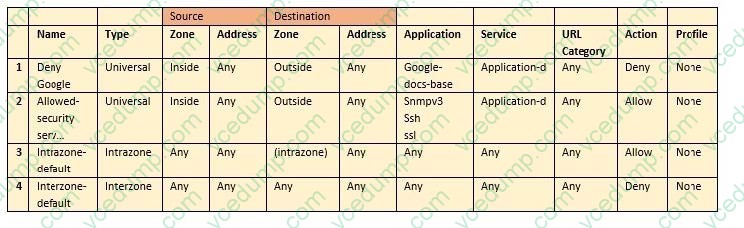
B. 53
C. 22
D. 23 -
Question 242:
An administrator is troubleshooting an issue with traffic that matches the intrazone-default rule, which is set to default configuration. What should the administrator do?
A. change the logging action on the rule
B. review the System Log
C. refresh the Traffic Log
D. tune your Traffic Log filter to include the dates -
Question 243:
Which action results in the firewall blocking network traffic with out notifying the sender?
A. Drop
B. Deny
C. Reset Server
D. Reset Client -
Question 244:
Which DNS Query action is recommended for traffic that is allowed by Security policy and matches Palo Alto Networks Content DNS Signatures?
A. block
B. sinkhole
C. alert
D. allow -
Question 245:
The Administrator profile “PCNSA Admin” is configured with an Authentication profile “Authentication Sequence PCNSA”. The Authentication Sequence PCNSA has a profile list with four Authentication profiles:
1.
Auth Profile LDAP
2.
Auth Profile Radius
3.
Auth Profile Local
4.
Auth Profile TACACS
After a network outage, the LDAP server is no longer reachable. The RADIUS server is still reachable but has lost the “PCNSA Admin” username and password.
Which option describes the “PCNSA Admin” login capabilities after the outage?
A. Auth OK because of the Auth Profile TACACS
B. Auth KO because RADIUS server lost user and password for PCNSA Admin
C. Auth OK because of the Auth Profile Local
D. Auth KO because LDAP server is not reachable -
Question 246:
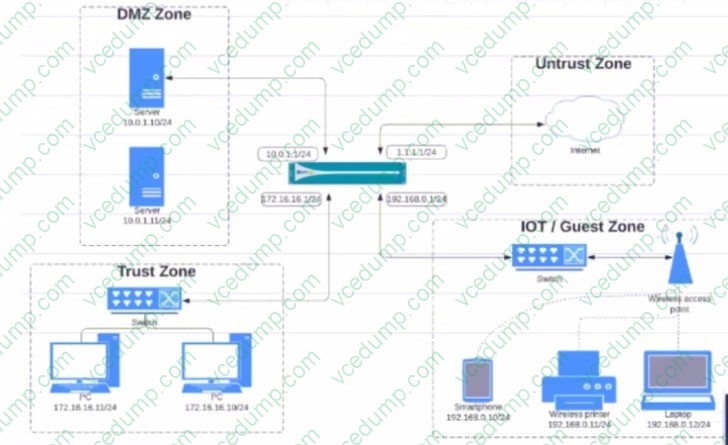
Given the network diagram, traffic should be permitted for both Trusted and Guest users to access general Internet and DMZ servers using SSH. web-browsing and SSL applications Which policy achieves the desired results?
A. Option A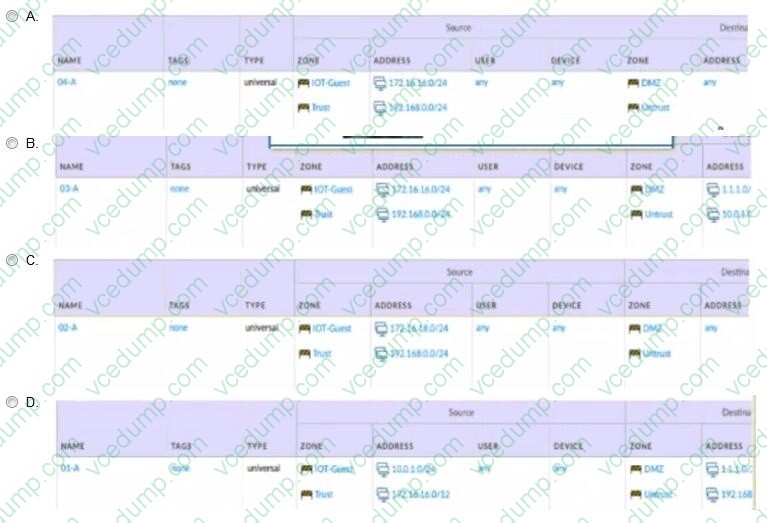
B. Option B
C. Option C
D. Option D -
Question 247:
Based on the screenshot what is the purpose of the included groups?
A. They are only groups visible based on the firewall's credentials.
B. They are used to map usernames to group names.
C. They contain only the users you allow to manage the firewall.
D. They are groups that are imported from RADIUS authentication servers. -
Question 248:
Which two Security profile actions can only be applied to DoS Protection profiles? (Choose two.)
A. Reset-server
B. Reset-both
C. SYN cookies
D. Random Early Drop -
Question 249:
An administrator would like to determine the default deny action for the application dns- over-https. Which action would yield the information?
A. View the application details in beacon paloaltonetworks.com
B. Check the action for the Security policy matching that traffic
C. Check the action for the decoder in the antivirus profile
D. View the application details in Objects > Applications -
Question 250:
The compliance officer requests that all evasive applications need to be blocked on all perimeter firewalls out to the internet The firewall is configured with two zones;
1.
trust for internal networks
2.
untrust to the internet
Based on the capabilities of the Palo Alto Networks NGFW, what are two ways to configure a security policy using App-ID to comply with this request? (Choose two )
A. Create a deny rule at the top of the policy from trust to untrust with service application-default and add an application filter with the evasive characteristic
B. Create a deny rule at the top of the policy from trust to untrust over any service and select evasive as the application
C. Create a deny rule at the top of the policy from trust to untrust with service application-default and select evasive as the application
D. Create a deny rule at the top of the policy from trust to untrust over any service and add an application filter with the evasive characteristic
Related Exams:
-
PAN-CSP
Palo Alto Networks Cloud Security Professional -
PAN-NGFE
Palo Alto Networks Network Next-Generation Firewall Engineer -
PAN-NSA
Palo Alto Networks Network Security Analyst -
PAN-NSG
Palo Alto Networks Network Security Professional -
PAN-NSP
Palo Alto Networks Network Security Professional -
PAN-SDWE
Palo Alto Networks SD-WAN Engineer -
PAN-SOP
Palo Alto Networks Security Operations Professional -
PAN-SSEE
Palo Alto Networks Security Service Edge Engineer -
PAN-XDRA
Palo Alto Networks XDR Analyst -
PAN-XDRE
Palo Alto Networks XDR Engineer
Tips on How to Prepare for the Exams
Nowadays, the certification exams become more and more important and required by more and more enterprises when applying for a job. But how to prepare for the exam effectively? How to prepare for the exam in a short time with less efforts? How to get a ideal result and how to find the most reliable resources? Here on Vcedump.com, you will find all the answers. Vcedump.com provide not only Palo Alto Networks exam questions, answers and explanations but also complete assistance on your exam preparation and certification application. If you are confused on your PCNSA exam preparations and Palo Alto Networks certification application, do not hesitate to visit our Vcedump.com to find your solutions here.