PCNSA Exam Details
-
Exam Code
:PCNSA -
Exam Name
:Palo Alto Networks Certified Network Security Administrator (PCNSA) -
Certification
:Palo Alto Networks Certifications -
Vendor
:Palo Alto Networks -
Total Questions
:443 Q&As -
Last Updated
:Mar 24, 2026
Palo Alto Networks PCNSA Online Questions & Answers
-
Question 1:
What is an advantage for using application tags?
A. They are helpful during the creation of new zones
B. They help with the design of IP address allocations in DHCP.
C. They help content updates automate policy updates
D. They help with the creation of interfaces -
Question 2:
The Administrator profile “PCNSA Admin” is configured with an Authentication profile “Authentication Sequence PCNSA”.
The Authentication Sequence PCNSA has a profile list with four Authentication profiles:
Auth Profile LDAP -
Auth Profile Radius -
Auth Profile Local -
Auth Profile TACACS After a network outage, the LDAP server is no longer reachable. The RADIUS server is still reachable but has lost the “PCNSA Admin” username and password.
Which option describes the “PCNSA Admin” login capabilities after the outage?
A. Auth OK because of the Auth Profile TACACS
B. Auth KO because RADIUS server lost user and password for PCNSA Admin
C. Auth OK because of the Auth Profile Local
D. Auth KO because LDAP server is not reachable -
Question 3:
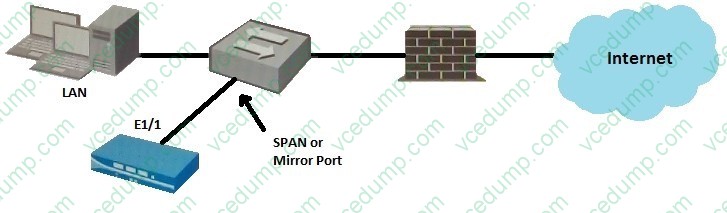
Given the topology, which zone type should interface E1/1 be configured with?
A. Tap
B. Tunnel
C. Virtual Wire
D. Layer3 -
Question 4:
An administrator needs to add capability to perform real-time signature lookups to block or sinkhole all known malware domains.
Which type of single unified engine will get this result?
A. User-ID
B. App-ID
C. Security Processing Engine
D. Content-ID -
Question 5:
What are two differences between an application group and an application filter? (Choose two.)
A. Application groups enable access to sanctioned applications explicitly, while application filters enable access to sanctioned applications implicitly.
B. Application groups are static, while application filters are dynamic.
C. Application groups dynamically group applications based on attributes, while application filters contain applications that are statically grouped.
D. Application groups can be added to application filters, while application filters cannot be added to application groups. -
Question 6:
Which option lists the attributes that are selectable when setting up an Application filters?
A. Category, Subcategory, Technology, and Characteristic
B. Category, Subcategory, Technology, Risk, and Characteristic
C. Name, Category, Technology, Risk, and Characteristic
D. Category, Subcategory, Risk, Standard Ports, and Technology -
Question 7:
Which type of administrator account cannot be used to authenticate user traffic flowing through the firewall's data plane?
A. Kerberos user
B. SAML user
C. local database user
D. local user -
Question 8:
An administrator needs to allow users to use their own office applications.
How should the administrator configure the firewall to allow multiple applications in a dynamic environment?
A. Create an Application Filter and name it Office Programs, the filter it on the business- systems category, office-programs subcategory
B. Create an Application Group and add business-systems to it
C. Create an Application Filter and name it Office Programs, then filter it on the business- systems category
D. Create an Application Group and add Office 365, Evernote, Google Docs, and Libre Office -
Question 9:
The administrator profile "SYS01 Admin" is configured with authentication profile "Authentication Sequence SYS01," and the authentication sequence SYS01 has a profile list with four authentication profiles:
Auth Profile LDAP Auth Profile Radius Auth Profile Local Auth Profile TACACS
After a network outage, the LDAP server is no longer reachable. The RADIUS server is still reachable but has lost the "SYS01 Admin" username and password.
What is the "SYS01 Admin" login capability after the outage?
A. Auth KO because RADIUS server lost user and password for SYS01 Admin
B. Auth OK because of the Auth Profile TACACS
C. Auth OK because of the Auth Profile Local
D. Auth KO because LDAP server is not reachable -
Question 10:
Where can you apply URL Filtering policy in a Security policy rule?
A. Within the applications selection
B. Within a destination address
C. Within a service type
D. Within the actions tab
Related Exams:
-
PAN-CSP
Palo Alto Networks Cloud Security Professional -
PAN-NGFE
Palo Alto Networks Network Next-Generation Firewall Engineer -
PAN-NSA
Palo Alto Networks Network Security Analyst -
PAN-NSG
Palo Alto Networks Network Security Professional -
PAN-NSP
Palo Alto Networks Network Security Professional -
PAN-SDWE
Palo Alto Networks SD-WAN Engineer -
PAN-SOP
Palo Alto Networks Security Operations Professional -
PAN-SSEE
Palo Alto Networks Security Service Edge Engineer -
PAN-XDRA
Palo Alto Networks XDR Analyst -
PAN-XDRE
Palo Alto Networks XDR Engineer
Tips on How to Prepare for the Exams
Nowadays, the certification exams become more and more important and required by more and more enterprises when applying for a job. But how to prepare for the exam effectively? How to prepare for the exam in a short time with less efforts? How to get a ideal result and how to find the most reliable resources? Here on Vcedump.com, you will find all the answers. Vcedump.com provide not only Palo Alto Networks exam questions, answers and explanations but also complete assistance on your exam preparation and certification application. If you are confused on your PCNSA exam preparations and Palo Alto Networks certification application, do not hesitate to visit our Vcedump.com to find your solutions here.