
PAN-NSA Real Exam Questions

Palo Alto Networks Network Security Analyst

96 questions available · Page 1 of 10

Updated Exam DumpsVerified AnswersPass Guarantee

Get Complete Exam Dumps
Question 1 Single choice

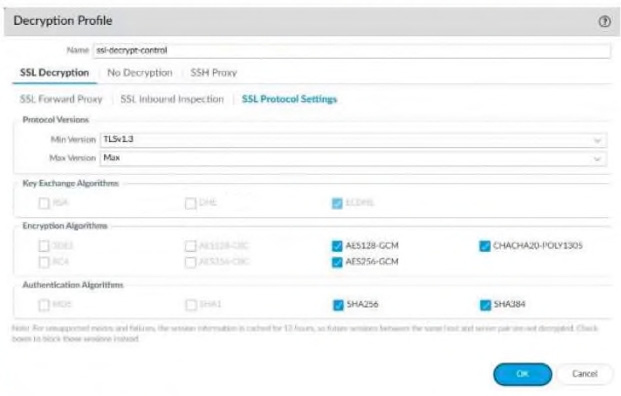
Based on the image below, what is a risk associated with this configuration?
  1. A

    Min Version setting of TLSv1.3 can cause compatibility issues with legacy applications or clients.

  2. B

    Authentication algorithm selections can significantly increase resource consumption and cause performance degradation.

  3. C

    Encryption algorithms 3DES and RC4 being disabled decreases security posture.

  4. D

    Max Version setting of "Max" enables the use of Perfect Forward Secrecy (PFS) and cannot be decrypted.

Show answer and explanation

Correct answer: A

Explanation

Comprehensive and Detailed 150 to 250 words of Explanation From Palo Alto Networks Network Security Analyst Knowledge: In the provided image, the Decryption Profile is configured with a Min Version of TLSv1.3. While this represents a high security posture, it introduces a significant operational risk: compatibility issues with legacy applications or clients.
Many older operating systems, web browsers, and legacy internal applications do not support TLS 1.3. If a client or server attempts to negotiate a connection using an older, unsupported protocol version (such as TLS 1.2 or 1.1), the firewall will drop the connection because it falls below the configured minimum threshold. A Network Security Analyst must balance the need for modern encryption with the functional requirements of the network.
Option C is incorrect because disabling weak algorithms like 3DES and RC4 actually improves the security posture.
Option D is incorrect because the firewall is fully capable of decrypting traffic using Perfect Forward Secrecy (PFS) if the appropriate certificates are installed.
Option B is a general concern for all decryption but is not a specific risk of the versioning shown. Therefore, the most immediate risk of setting the minimum version to TLS 1.3 is the potential disruption of services for any user or system still relying on the widely-used TLS 1.2 protocol or older.

Question 2 Single choice

A Palo Alto Networks NGFW for a high-security environment is being configured and requires a security profile group that includes vulnerability protection.

When configuring the action based on the severity of the threat types, what does Palo Alto Networks recommend? (Choose one answer)

  1. A

    Use action "reset-both" for critical, high, and medium vulnerabilities.

  2. B

    Use action "alert" for critical, high, and medium vulnerabilities.

  3. C

    Use action "allow" for critical, high, and medium vulnerabilities.

  4. D

    Use action "default" for critical, high, and medium vulnerabilities.

Show answer and explanation

Correct answer: D

Explanation

Comprehensive and Detailed 150 to 250 words of Explanation From Palo Alto Networks Network Security Analyst Knowledge: For organizations deploying Next-Generation Firewalls (NGFWs), Palo Alto Networks provides a set of pre-configured "Best Practice" recommendations for Security Profiles. In the context of a Vulnerability Protection profile, the recommended best practice for all threat severities (critical, high, medium, low, and informational) is to use the "default" action.
The "default" action is not a single static response; rather, it is a dynamic setting where the firewall applies the specific action (such as reset-both, drop, or alert) that Palo Alto Networks' threat research team has determined to be the most appropriate for each individual signature. For critical and high-severity vulnerabilities that represent clear exploit attempts, the default action is typically set to block the traffic. For lower-severity or informational signatures, the default action might simply be to alert. By using the "default" action, a Network Security Analyst ensures that the security posture stays aligned with the latest threat intelligence and research without the administrative burden of manually overriding thousands of individual signature actions, which can lead to accidental security gaps or performance-degrading false positives.

Question 3 Single choice

When using Strata Cloud Manager (SCM), which tool allows an analyst to automatically migrate local firewall configurations to a centralized management folder?

  1. A

    Strata Cloud Manager Transition

  2. B

    Policy Optimizer

  3. C

    Config Audit

  4. D

    Template Variable

Show answer and explanation

Correct answer: A

Explanation

Comprehensive and Detailed 150 to 250 words of Explanation From Palo Alto Networks Network Security Analyst Knowledge: The Strata Cloud Manager Transition tool is specifically designed to facilitate the migration of local, standalone firewall configurations into the SCM centralized management framework. This is a critical workflow for analysts moving toward a "unified management" model. The tool analyzes the existing local configuration-including objects, policies, and network settings-and maps them to the appropriate Folders and Snippets within SCM. This ensures that the local "Source of Truth" is successfully shifted to the cloud management plane without losing granular security settings. During this process, the analyst can identify and resolve naming conflicts or redundant objects, cleaning up the configuration as it is centralized.
Transitioning firewalls into SCM is a key objective as it unlocks AI-powered monitoring, centralized auditing, and simplified lifecycle management across the entire global estate.

Question 4 Single choice

An organization wants to centralize network and device settings such as interfaces, virtual routers, DNS, and NTP for multiple firewalls managed from Panorama.

Which Panorama component is designed for this purpose?

  1. A

    Device Group

  2. B

    Template

  3. C

    Rule Usage

  4. D

    Log Collector Group

Show answer and explanation

Correct answer: B

Explanation

Comprehensive and Detailed 150 to 250 words of Explanation From Palo Alto Networks Network Security Analyst Knowledge: A Template is the Panorama component used to manage network and device settings across multiple firewalls. This includes items such as interfaces, zones, virtual routers, server profiles, DNS, NTP, and other settings normally found under the Network and Device tabs on a local firewall. Templates help administrators maintain consistency across large environments while simplifying deployment and operations.

Option A is incorrect because a Device Group is primarily used for managing policies and shared objects rather than network and device configuration.
Option C is incorrect because Rule Usage is a policy analysis feature and has no role in centralized device configuration.
Option D is incorrect because a Log Collector Group is related to log storage and collection architecture, not interface or routing configuration.

For a Network Security Analyst, understanding the difference between Templates and Device Groups is essential. Templates standardize the foundational behavior of managed firewalls, while Device Groups handle policy logic. Using the correct management component prevents configuration sprawl and reduces the likelihood of inconsistent network settings across sites. This is especially important in distributed environments where many devices need a consistent baseline but may still require limited local variation through template variables.

Question 5 Single choice

An administrator is using Strata Cloud Manager (SCM) and notices that several firewalls are reporting a low health score due to "Untrusted Certificates" being used for management.

Which specific SCM dashboard provides the fastest way to identify which certificates are nearing expiration across the entire estate?

  1. A

    Command Center

  2. B

    Activity Insights

  3. C

    Policy Optimizer

  4. D

    Device Health Dashboard

Show answer and explanation

Correct answer: B

Explanation

Comprehensive and Detailed 150 to 250 words of Explanation From Palo Alto Networks Network Security Analyst Knowledge: In a modern Palo Alto Networks environment managed by Strata Cloud Manager (SCM), the Activity Insights dashboard is specifically designed to provide visibility into operational risks that are not necessarily "threats" but impact the stability of the security posture. One of its core functions is monitoring the lifecycle of certificates used throughout the network, including those for SSL Decryption, GlobalProtect, and web interface management.
While the Device Health Dashboard (Option D) provides a generalized health score based on operational metrics like CPU and memory, Activity Insights drills down into specific configuration risks such as expired or weak certificates. This allows a Network Security Analyst to proactively identify which firewalls or service profiles are at risk of service disruption before a certificate actually expires. By centralizing this information, SCM eliminates the need for analysts to manually check local certificate stores on dozens or hundreds of individual firewalls, significantly reducing administrative overhead and ensuring that secure management channels remain operational without interruption.

Question 6 Single choice

Which SCM feature allows an administrator to see a "Safety Score" for a proposed policy change before it is committed to the firewalls?

  1. A

    Policy Optimizer

  2. B

    Activity Insights

  3. C

    Best Practice Assessment (BPA)

  4. D

    Strata Cloud Manager (SCM) Copilot

Show answer and explanation

Correct answer: C

Explanation

Comprehensive and Detailed 150 to 250 words of Explanation From Palo Alto Networks Network Security Analyst Knowledge: The Best Practice Assessment (BPA) tool-which is integrated directly into Strata Cloud Manager as an inline check-allows analysts to evaluate their security configuration against Palo Alto Networks' recommended standards. It provides a "Security Adoption" or "Safety" score based on how well the policies implement features like App-ID, User-ID, and Security Profiles. By reviewing these checks before a commit, the analyst can identify "overly permissive" rules or rules missing critical threat inspection profiles. This proactive approach ensures that new policy changes do not inadvertently weaken the organization's security posture. For a Network Security Analyst, using the inline BPA in SCM is a key objective for maintaining a high-quality rulebase and moving the organization toward a "best practice" implementation of the Next-Generation Firewall.

Question 7 Single choice

Which Strata Cloud Manager (SCM) feature provides a consolidated view of all high-priority security incidents across a global network, including those from firewalls and Prisma Access?

  1. A

    Activity Insights

  2. B

    Command Center

  3. C

    Policy Optimizer

  4. D

    Device Health Dashboard

Show answer and explanation

Correct answer: B

Explanation

Comprehensive and Detailed 150 to 250 words of Explanation From Palo Alto Networks Network Security Analyst Knowledge: The Command Center in Strata Cloud Manager (SCM) is the primary operational dashboard for high-level monitoring. Its objective is to provide a "single pane of glass" view into the overall security and health of the organization.
The Command Center aggregates alerts and logs from all managed security components-including hardware firewalls, VM-Series firewalls, and Prisma Access-into a centralized incident list. This allows the analyst to quickly identify global trends, such as a widespread malware outbreak or a performance issue affecting multiple regional offices, without having to log into individual management consoles. By prioritizing incidents based on their potential impact, the Command Center helps the analyst focus their efforts on the most critical issues, improving incident response times and ensuring a consistent security posture across the entire distributed enterprise.

Question 8 Single choice

There are intermittent connectivity issues between two internal zones on a PA-Series firewall. Although the Security policies appear correctly configured, traffic between the zones is experiencing unexpected drops.

Which troubleshooting step will isolate the root cause of this behavior?

  1. A

    Use the CLI command tcpdump filter and set the source and destination zones in the filter to capture and analyze traffic flows between zones, checking for packet loss on the data plane.

  2. B

    Use the CLI command show system info to monitor CPU and memory usage, ensuring that resource constraints are not causing interfaces to drop packets between zones.

  3. C

    Use the PAN-OS GUI Troubleshooting tool to review interface status, verify zone assignments, and confirm that all links are operational.

  4. D

    Use the CLI command show system state filter sys.sl.* | match Error to find interface errors across all
    the interfaces.

Show answer and explanation

Correct answer: D

Explanation

Comprehensive and Detailed 150 to 250 words of Explanation From Palo Alto Networks Network Security Analyst Knowledge: When a Network Security Analyst encounters "unexpected drops" despite valid Security policies, the investigation must shift from the logical policy layer to the physical and hardware interface layer.
Intermittent issues are frequently caused by hardware-level errors, such as CRC errors, duplex mismatches, or faulty cables /transceivers, which occur before the firewall even begins processing the traffic via the Security rulebase.
The command show system state filter sys.sl.* | match Error (Option D) is a powerful, low-level troubleshooting tool used to query the system state database. It identifies hardware-level errors across all internal and external interfaces (the sys.sl namespace refers to "System Link" status). If an interface is experiencing incrementing error counters, it explains why traffic is intermittently dropping even if the policy is configured correctly to "Allow."
Option A is incorrect because standard tcpdump on the management plane does not natively filter by "zones" and may not capture hardware-induced drops that occur at the physical layer before reaching the packet capture engine.

Option B provides system-wide health but lacks the specific interface granularity needed here.
Option C is a general health check but often lacks the depth of the raw error counters found in the system state database. By using the command in Option D, an analyst can pinpoint the exact physical or logical interface failure, facilitating a targeted resolution such as replacing hardware or correcting port settings.

Question 9 Single choice

A firewall administrator wants to use a domain name in a Security policy because the destination's IP addresses change over time.

Which address object type should be selected?

  1. A

    IP Netmask

  2. B

    IP Range

  3. C

    FQDN

  4. D

    Region

Show answer and explanation

Correct answer: C

Explanation

Comprehensive and Detailed 150 to 250 words of Explanation From Palo Alto Networks Network Security Analyst Knowledge: An FQDN address object is the correct choice when the destination is identified by a domain name and its underlying IP addresses may change. The firewall periodically resolves the fully qualified domain name through DNS and updates the resolved IP addresses used by policy. This allows the Security policy to remain effective even when the destination infrastructure changes.

Option A is incorrect because IP Netmask requires a fixed IP address or subnet and is not suitable when the destination IPs are dynamic.
Option B is incorrect because IP Range also depends on known static numeric addresses.
Option D is incorrect because Region objects are based on geographic mappings of IP space and do not target a specific domain name.

For analysts, FQDN objects are valuable when dealing with SaaS providers, external partners, or services hosted behind changing infrastructure. They reduce the operational burden of manually tracking address changes and help maintain policy continuity. However, analysts should still remember that the firewall relies on DNS resolution timing, so there may be a short delay before changes are reflected. Even so, using FQDN objects is far more manageable than maintaining static IP policies for dynamic external services.

Question 10 Single choice

When performing a "Push to Devices" from Panorama, an analyst wants to ensure that the push only affects a specific firewall in a shared Device Group.

Which option in the push window allows this granular selection?

  1. A

    Include Device and Network Templates

  2. B

    Force Template Values

  3. C

    Edit Selections

  4. D

    Merge with Device Candidate Config

Show answer and explanation

Correct answer: C

Explanation

Comprehensive and Detailed 150 to 250 words of Explanation From Palo Alto Networks Network Security Analyst Knowledge: In a large environment with hundreds of firewalls, an analyst rarely wants to push a configuration to the entire fleet at once. After selecting "Push to Devices," the analyst should use the "Edit Selections" button.
This opens a window where the analyst can uncheck the boxes for any firewalls that should not receive the update. This allows for a "staged" rollout, where the analyst can push a configuration to a single test firewall before deploying it to production units. Granular push control is a critical objective for maintaining high availability and minimizing the "blast radius" of potential configuration errors. It ensures that the analyst can carefully manage the deployment lifecycle of security policies across a complex enterprise network.