NSK300 Exam Details
-
Exam Code
:NSK300 -
Exam Name
:Netskope Certified Cloud Security Architect (NCCSA) -
Certification
:Netskope Certifications -
Vendor
:Netskope -
Total Questions
:60 Q&As -
Last Updated
:Jul 08, 2026
Netskope NSK300 Online Questions & Answers
-
Question 51:
Review the exhibit.
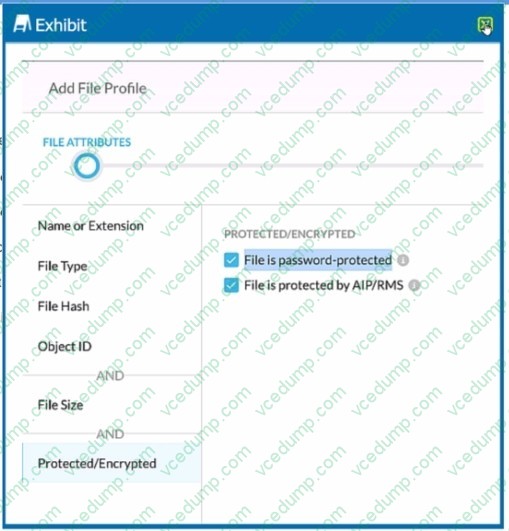
You are attempting to block uploads of password-protected files. You have created the file profile shown in the exhibit. Where should you add this profile to use in a Real-time Protection policy?
A. Add the profile to a DLP profile that is used in a Real-time Protection policy.
B. Add the profile to a Malware Detection profile that is used in a Real-time Protection policy.
C. Add the profile directly to a Real-time Protection policy as a Constraint.
D. Add the profile to a Constraint profile that is used in a Real-time Protection policy. -
Question 52:
You have enabled CASB traffic steering using the Netskope Client, but have not yet enabled a Real-time Protection policy. What is the default behavior of the traffic in this scenario?
A. Traffic will be blocked and logged.
B. Traffic will be allowed and logged.
C. Traffic will be blocked, but not logged.
D. Traffic will be allowed, but not logged. -
Question 53:
Your customer is currently using Directory Importer with Active Directory (AD) to provision users to Nelskope. They have recently acquired three new companies (A.
B. and C) and want to onboard users from the companies onto the NetsKope platform. Information about the companies is shown below.
1. Company A uses Active Directory.
2. Company B uses Azure AD.
3. Company C uses Okta Universal Directory. Which statement is correct in this scenario?
A. Users from Company B and Company C cannot be provisioned because the customer is already using AD Importer.
B. Either Company B or Company C users cannot be provisioned because integration with only one SCIM solution is allowed.
C. Users from Companies A. B, and C can be provisioned to Netskope by deploying additional AD Importers and integrating more than one SCIM solution.
D. Company A users cannot be provisioned to Netskope because the customer is already using AD Importer to import users from another Active Directory environment. -
Question 54:
You are attempting to merge two Advanced Analytics reports with DLP incidents: Report A with 3000 rows and Report B with 6000 rows. Once merged, you notice that the merged report is missing a significant number of rows. What is causing this behavior?
A. Netskope automatically deduplicates data in merged reports.
B. Missing data is due to viewing limits.
C. Filters are applied differently to dimensions and measures
D. Visualizations have a system limit of 5000 rows. -
Question 55:
Review the exhibit.
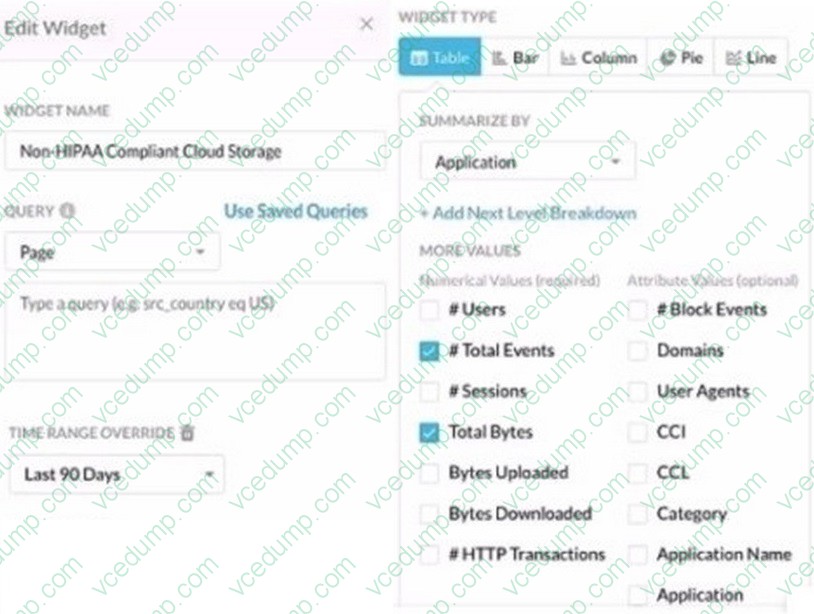
You work for a medical insurance provider. You have Netskope Next Gen Secure Web Gateway deployed to all managed user devices with limited block policies.
Your manager asks that you begin blocking Cloud Storage applications that are not HIPAA compliant Prior to implementing this policy, you want to verity that no business or departmental applications would be blocked by this policy.
Referring to the exhibit, which query would you use in the Edit Widget window to narrow down the results?
A. app-ccl-compliance-cert neq 'HIPAA' and category eq 'Cloud Storage'
B. Cloud Confidence Compliance neq HIPAA and Cloud Confidence Category is Cloud Storage
C. SELECT application WHERE 'HIPAA' NOT IN app-cci-compliance AND WHERE 'Cloud Storage' IN category
D. app-compliance does not contain HIPAA and category must equal Cloud Storage -
Question 56:
You are architecting a Netskope steering configuration for devices that are not owned by the organization The users could be either on-premises or off-premises and the architecture requires that traffic destined to the company's instance of Microsoft 365 be steered to Netskope for inspection.
How would you achieve this scenario from a steering perspective?
A. Use IPsec and GRE tunnels.
B. Use reverse proxy.
C. Use explicit proxy and the Netskope Client
D. Use DPoP and Secure Forwarder -
Question 57:
You built a number of DLP profiles for different sensitive data types. If a file contains any of this sensitive data, you want to take the most restrictive policy action but also create incident details for all matching profiles. Which statement is correct in this scenario?
A. Create a Real-time Protection policy for each DLP profile; each matched profile will generate a unique DLP incident.
B. Create a Real-time Protection policy for each DLP profile; all matched profiles will show up in a single DLP incident
C. Create a single Real-time Protection policy and include all of the DLP profiles; each matched profile will generate a unique DLP incident
D. Create a single Real-time Protection policy and include all of the DLP profiles; all matched profiles will show up in a single DLP incident. -
Question 58:
Review the exhibit.
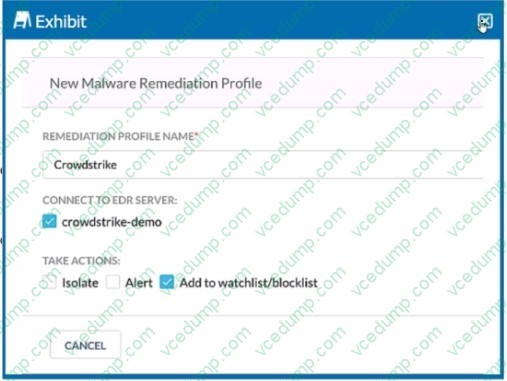
You are asked to integrate Netskope with Crowdstrike EDR. You added the Remediation profile shown in the exhibit. Which action will this remediation profile take?
A. The endpoint will be isolated.
B. The malware hash will be added as an IOC in Crowdstrike.
C. The malware will be quarantined.
D. The malware hash will be added as an IOC in Netskope. -
Question 59:
Review the exhibit.
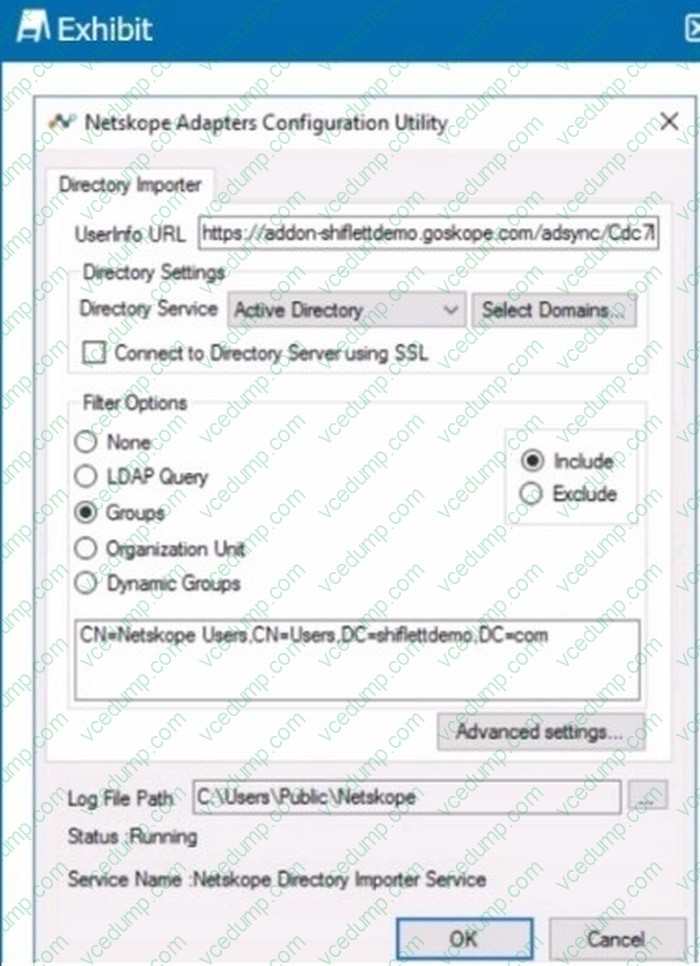
You installed Directory Importer and configured it to import specific groups ot users into your Netskope tenant as shown in the exhibit. One hour after a new user has been added to the domain, the user still has not been provisioned to Netskope.
What are three potential reasons for this failure? (Choose three.)
A. Directory Importer does not support ongoing user syncs; you must manually provision the user.
B. The server that the Directory Importer is installed on is unable to reach Netskope's add- on endpomt.
C. The user is not a member of the group specified as a filter
D. Active Directory integration is not enabled on your tenant.
E. The default collection interval is 180 minutes, therefore a sync may not have run yet. -
Question 60:
What are three valid Instance Types for supported SaaS applications when using Netskope's API-enabled Protection? (Choose three.)
A. Forensic
B. API Data Protection
C. Behavior Analytics
D. DLP Scan
E. Quarantine
Tips on How to Prepare for the Exams
Nowadays, the certification exams become more and more important and required by more and more enterprises when applying for a job. But how to prepare for the exam effectively? How to prepare for the exam in a short time with less efforts? How to get a ideal result and how to find the most reliable resources? Here on Vcedump.com, you will find all the answers. Vcedump.com provide not only Netskope exam questions, answers and explanations but also complete assistance on your exam preparation and certification application. If you are confused on your NSK300 exam preparations and Netskope certification application, do not hesitate to visit our Vcedump.com to find your solutions here.