NSK300 Exam Details
-
Exam Code
:NSK300 -
Exam Name
:Netskope Certified Cloud Security Architect (NCCSA) -
Certification
:Netskope Certifications -
Vendor
:Netskope -
Total Questions
:60 Q&As -
Last Updated
:Jul 08, 2026
Netskope NSK300 Online Questions & Answers
-
Question 1:
You deployed Netskope Cloud Security Posture Management (CSPM) using pre-defined benchmark rules to monitor your cloud posture in AWS, Azure, and GCP. You are asked to assess if you can extend the Netskope CSPM solution by creating custom rules for each environment.
Which statement is correct?
A. Custom rules using Domain Specific Language are only available when using SSPM.
B. You will need to evaluate SaaS Security Posture Management (SSPM) in addition to CSPM so that rules applied to GCP will align with Google Workspace
C. With Netskope CSPM, you can create custom rules using Domain Specific Language for AWS. Azure, but not for GCP.
D. With Netskope CSPM, you can create custom rules using Domain Specific Language for AWS. Azure, and GCP -
Question 2:
A company's architecture includes a server subnet that is logically isolated from the rest of the network with no Internet access, no default gateway, and no access to DNS. New resources can only be provisioned on virtual resources in that segment and there is a firewall that is tunnel-capable securing the perimeter of the segment. The only requirement is to have content filtering for any server that might access the Internet using a browser.
Which two Netskope deployment methods would achieve this requirement? (Choose two.)
A. Deploy a mobile profile on the servers.
B. Deploy Data Plane on Premises (DPoP)with a proxy configuration on the servers.
C. Deploy IPsec or GRE tunnels in the segment to steer traffic from the servers to Netskope.
D. Install the Netskope Client on the servers -
Question 3:
You deployed IPsec tunnels to steer on-premises traffic to Netskope. You are now experiencing problems with an application that had previously been working. In an attempt to solve the issue, you create a Steering Exception in the Netskope tenant tor that application: however, the problems are still occurring
Which statement is correct in this scenario?
A. You must create a private application to steer Web application traffic to Netskope over an IPsec tunnel.
B. Exceptions only work with IP address destinations
C. Steering bypasses for IPsec tunnels must be applied at your edge network device.
D. You must deploy a PAC file to ensure the traffic is bypassed pre-tunnel -
Question 4:
You configured a pair of IPsec funnels from the enterprise edge firewall to a Netskope data plane. These tunnels have been implemented to steer traffic for a set of defined HTTPS SaaS applications accessed from end-user devices that do not support the Netskope Client installation. You discover that all applications steered through this tunnel are non- functional.
According to Netskope. how would you solve this problem?
A. Restart the tunnel to stop the tunnel from flapping.
B. Downgrade from IKE v2 to IKE v1.
C. Install the Netskope root and intermediate certificates on the end-user devices.
D. Disable Perfect Forward Secrecy on the tunnel configuration. -
Question 5:
You are currently designing a policy for AWS S3 bucket scans with a custom DLP profile Which policy action(s) are available for this policy?
A. Alert, Quarantine. Block, User Notification
B. Alert, User Notification
C. Alert only
D. Alert,Quarantine -
Question 6:
You need to extract events and alerts from the Netskope Security Cloud platform and push it to a SIEM solution. What are two supported methods to accomplish this task? (Choose two.)
A. Use Cloud Ticket Orchestrator.
B. Use Cloud Log Shipper.
C. Stream directly to syslog.
D. Use the REST API. -
Question 7:
Users in your network are attempting to reach a website that has a self-signed certificate using a GRE tunnel to Netskope. They are currently being blocked by Netskope with an SSL error. How would you allow this traffic?
A. Configure a Do Not Decrypt SSL Decryption rule to allow traffic to pass.
B. Configure a Real-time Protection policy with the action set to Allow.
C. Set the No SNI setting in Netskope to Bypass.
D. Ensure that the users add the self-signed certificate to their local certificate store. -
Question 8:
You are the network architect for a company using Netskope Private Access. Multiple users are reporting that they are unable to access an application using Netskope Private Access that was working previously. You have verified that the Real-time Protection policy allows access to the application, private applications are steered for the users, and the application is reachable from internal machines. You must verify that the application is reachable through Netskope Publisher
In this scenario, which two tools in the Netskope Ul would you use to accomplish this task? (Choose two.)
A. Reachability Via Publisher in the App Definitions page
B. Troubleshooter tool in the App Definitions page
C. Applications in Skope IT
D. Clear Private App Auth under Users in Skope IT -
Question 9:
Review the exhibit.
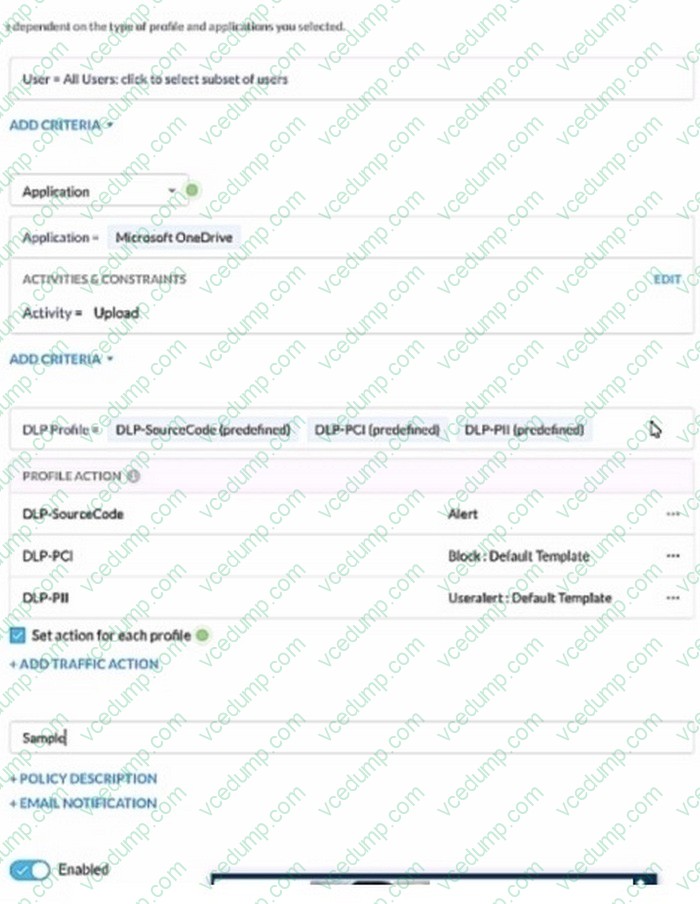
A user has attempted to upload a file to Microsoft OneDrive that contains source code with Pll and PCI data. Referring to the exhibit, which statement Is correct?
A. The user will be blocked and a single Incident will be generated referencing the DLP- PCI profile.
B. The user will be blocked and a single Incident will be generated referencing all of the matching DLP profiles
C. The user will be blocked and a separate incident will be generated for each of the matching DLP profiles.
D. The user will be alerted and a single incident will be generated referencing the DLP-PII profile. -
Question 10:
You are building an architecture plan to roll out Netskope for on-premises devices. You determine that tunnels are the best way to achieve this task due to a lack of support for explicit proxy in some instances and IPsec is the right type of tunnel to achieve the desired security and steering.
What are three valid elements that you must consider when using IPsec tunnels in this scenario? (Choose three.)
A. cipher support on tunnel-initiating devices
B. bandwidth considerations
C. the categories to be blocked
D. the impact of threat scanning performance
E. Netskope Client behavior when on-premises
Tips on How to Prepare for the Exams
Nowadays, the certification exams become more and more important and required by more and more enterprises when applying for a job. But how to prepare for the exam effectively? How to prepare for the exam in a short time with less efforts? How to get a ideal result and how to find the most reliable resources? Here on Vcedump.com, you will find all the answers. Vcedump.com provide not only Netskope exam questions, answers and explanations but also complete assistance on your exam preparation and certification application. If you are confused on your NSK300 exam preparations and Netskope certification application, do not hesitate to visit our Vcedump.com to find your solutions here.