NSE7_EFW-7.0 Exam Details
-
Exam Code
:NSE7_EFW-7.0 -
Exam Name
:Fortinet NSE 7 - Enterprise Firewall 7.0 -
Certification
:Fortinet Certifications -
Vendor
:Fortinet -
Total Questions
:163 Q&As -
Last Updated
:Jul 09, 2026
Fortinet NSE7_EFW-7.0 Online Questions & Answers
-
Question 51:
Which of the following statements is true regarding a FortiGate configured as an explicit web proxy?
A. FortiGate limits the number of simultaneous sessions per explicit web proxy user. This limit CANNOT be modified by the administrator.
B. FortiGate limits the total number of simultaneous explicit web proxy users.
C. FortiGate limits the number of simultaneous sessions per explicit web proxy user The limit CAN be modified by the administrator
D. FortiGate limits the number of workstations that authenticate using the same web proxy user credentials. This limit CANNOT be modified by the administrator. -
Question 52:
Refer to the exhibit, which contains a TCL script configuration on FortiManager.
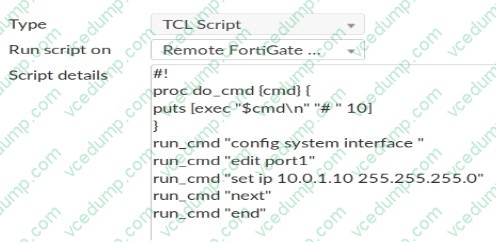
An administrator has configured the TCL script on FortiManager, but failed to apply any changes to the managed device after being executed. Why did the TCL script fail to make any changes to the managed device?
A. Changes in an interface configuration can only be done by CLI script.
B. The TCL script must start with #include .
C. Incomplete commands are ignored in TCL scripts.
D. The TCL command run_cmd has not been created. -
Question 53:
Examine the following traffic log; then answer the question below.
date-20xx-02-01 time=19:52:01 devname=master device_id="xxxxxxx" log_id=0100020007 type=event subtype=system pri critical vd=root service=kemel status=failure msg="NAT port is exhausted."
What does the log mean?
A. There is not enough available memory in the system to create a new entry in the NAT port table.
B. The limit for the maximum number of simultaneous sessions sharing the same NAT port has been reached.
C. FortiGate does not have any available NAT port for a new connection.
D. The limit for the maximum number of entries in the NAT port table has been reached. -
Question 54:
Examine the following partial outputs from two routing debug commands; then answer the question below.
# get router info kernel
tab=254 vf=0 scope=0type=1 proto=11 prio=0 0.0.0.0/0.0.0.0/0->0.0.0.0/0 pref=0.0.0.0
gwy=10.200.1.254 dev=2(port1)
tab=254 vf=0 scope=0type=1 proto=11 prio=10 0.0.0.0/0.0.0.0/0->0.0.0.0/0 pref=0.0.0.0
gwy=10.200.2.254 dev=3(port2)
tab=254 vf=0 scope=253type=1 proto=2 prio=0 0.0.0.0/0.0.0.0/.->10.0.1.0/24 pref=10.0.1.254
gwy=0.0.0.0 dev=4(port3)
# get router info routing-table all s*0.0.0.0/0 [10/0] via 10.200.1.254, portl [10/0] via 10.200.2.254, port2, [10/0] dO.0.1.0/24 is directly connected, port3 dO.200.1.0/24 is directly connected, portl d0.200.2.0/24 is directly connected, port2
Which outbound interface or interfaces will be used by this FortiGate to route web traffic from internal users to the Internet?
A. port!
B. port2.
C. Both portl and port2.
D. port3. -
Question 55:
Refer to the exhibit, which contains the partial output of a diagnose command.
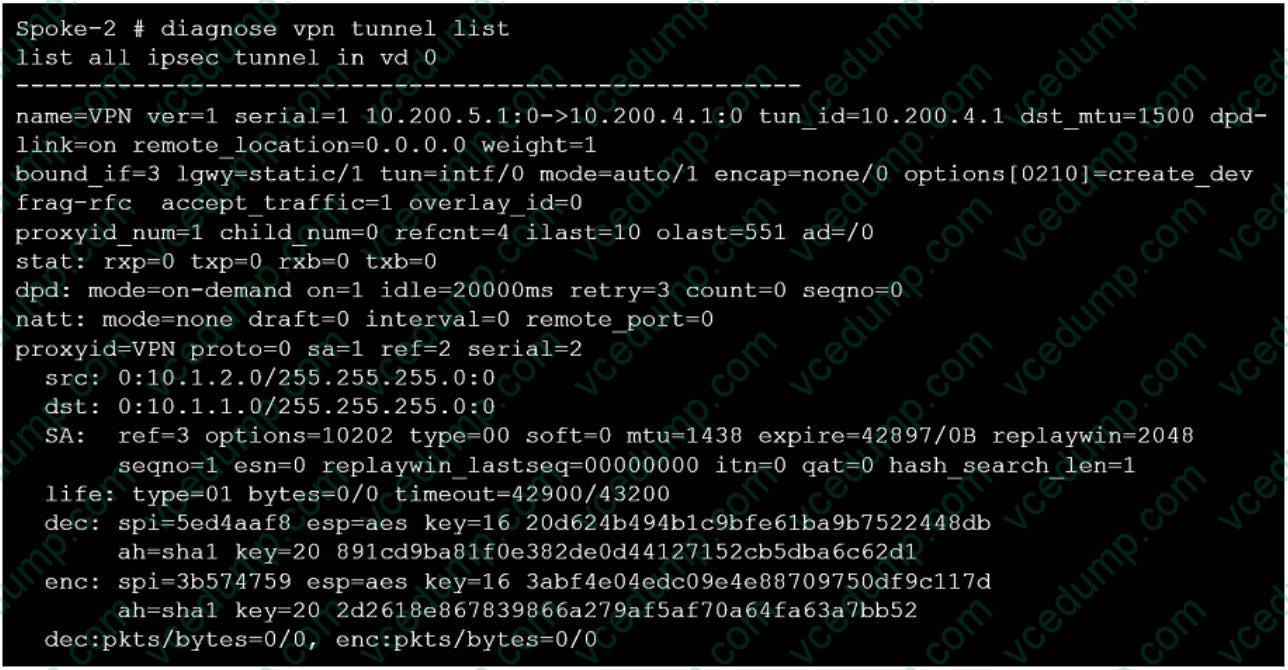
Based on the output, which two statements are correct? (Choose two.)
A. The remote gateway has quick mode selectors containing a destination subnet of 10.1.2.0/24.
B. The remote gateway IP is 10.200.5.1.
C. DPD is disabled.
D. Anti-replay is enabled. -
Question 56:
Refer to the exhibit, which shows the output of diagnose sys session list.
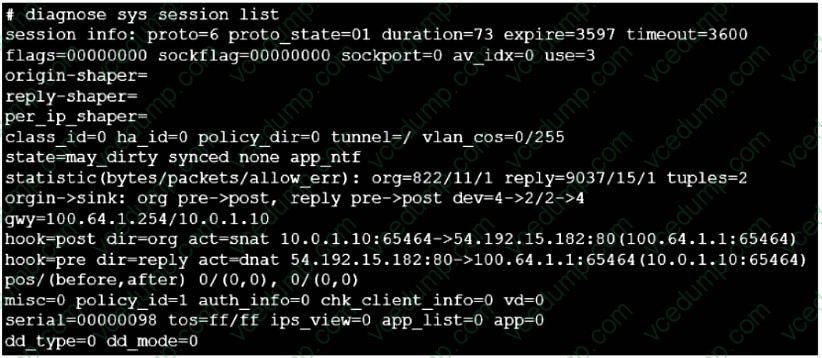
If the HA ID for the primary device is 0, what will happen if the primary fails and the secondary becomes the primary?
A. Traffic for this session continues to be permitted on the new primary device after failover, without requiring the client to restart the session with the server.
B. The secondary device has this session synchronized; however, because application control is applied, the session will be marked dirty and have to be re-evaluated after failover.
C. The session state will be preserved but the kernel will need to re-evaluate the session due to NAT being applied.
D. The session will be removed from the session table of the secondary device due to the presence of allowed error packets, which will force the client to restart the session with the server. -
Question 57:
A FortiGate has two default routes:
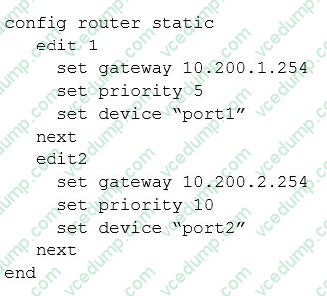
All Internet traffic is currently using port1. The exhibit shows partial information for one sample session of Internet traffic from an internal user:
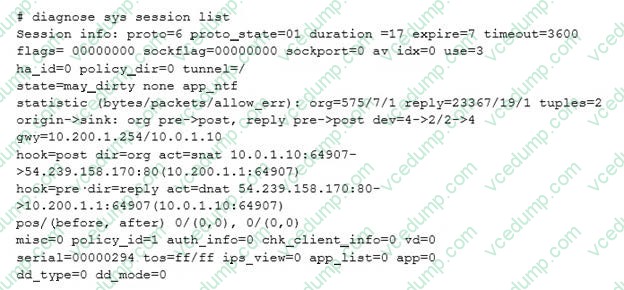
What would happen with the traffic matching the above session if the priority on the first default route (IDd1) were changed from 5 to 20?
A. The session would be deleted, and the client would need to start a new session.
B. The session would remain in the session table, and its traffic would start to egress from port2.
C. The session would remain in the session table, but its traffic would now egress from both port1 and port2.
D. The session would remain in the session table, and its traffic would still egress from port1. -
Question 58:
A FortiGate device has the following LDAP configuration:
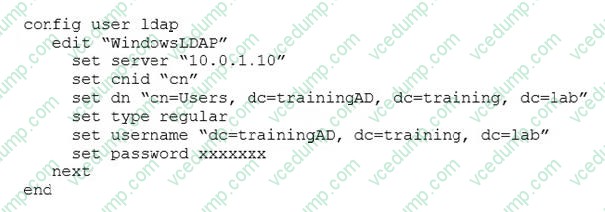
The administrator executed the `dsquery' command in the Windows LDAp server 10.0.1.10, and got the following output:
>dsquery user -samid administrator
"CN=Administrator, CN=Users, DC=trainingAD, DC=training, DC=lab"
Based on the output, what FortiGate LDAP setting is configured incorrectly?
A. cnid.
B. username.
C. password.
D. dn. -
Question 59:
Refer to the exhibit, which shows the output of a BGP debug command.
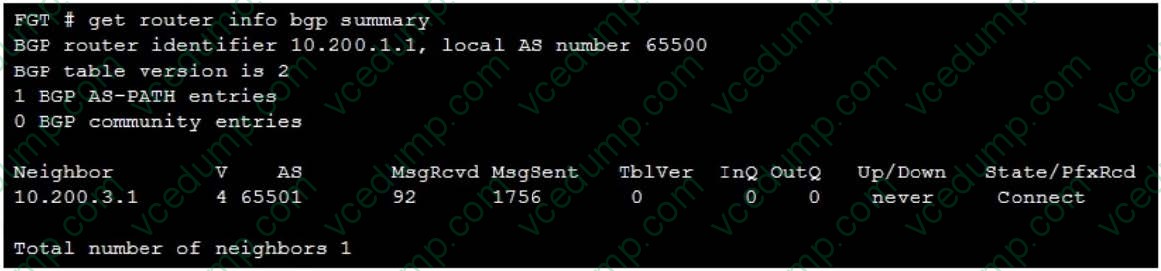
Which statement explains why the state of the 10.200.3.1 peer is Connect?
A. The local router has a different AS number than the remote peer.
B. The local router is receiving BGP keepalives from the remote peer, but the local peer has not received the openConfirm yet.
C. The local router initiated the BGP session to 10.200.3.1 but did not receive a response.
D. The router 10.200.3.1 has authentication configured for BGP and the local router does not. -
Question 60:
Which statement about the designated router (DR) and backup designated router (BDR) in an OSPF multi-access network is true?
A. FortiGate first checks the OSPF ID to elect a DR.
B. Non-DR and non-BDR routers will form full adjacencies to DR and BDR only.
C. BDR is responsible for forwarding link state information from one router to another.
D. Only the DR receives link state information from non-DR routers.
Related Exams:
-
EMEA-ADVANCED-SUPPORT
Fortinet EMEA Advanced Support -
FCP_FAC_AD-6.5
FCP - FortiAuthenticator 6.5 Administrator -
FCP_FAZ_AD-7.4
FCP - FortiAnalyzer 7.4 Administrator -
FCP_FAZ_AN-7.4
FCP - FortiAnalyzer 7.4 Analyst -
FCP_FAZ_AN-7.6
Fortinet NSE 5 - FortiAnalyzer 7.6 Analyst -
FCP_FCT_AD-7.2
FCP - Forti Client EMS 7.2 Administrator -
FCP_FCT_AD-7.4
Fortinet NSE 6 - FortiClient EMS 7.4 Administrator -
FCP_FGT_AD-7.4
FCP - FortiGate 7.4 Administrator -
FCP_FGT_AD-7.6
FortiGate 7.6 Administrator FCP_FGT_AD-7.6 -
FCP_FMG_AD-7.4
FCP - FortiManager 7.4 Administrator
Tips on How to Prepare for the Exams
Nowadays, the certification exams become more and more important and required by more and more enterprises when applying for a job. But how to prepare for the exam effectively? How to prepare for the exam in a short time with less efforts? How to get a ideal result and how to find the most reliable resources? Here on Vcedump.com, you will find all the answers. Vcedump.com provide not only Fortinet exam questions, answers and explanations but also complete assistance on your exam preparation and certification application. If you are confused on your NSE7_EFW-7.0 exam preparations and Fortinet certification application, do not hesitate to visit our Vcedump.com to find your solutions here.