NSE7_EFW-7.0 Exam Details
-
Exam Code
:NSE7_EFW-7.0 -
Exam Name
:Fortinet NSE 7 - Enterprise Firewall 7.0 -
Certification
:Fortinet Certifications -
Vendor
:Fortinet -
Total Questions
:163 Q&As -
Last Updated
:Jul 09, 2026
Fortinet NSE7_EFW-7.0 Online Questions & Answers
-
Question 21:
Examine the output of the `diagnose ips anomaly list' command shown in the exhibit; then answer the question below.
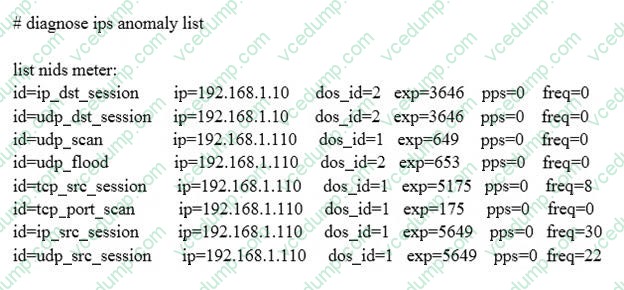
Which IP addresses are included in the output of this command?
A. Those whose traffic matches a DoS policy.
B. Those whose traffic matches an IPS sensor.
C. Those whose traffic exceeded a threshold of a matching DoS policy.
D. Those whose traffic was detected as an anomaly by an IPS sensor. -
Question 22:
An administrator wants to capture encrypted phase 2 traffic between two FortiGate devices using the built-in sniffer.
If the administrator knows that there is no NAT device located between both FortiGate devices, which command should the administrator run?
A. diagnose sniffer packet any `ah'
B. diagnose sniffer packet any `ip proto 50'
C. diagnose sniffer packet any `udp port 4500'
D. diagnose sniffer packet any `udp port 500' -
Question 23:
Which two conditions must be met for a statistic route to be active in the routing table? (Choose two.)
A. The link health monitor (if configured) is up.
B. There is no other route, to the same destination, with a higher distance.
C. The outgoing interface is up.
D. The next-hop IP address is up. -
Question 24:
Which statement about NGFW policy-based application filtering is true?
A. After the application has been identified, the kernel uses only the Layer 4 header to match the traffic.
B. The IPS security profile is the only security option you can apply to the security policy with the action set to ACCEPT.
C. After IPS identifies the application, it adds an entry to a dynamic ISDB table.
D. FortiGate will drop all packets until the application can be identified. -
Question 25:
Refer to the exhibit, which shows the output of get system ha status. NGFW-1 and NGFW- 2 have been up for a week.
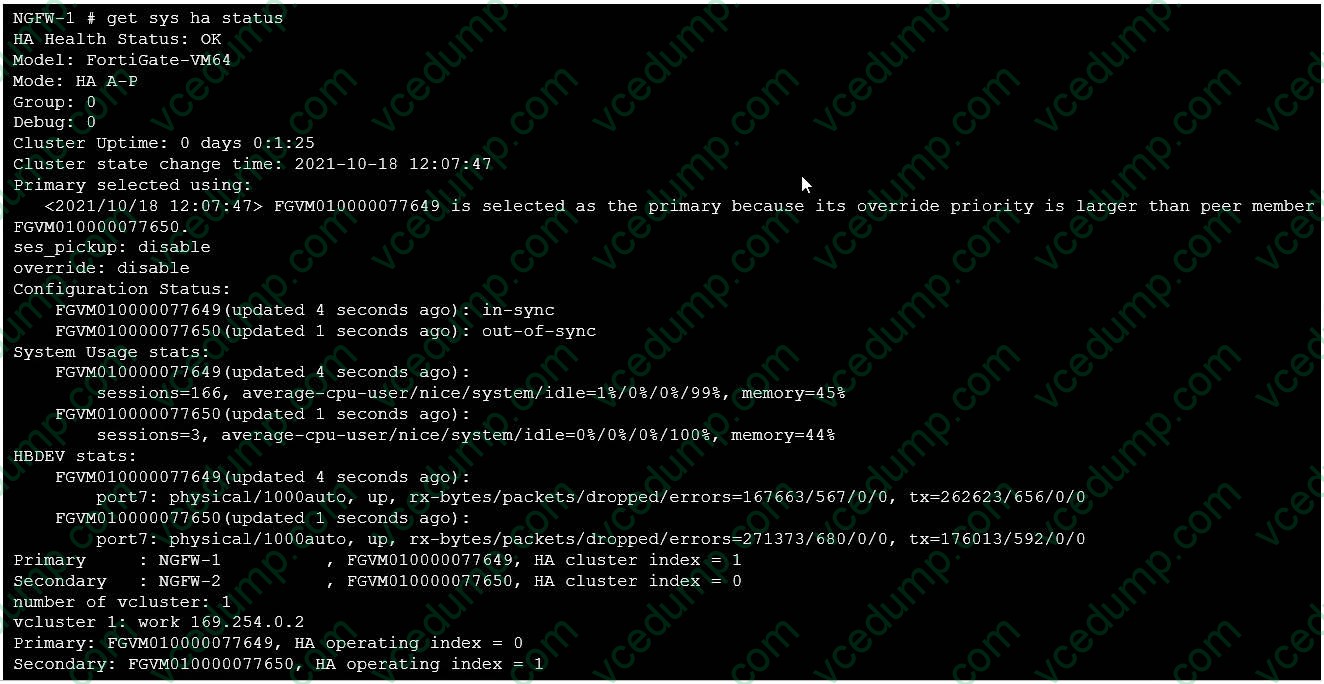
Which two statements about the output are true? (Choose two.)
A. If FGVM...649 is rebooted, FGVM...650 will become the primary and retain that role, even after FGVM...649 rejoins the cluster.
B. If no action is taken, the primary FortiGate will leave the cluster due to the current sync status.
C. If port7 becomes disconnected on the secondary, both FortiGate devices will elect itself the primary.
D. If a configuration change is made to the primary FortiGate at this time, the secondary will initiate a synchronization reset. -
Question 26:
Examine the following routing table and BGP configuration; then answer the question below.
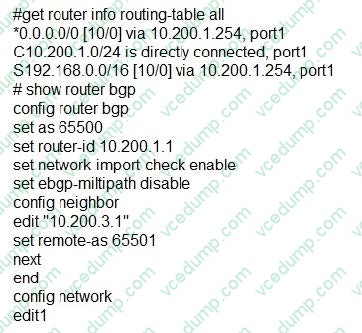
TheBGP connection is up, but the local peer is NOT advertising the prefix 192.168.1.0/24. Which configuration change will make the local peer advertise this prefix?
A. Enable the redistribution of connected routers into BGP.
B. Enable the redistribution of static routers into BGP.
C. Disable the setting network-import-check.
D. Enable the setting ebgp-multipath. -
Question 27:
Examine the output from the 'diagnose debug authd fsso list' command; then answer the question below.
# diagnose debug authd fsso list --FSSO logons-IP: 192.168.3.1 User: STUDENT Groups: TRAININGAD/USERS Workstation: INTERNAL2. TRAINING. LAB The IP address 192.168.3.1 is NOT the one used by the workstation INTERNAL2.
TRAINING.
LAB.
What should the administrator check?
A. The IP address recorded in the logon event for the user STUDENT.
B. The DNS name resolution for the workstation name INTERNAL2. TRAINING. LAB.
C. The source IP address of the traffic arriving to the FortiGate from the workstation INTERNAL2. TRAINING. LAB.
D. The reserve DNS lookup forthe IP address 192.168.3.1. -
Question 28:
Which configuration can be used to reduce the number of BGP sessions in an IBGP network?
A. route-reflector enable
B. route-reflector-server enable
C. route-reflector-client enable
D. route-reflector-peer enable -
Question 29:
Refer to the exhibit, which shows the output of a diagnose command.
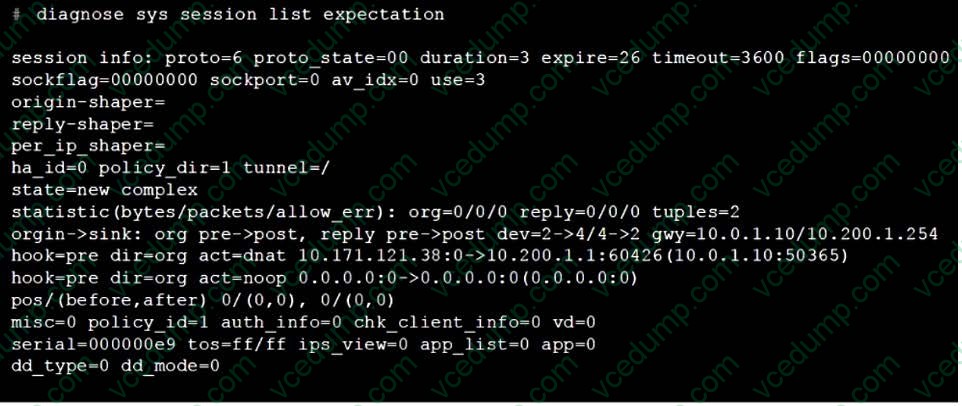
What can you conclude from the output shown in the exhibit? (Choose two.)
A. This is a pinhole session created to allow traffic for a protocol that requires additional sessions to operate through FortiGate.
B. This is an expected session created by the IPS engine.
C. Traffic in the original direction (coming from the IP address 10.171.121.38) will be routed to the next-hop IP address 10.200.1.1.
D. Traffic in the original direction (coming from the IP address 10.171.121.38) will be routed to the next-hop IP address 10.0.1.10. -
Question 30:
Which two tasks are automated using the Install Wizard on FortiManager? (Choose two.)
A. Preview pending configuration changes for managed devices.
B. Add devices to FortiManager.
C. Import policy packages from managed devices.
D. Install configuration changes to managed devices.
E. Import interface mappings from managed devices.
Related Exams:
-
EMEA-ADVANCED-SUPPORT
Fortinet EMEA Advanced Support -
FCP_FAC_AD-6.5
FCP - FortiAuthenticator 6.5 Administrator -
FCP_FAZ_AD-7.4
FCP - FortiAnalyzer 7.4 Administrator -
FCP_FAZ_AN-7.4
FCP - FortiAnalyzer 7.4 Analyst -
FCP_FAZ_AN-7.6
Fortinet NSE 5 - FortiAnalyzer 7.6 Analyst -
FCP_FCT_AD-7.2
FCP - Forti Client EMS 7.2 Administrator -
FCP_FCT_AD-7.4
Fortinet NSE 6 - FortiClient EMS 7.4 Administrator -
FCP_FGT_AD-7.4
FCP - FortiGate 7.4 Administrator -
FCP_FGT_AD-7.6
FortiGate 7.6 Administrator FCP_FGT_AD-7.6 -
FCP_FMG_AD-7.4
FCP - FortiManager 7.4 Administrator
Tips on How to Prepare for the Exams
Nowadays, the certification exams become more and more important and required by more and more enterprises when applying for a job. But how to prepare for the exam effectively? How to prepare for the exam in a short time with less efforts? How to get a ideal result and how to find the most reliable resources? Here on Vcedump.com, you will find all the answers. Vcedump.com provide not only Fortinet exam questions, answers and explanations but also complete assistance on your exam preparation and certification application. If you are confused on your NSE7_EFW-7.0 exam preparations and Fortinet certification application, do not hesitate to visit our Vcedump.com to find your solutions here.