CompTIA N10-008 Online Practice
Questions and Exam Preparation
N10-008 Exam Details
Exam Code
:N10-008
Exam Name
:CompTIA Network+
Certification
:CompTIA Certifications
Vendor
:CompTIA
Total Questions
:1219 Q&As
Last Updated
:Feb 16, 2025
CompTIA N10-008 Online Questions &
Answers
Question 691:
The following instructions were published about the proper network configuration for a videoconferencing device: "Configure a valid static RFC1918 address accordingly to your network. Check the option to use a connection over NAT". Which of the following is a valid IP address configuration for the device?
A. FE80::1 B. 100.64.0.1 C. 169.254.1.2 D. 172.19.0.2 E. 224.0.0.12
D. 172.19.0.2
Explanation/Reference:
172.19.0.2 is a valid IP address configuration for the device that uses a static RFC1918 address for the network and allows for a connection over NAT (Network Address Translation). RFC1918 addresses are private IP addresses that are not routable on the public Internet and are used for internal networks. The RFC1918 address ranges are 10.0.0.0/8, 172.16.0.0/12, and 192.168.0.0/16. NAT is a technique that translates private IP addresses to public IP addresses when communicating with external networks, such as the Internet. FE80::1 is an IPv6 link-local address that is not a static RFC1918 address and does not allow for a connection over NAT. 100.64.0.1 is an IPv4 address that belongs to the shared address space range (100.64.0.0/10) that is used for carrier-grade NAT (CGN) between service providers and subscribers, which is not a static RFC1918 address and does not allow for a connection over NAT. 169.254.1.2 is an IPv4 link-local address that is automatically assigned by a device when it cannot obtain an IP address from a DHCP server or manual configuration, which is not a static RFC1918 address and does not allow for a connection over NAT. 224.0.0.12 is an IPv4 multicast address that is used for VRRP (Virtual Router Redundancy Protocol), which is not a static RFC1918 address and does not allow for a connection over NAT.
Question 692:
Which of the following bandwidth management techniques uses buffers al the client side to prevent TCP retransmissions from occurring when the ISP starts to drop packets of specific types that exceed the agreed traffic rate?
A. Traffic shaping B. Traffic policing C. Traffic marking D. Traffic prioritization
A. Traffic shaping
Explanation/Reference:
Traffic shaping is a bandwidth management technique that allows the administrator to control the flow of traffic from the network to the client. The technique uses buffers at the client side to prevent TCP retransmissions from occurring when the ISP starts to drop packets of specific types that exceed the agreed traffic rate. Traffic shaping enables the administrator to prioritize traffic types and specify the maximum bandwidth that each traffic type can consume.
Question 693:
A help desk supervisor reviews the following excerpt of a call transcript:
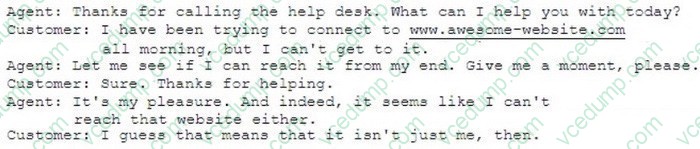
Which of the following was the agent trying to accomplish with this exchange?
A. The agent was questioning the obvious. B. The agent was verifying full system functionality. C. The agent was identifying potential effects. D. The agent was trying to duplicate the problem.
D. The agent was trying to duplicate the problem.
Question 694:
A building was recently remodeled in order to expand the front lobby. Some mobile users have been unable to connect to the available network jacks within the new lobby, while others have had no issues.
Which of the following is the MOST likely cause of the connectivity issues?
A. LACP B. Port security C. 802.11ax D. Duplex settings
B. Port security
Explanation/Reference:
Port security is a feature that allows a network device to limit the number and type of MAC addresses that can access a port. Port security can prevent unauthorized devices from connecting to the network through an available network jack. Therefore, port security is the most likely cause of the connectivity issues for some mobile users in the new lobby.
Question 695:
A technician is troubleshooting a previously encountered issue. Which of the following should the technician reference to find what solution was implemented to resolve the issue?
A. Standard operating procedures B. Configuration baseline documents C. Work instructions D. Change management documentation
D. Change management documentation
Explanation/Reference:
Change management documentation is a record of the changes that have been made to a system or process, including the reason, date, time, and impact of each change. A technician can reference this documentation to find what solution was implemented to resolve a previously encountered issue, as well as any potential side effects or dependencies of the change. References: https://www.comptia.org/blog/what-is-change-management
Question 696:
A network administrator would like to purchase a device that provides access ports to endpoints and has the ability to route between networks. Which of the following would be BEST for the administrator to purchase?
A. An IPS B. A Layer 3 switch C. A router D. A wireless LAN controller
B. A Layer 3 switch
Question 697:
An AP uses a 98ft (30m) Cat 6 cable to connect to an access switch. The cable is wired through a duct close to a three-phase motor installation. Anytime the three-phase is turned on, all users connected to the switch experience high latency on the network. Which of the following is MOST likely the cause of the issue?
A. Interference B. Attenuation C. Open circuit D. Short circuit
A. Interference
Explanation/Reference:
Interference is a phenomenon that occurs when unwanted signals or noise affect the transmission or reception of data signals on a network. Interference can cause network issues such as high latency, low throughput, packet loss, or errors. Interference can be caused by various sources, such as electromagnetic fields, radio waves, power lines, or electrical devices. In this scenario, the three-phase motor installation is a source of interference that affects the Cat 6 cable that connects the AP to the access switch. The cable is wired through a duct close to the motor installation, which exposes it to the electromagnetic fields generated by the motor. Anytime the motor is turned on, the interference causes high latency for all users connected to the switch.
Question 698:
A systems administrator wants to use the least amount of equipment to segment two departments that nave cables terminating in the same room. Which of the following would allow this to occur?
A. A load balancer B. A proxy server C. A Layer 3 switch D. A hub E. A Layer 7 firewall F. The RSSI was not strong enough on the link
C. A Layer 3 switch
Explanation/Reference:
A Layer 3 switch would allow this to occur, as it can segment the two departments by creating virtual LANs (VLANs) and routing traffic between them.
A Layer 3 switch is a type of switch that can perform routing functions in addition to switching. It can use the network layer (Layer 3) of the OSI model to route traffic between different VLANs, which allows for the segmentation of different departments or networks within the same physical space. By creating VLANs for each department and using the Layer 3 switch to route traffic between them, the administrator can segment the two departments without the need for additional equipment.
Question 699:
A network engineer performs the following tasks to increase server bandwidth:
1.
Connects two network cables from the server to a switch stack
2.
Configure LACP on the switchports
3.
Verifies the correct configurations on the switch interfaces
Which of the following needs to be configured on the server?
A. Load balancing B. Multipathing C. NIC teaming D. Clustering
C. NIC teaming
Explanation/Reference:
In this scenario, the network engineer has connected two network cables from the server to a switch stack and configured LACP on the switchports. To take advantage of the increased bandwidth, the server needs to be configured with NIC
teaming, which will allow it to use both network interfaces simultaneously.
Load balancing, multipathing, and clustering are related but different techniques that may also be used to increase server performance and/or availability.
Question 700:
Which of the following is used when a workstation sends a DHCP broadcast to a server on another LAN?
A. Reservation B. Dynamic assignment C. Helper address D. DHCP offer
C. Helper address
Explanation/Reference:
A helper address is an IP address that is configured on a router interface to forward DHCP broadcast messages to a DHCP server on another LAN. A DHCP broadcast message is a message that a workstation sends when it needs to obtain an IP address from a DHCP server. Since broadcast messages are not routed across different networks, a helper address is needed to relay the DHCP broadcast message to the DHCP server on another network.
Nowadays, the certification exams become more and more important and required by more and more
enterprises when applying for a job. But how to prepare for the exam effectively? How to prepare
for the exam in a short time with less efforts? How to get a ideal result and how to find the
most reliable resources? Here on Vcedump.com, you will find all the answers.
Vcedump.com provide not only CompTIA exam questions,
answers and explanations but also complete assistance on your exam preparation and certification
application. If you are confused on your N10-008 exam preparations
and CompTIA certification application, do not hesitate to visit our
Vcedump.com to find your solutions here.