N10-008 Exam Details
-
Exam Code
:N10-008 -
Exam Name
:CompTIA Network+ -
Certification
:CompTIA Certifications -
Vendor
:CompTIA -
Total Questions
:1219 Q&As -
Last Updated
:Feb 16, 2025
CompTIA N10-008 Online Questions & Answers
-
Question 171:
A network client is trying to connect to the wrong TCP port. Which of the following responses would the client MOST likely receive?
A. RST
B. FIN
C. ICMP Time Exceeded
D. Redirect -
Question 172:
Which of the following is a document that states what the minimum performance expectations are within a network?
A. Memorandum of understanding
B. Service-level agreement
C. Non-disclosure agreement
D. Baseline metrics -
Question 173:
Due to space constraints in an IDF, a network administrator can only a do a single switch to accommodate three data networks. The administrator needs a configuration that will allow each device to access its expected network without additional connections. The configuration must also allow each device to access the rest of the network. Which of the following should the administrator do to meet these requirements? (Select TWO).
A. Untag the three VLANs across the uplink
B. Tag an individual VLAN across the uplink
C. Untag an individual VLAN per device port
D. Tag an individual VLAN per device port
E. Tag the three VLANs across the uplink.
F. Tag the three VLANs per device port. -
Question 174:
Given the following output:
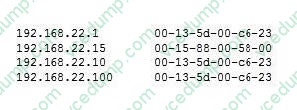
Which of the following attacks is this MOST likely an example of?
A. ARP poisoning
B. VLAN hopping
C. Rogue access point
D. Amplified DoS -
Question 175:
A help desk technician discovers the following note while reviewing tickets in a customer's account:
Was able to confirm customer's problem with the system. Will upgrade system to latest version and monitor for further connectivity problems per developer's instructions.
Which of the following describes what the technician was documenting with this note?
A. The technician was approaching multiple problems individually.
B. The technician was establishing a plan of action and identifying potential effects.
C. The technician was testing a theory to determine the cause.
D. The technician was identifying the problem by gathering information. -
Question 176:
A network technician recently installed a new Layer 2 switch. After scanning the device, the network administrator mentions there is traffic on port 23. Which of the following should the network technician have done during the installation?
A. Disabled Telnet and enabled SSH
B. Created an ACL to block port 23
C. Disabled DHCP snooping
D. Changed the native VLAN -
Question 177:
At which of the following OSI model layers does the Layer 2 Tunneling Protocol operate?
A. Application
B. Session
C. Transport
D. Data link -
Question 178:
A user is unable to perform a reverse DNS lookup of an IP address to a hostname. Which of the following DNS record types is missing?
A. PTR
B. CNAME
C. SOA
D. AAAA -
Question 179:
A network technician needs to install patch cords from the UTP patch panel to the access switch for a newly occupied set of offices. The patch panel is not labeled for easy jack identification. Which of the following tools provides the easiest way to identify the appropriate patch panel port?
A. Toner
B. Laptop
C. Cable tester
D. Visual fault locator -
Question 180:
A business is using the local cable company to provide Internet access. Which of the following types of cabling will the cable company MOST likely use from the demarcation point back to the central office?
A. Multimode
B. Cat 5e
C. RG-6
D. Cat 6
E. 100BASE-T
Related Exams:
-
220-1001
CompTIA A+ Certification: Core 1 -
220-1002
CompTIA A+ Certification: Core 2 -
220-1101
CompTIA A+ Certification: Core 1 -
220-1102
CompTIA A+ Certification: Core 2 -
220-1201
CompTIA A+ Certification: Core 1 -
220-1202
CompTIA A+ Core 2 (2026) -
220-902
CompTIA A+ Certification -
CAS-004
CompTIA Advanced Security Practitioner (CASP+) -
CAS-005
CompTIA SecurityX -
CLO-001
CompTIA Cloud Essentials+
Tips on How to Prepare for the Exams
Nowadays, the certification exams become more and more important and required by more and more enterprises when applying for a job. But how to prepare for the exam effectively? How to prepare for the exam in a short time with less efforts? How to get a ideal result and how to find the most reliable resources? Here on Vcedump.com, you will find all the answers. Vcedump.com provide not only CompTIA exam questions, answers and explanations but also complete assistance on your exam preparation and certification application. If you are confused on your N10-008 exam preparations and CompTIA certification application, do not hesitate to visit our Vcedump.com to find your solutions here.