MLA-C01 Exam Details
-
Exam Code
:MLA-C01 -
Exam Name
:AWS Certified Machine Learning Engineer - Associate (MLA-C01) -
Certification
:Amazon Certifications -
Vendor
:Amazon -
Total Questions
:124 Q&As -
Last Updated
:Jul 09, 2026
Amazon MLA-C01 Online Questions & Answers
-
Question 91:
A company provides access to Amazon SageMaker Studio notebooks via a VPN and needs to enforce access controls to prevent malicious actors from exploiting presigned URLs to access the notebooks. Which solution would effectively address these security requirements?
A. Set up Studio client IP validation by using the aws:sourceIp IAM policy condition.
B. Set up Studio client VPC validation by using the aws:sourceVpc IAM policy condition.
C. Set up Studio client role endpoint validation by using the aws:PrimaryTag IAM policy condition.
D. Set up Studio client user endpoint validation by using the aws:PrincipalTag IAM policy condition. -
Question 92:
A model’s precision is 0.8 and recall is 0.6. What is the F1 score?
A. 0.68
B. 0.72
C. 0.75
D. 0.70 -
Question 93:
A company has AWS Glue data processing jobs that are orchestrated by an AWS Glue work ow. The AWS Glue jobs can run on a schedule or can be launched manually. The company is developing pipelines in Amazon SageMaker Pipelines for ML model development. The pipelines will use the output of the AWS Glue jobs during the data processing phase of model development. An ML engineer needs to implement a solution that integrates the AWS Glue jobs with the pipelines. Which solution will meet these requirements with the LEAST operational overhead?
A. Use AWS Step Functions for orchestration of the pipelines and the AWS Glue jobs.
B. Use processing steps in SageMaker Pipelines. Configure inputs that point to the Amazon Resource Names (ARNs) of the AWS Glue jobs.
C. Use Callback steps in SageMaker Pipelines to start the AWS Glue work ow and to stop the pipelines until the AWS Glue jobs nish running.
D. Use Amazon EventBridge to invoke the pipelines and the AWS Glue jobs in the desired order. -
Question 94:
A company is creating an application that will recommend products for customers to purchase. The application will make API calls to Amazon Q Business. The company must ensure that responses from Amazon Q Business do not include
the name of the company's main competitor.
Which solution will meet this requirement?
A. Configure the competitor's name as a blocked phrase in Amazon Q Business.
B. Configure an Amazon Q Business retriever to exclude the competitor's name.
C. Configure an Amazon Kendra retriever for Amazon Q Business to build indexes that exclude the competitor's name.
D. Configure document attribute boosting in Amazon Q Business to deprioritize the competitor's name. -
Question 95:
An ML engineer is developing a fraud detection model on AWS. The training dataset includes transaction logs, customer profiles, and tables from an on-premises MySQL database. The transaction logs and customer profiles are stored in
Amazon S3. The dataset has a class imbalance that affects the learning of the model's algorithm. Additionally, many of the features have interdependencies. The algorithm is not capturing all the desired underlying patterns in the data. The
ML engineer needs to use an Amazon SageMaker built-in algorithm to train the model.
Which algorithm should the ML engineer use to meet this requirement?
A. LightGBM
B. Linear learner
C. means clustering
D. Neural Topic Model (NTM) -
Question 96:
An ML engineer must evaluate the quality of a time-series forecasting model using appropriate metrics. Which two metrics are most suitable for assessing the performance of this model?
A. Recall
B. LogLoss
C. Root mean square error (RMSE)
D. InferenceLatency
E. Average weighted quantile loss (wQL) -
Question 97:
A company has used Amazon SageMaker to deploy a predictive ML model in production. The company is using SageMaker Model Monitor on the model. After a model update, an ML engineer notices data quality issues in the Model Monitor checks. What should the ML engineer do to mitigate the data quality issues that Model Monitor has identified?
A. Adjust the model's parameters and hyperparameters.
B. Initiate a manual Model Monitor job that uses the most recent production data.
C. Create a new baseline from the latest dataset. Update Model Monitor to use the new baseline for evaluations.
D. Include additional data in the existing training set for the model. Retrain and redeploy the model. -
Question 98:
An advertising company uses AWS Lake Formation to manage a data lake. The data lake contains structured data and unstructured data. The company's ML engineers are assigned to specific advertisement campaigns. The ML engineers must interact with the data through Amazon Athena and by browsing the data directly in an Amazon S3 bucket. The ML engineers must have access to only the resources that are specific to their assigned advertisement campaigns. Which solution will meet these requirements in the MOST operationally efficient way?
A. Configure IAM policies on an AWS Glue Data Catalog to restrict access to Athena based on the ML engineers' campaigns.
B. Store users and campaign information in an Amazon DynamoDB table. Configure DynamoDB Streams to invoke an AWS Lambda function to update S3 bucket policies.
C. Use Lake Formation to authorize AWS Glue to access the S3 bucket. Configure Lake Formation tags to map ML engineers to their campaigns.
D. Configure S3 bucket policies to restrict access to the S3 bucket based on the ML engineers' campaigns. -
Question 99:
A company needs to automatically install a custom script on all newly created Amazon SageMaker notebook instances, aiming to minimize operational overhead. Which solution would most efficiently satisfy this requirement?
A. Create a lifecycle configuration script to install the custom script when a new SageMaker notebook is created. Attach the lifecycle configuration to every new SageMaker notebook as part of the creation steps.
B. Create a custom Amazon Elastic Container Registry (Amazon ECR) image that contains the custom script. Push the ECR image to a Docker registry. Attach the Docker image to a SageMaker Studio domain. Select the kernel to run as part of the SageMaker notebook.
C. Create a custom package index repository. Use AWS CodeArtifact to manage the installation of the custom script. Set up AWS PrivateLink endpoints to connect CodeArtifact to the SageMaker instance. Install the script.
D. Store the custom script in Amazon S3. Create an AWS Lambda function to install the custom script on new SageMaker notebooks. Configure Amazon EventBridge to invoke the Lambda function when a new SageMaker notebook is initialized. -
Question 100:
HOTSPOT
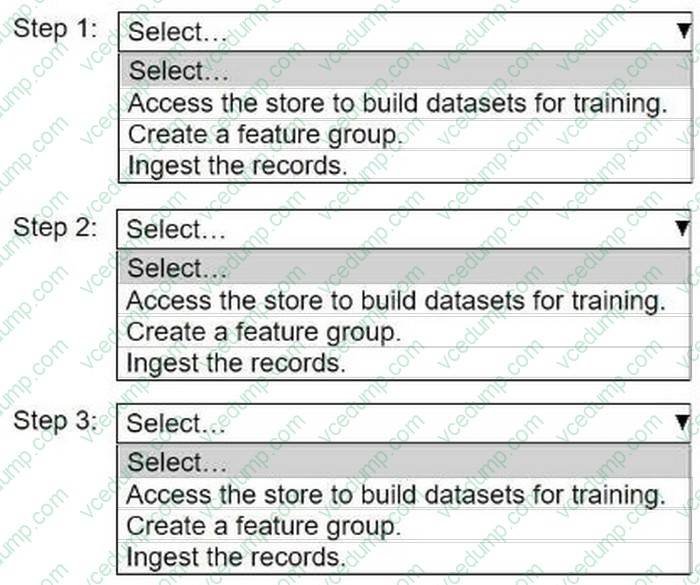
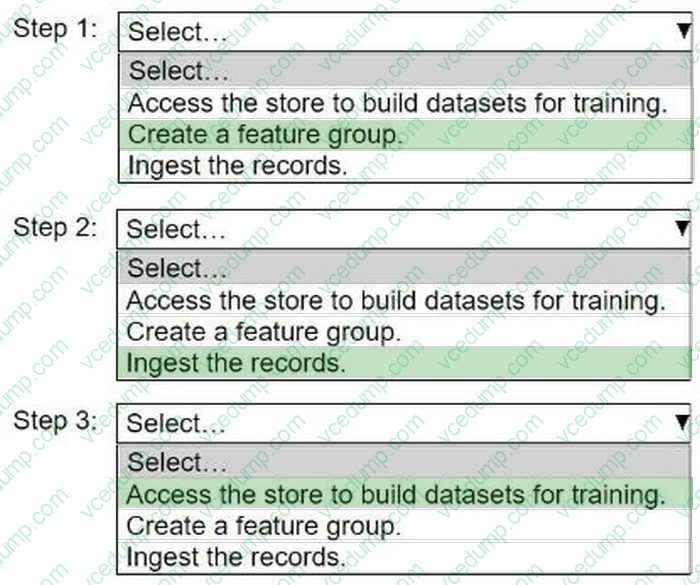
An ML engineer needs to use Amazon SageMaker Feature Store to create and manage features to train a model. Select and order the steps from the following list to create and use the features in Feature Store. Each step should be selected one time.
(Select and order three.)
1. Access the store to build datasets for training.
2. Create a feature group.
3. Ingest the records.
Related Exams:
-
AIF-C01
Amazon AWS Certified AI Practitioner (AIF-C01) -
AIP-C01
AWS Certified Generative AI Developer - Professional -
ANS-C00
AWS Certified Advanced Networking - Specialty (ANS-C00) -
ANS-C01
AWS Certified Advanced Networking - Specialty (ANS-C01) -
AXS-C01
AWS Certified Alexa Skill Builder - Specialty (AXS-C01) -
BDS-C00
AWS Certified Big Data - Speciality (BDS-C00) -
CLF-C02
AWS Certified Cloud Practitioner (CLF-C02) -
DAS-C01
AWS Certified Data Analytics - Specialty (DAS-C01) -
DATA-ENGINEER-ASSOCIATE
AWS Certified Data Engineer - Associate (DEA-C01) -
DBS-C01
AWS Certified Database - Specialty (DBS-C01)
Tips on How to Prepare for the Exams
Nowadays, the certification exams become more and more important and required by more and more enterprises when applying for a job. But how to prepare for the exam effectively? How to prepare for the exam in a short time with less efforts? How to get a ideal result and how to find the most reliable resources? Here on Vcedump.com, you will find all the answers. Vcedump.com provide not only Amazon exam questions, answers and explanations but also complete assistance on your exam preparation and certification application. If you are confused on your MLA-C01 exam preparations and Amazon certification application, do not hesitate to visit our Vcedump.com to find your solutions here.