JN0-681 Real Exam Questions

Data Center, Professional (JNCIP-DC)

65 questions available · Page 1 of 7

Updated Exam DumpsVerified AnswersPass Guarantee

Get Complete Exam Dumps
Question 1 Multiple choice

You are asked to manage the oversubscription ratio of your spine and leaf IP fabric. You determine that you are at a 3:1 ratio of downstream to upstream traffic and must achieve a 1:1 ratio.

In this scenario, which two actions would you take to achieve this goal? (Choose two.)

  1. A

    Increase the number of server-facing ports that each leaf node uses to carry traffic.

  2. B

    Reduce the number of server-facing ports that each leaf node uses to carry traffic.

  3. C

    Increase the number of spine nodes in your design.

  4. D

    Reduce the number of leaf nodes in your design.

Show answer and explanation

Correct answers: B, C
Question 2 Single choice

Which EVPN route type would be used in a DCI situation in which the IP subnets between data centers are completely unique?

  1. A

    Type 2

  2. B

    Type 3

  3. C

    Type 4

  4. D

    Type 5

Show answer and explanation

Correct answer: D

Question 3 Single choice

You are implementing perimeter security for your data center. You need to inspect all traffic at Layer 7 and ensure the failure of a port or device will not result in an interruption to traffic flows.

In this scenario, which design would satisfy these requirements?

  1. A

    SRX using LAG

  2. B

    MX with MC-LAG

  3. C

    QFX Virtual Chassis

  4. D

    SRX chassis cluster

Show answer and explanation

Correct answer: D

Question 4 Single choice

You are creating a new EVPN and are asked to selectively accept certain MAC advertisement routes from
your EVPN peers using VXLAN encapsulation.

Which statement is correct in this scenario?

  1. A

    You can use MAC filtering to filter out unwanted routes.

  2. B

    You can use VRF import policies and route distinguisher values to filter out unwanted routes.

  3. C

    You can use VRF import policies and community values to filter out unwanted routes.

  4. D

    You can use firewall filters to filter out unwanted routes.

Show answer and explanation

Correct answer: C

Question 5 Single choice

What happens when a packet is encapsulated by a VXLAN before being placed in the overlay?

  1. A

    The QoS markings are placed in the VXLAN header.

  2. B

    The VLAN-ID is placed in the VXLAN header.

  3. C

    A VNI that maps to the VLAN-ID is placed in the VXLAN header.

  4. D

    The TTL is decremented by two and placed in the VXLAN header.

Show answer and explanation

Correct answer: C

Question 6 Multiple choice

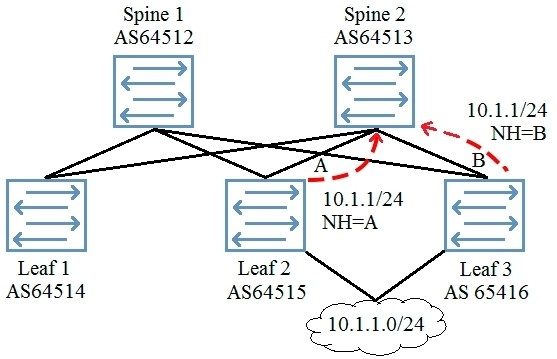
Referring to the exhibit, each node in the IP fabric is peering to its directly attached neighbor using EBGP.
Each node is peering using physical interface IP addresses. Leaf 2 and Leaf 3 are advertising the 10.1.1/24 network into EBGP. Spine 2 must be configured so that it can load-share traffic destined to the 10 1.1/24 network over both next-hop A and next-hop B.

Which two actions must be performed to accomplish this task? (Choose two.)

  1. A

    Use a load-balancing policy applied to the forwarding table.

  2. B

    Use multipath multiple-AS.

  3. C

    Use advertise-inactive.

  4. D

    Use multihop.

Show answer and explanation

Correct answers: A, B

Question 7 Multiple choice

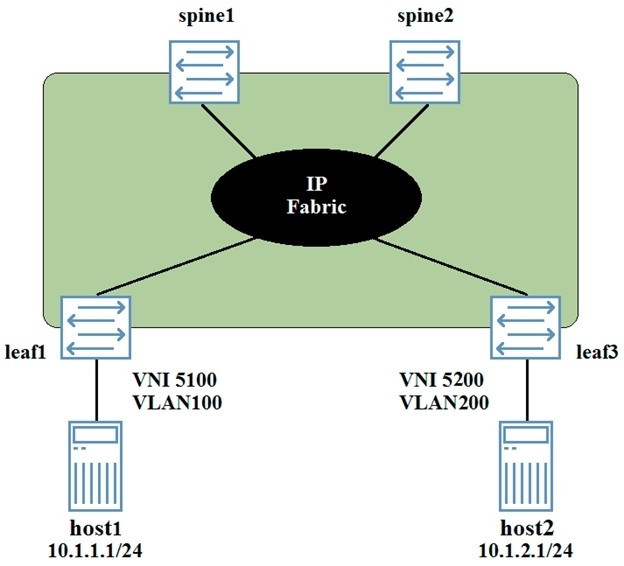
Host1 and host2 are connected to an EVPN signaled VXLAN overlay, and must have Layer 3 connectivity.
The VNI and VLAN assignments are shown in the exhibit.

In this scenario, which two statements are true? (Choose two.)

  1. A

    The ESI assigned to the host1 link will be different from the ESI assigned to the host2 link.

  2. B

    The VNI assigned to the host1 link must be the same as the VNI assigned to the host2 link.

  3. C

    A Layer 3 gateway can be configured on the spine devices.

  4. D

    A Layer 3 gateway can be configured on the leaf devices.

Show answer and explanation

Correct answers: C, D

Question 8 Single choice

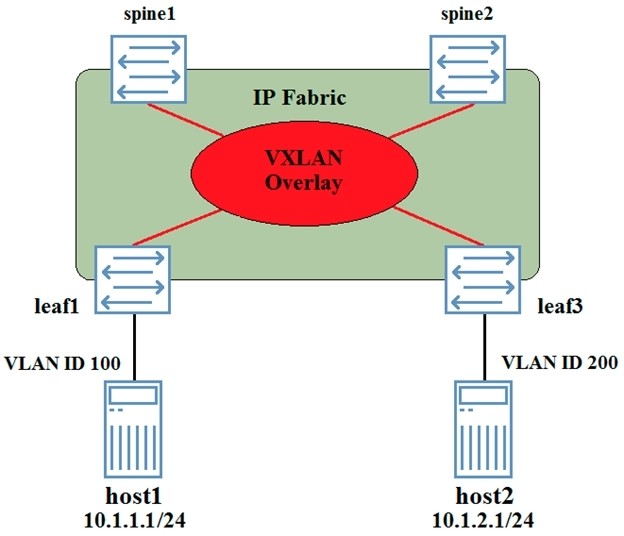
You have deployed a VXLAN as shown in the exhibit Leaf1, leaf3, spine1, and spine2 have been configured as VTEPs. Host1 cannot communicate with host2.

Referring to the exhibit, how would you solve this problem?

  1. A

    The VLAN ID on the link connected to host2 must be changed to VLAN 100.

  2. B

    A DCI connection must be created between the VLANs.

  3. C

    A Layer 3 VXLAN gateway must be configured on at least one of the devices.

  4. D

    Host1 and host2 must be placed in the same VRF.

Show answer and explanation

Correct answer: C

Question 9 Single choice

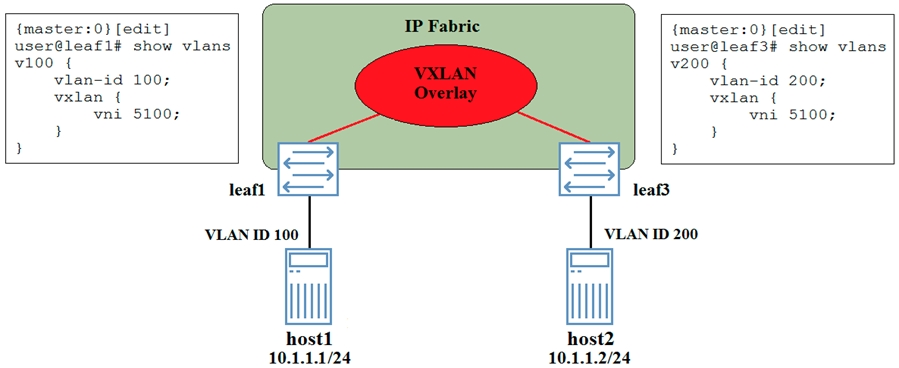
A VXLAN has been created between devices leaf1 and leaf3.

Referring to the exhibit, which statement is true?

  1. A

    Traffic sent from host1 to host2 will be tagged with VLAN ID 200 when exiting leaf3.

  2. B

    Traffic sent from leaf1 to host2 will he dropped on leaf1.

  3. C

    Traffic sent from host1 to host2 will be tagged with VLAN ID 100 when exiting leaf3.

  4. D

    Traffic sent from leaf1 to host2 will he dropped on leaf3.

Show answer and explanation

Correct answer: A

Question 10 Single choice

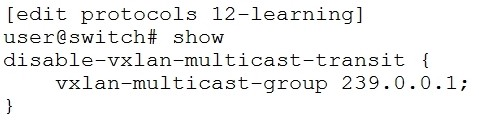
What is the purpose of the command shown in the exhibit?

  1. A

    to stop the transmission of transit multicast traffic when there are no interested receivers attached to a remote VTEP.

  2. B

    to disallow IGMP requests for the group 239.0.0.1 from hosts attached to the local VTEP.

  3. C

    to disable the multicast group 239.0.0.1 across the entire VXLAN.

  4. D

    to stop the reception of transit multicast traffic when there are no interested receivers attached to the local VTEP.

Show answer and explanation

Correct answer: A