JN0-650 Real Exam Questions

Enterprise Routing and Switching - Professional (JNCIP-ENT)

136 questions available · Page 1 of 14

Updated Exam DumpsVerified AnswersPass Guarantee

Get Complete Exam Dumps
Question 1 Multiple choice

Which two statements are correct about EVPN/VXLAN deployments? (Choose two.)

  1. A

    The VLAN tags are maintained when traffic is sent through the IP fabric.

  2. B

    The VLAN tags associated with source and destination ports for a given flow must match.

  3. C

    The VLAN tags are removed before traffic is sent through the IP fabric.

  4. D

    The VLAN tags associated with source and destination ports for a given flow are not required to match.

Show answer and explanation

Correct answers: C, D

Question 2 Single choice

Which EVPN route type advertises a learned endpoint MAC address and can also carry its associated IP information?

  1. A

    Route type 1, Ethernet auto-discovery

  2. B

    Route type 2, MAC/IP advertisement

  3. C

    Route type 3, inclusive multicast Ethernet tag

  4. D

    Route type 5, IP prefix

Show answer and explanation

Correct answer: B

Question 3 Multiple choice

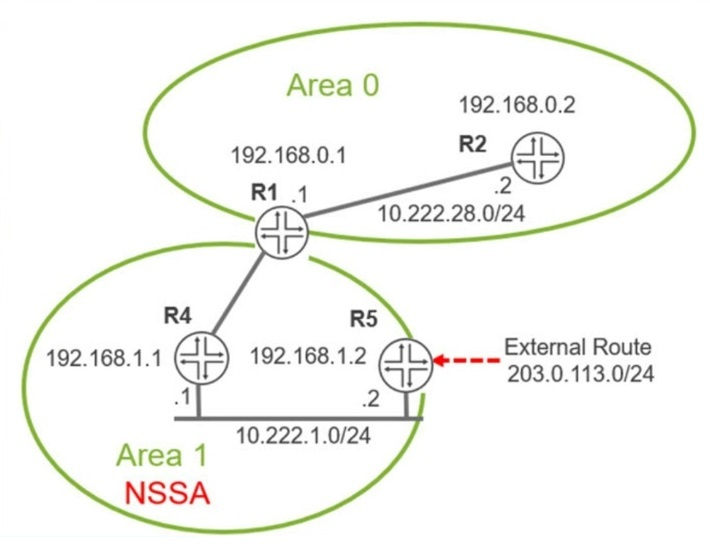
Click the Exhibit button.

Referring to the exhibit, which two statements are correct? (Choose two.)

  1. A

    R1 will advertise the 203.0.113.0/24 route as an OSPF Type 7 LSA into Area 0.

  2. B

    R5 will advertise the 203.0.113.0/24 route as an OSPF Type 5 LSA into Area 1.

  3. C

    R1 will advertise the 203.0.113.0/24 route as an OSPF Type 5 LSA into Area 0.

  4. D

    R5 will advertise the 203.0.113.0/24 route as an OSPF Type 7 LSA into Area 1.

Show answer and explanation

Correct answers: C, D

Question 4 Single choice

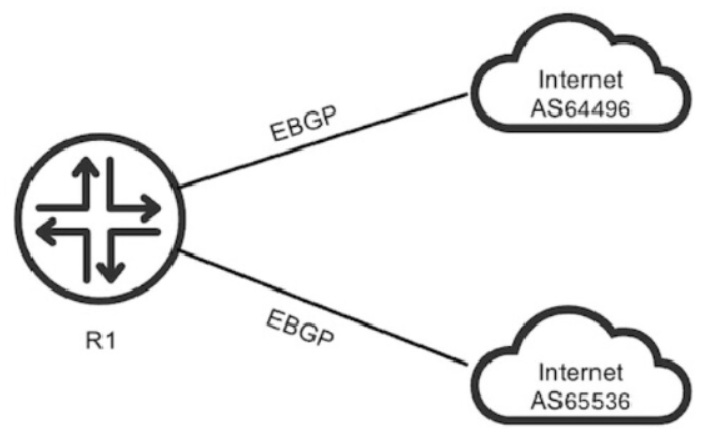
Click the Exhibit button.

You are configuring EBGP load balancing on R1 to use both uplinks to ISPs for outbound traffic. Both ISPs advertise the multiple prefixes with identical AS_PATH lengths. However, traffic is still using only one uplink.

Referring to the exhibit, which additional configuration is required on R1 to enable EBGP multipath load balancing?

  1. A

    Ensure that both EBGP peers are in the same BGP group and use set protocols bgp group EBGP multipath.

  2. B

    Configure set protocols bgp path-selection external-router-id to prefer the router ID for tie-breaking.

  3. C

    Enable multipath multiple-as under the BGP group to allow multipath across different ASs.

  4. D

    Configure set routing-options forwarding-table export load-balance to enable per-packet load balancing.

Show answer and explanation

Correct answer: C

Question 5 Multiple choice

While reviewing routing information on your router, you notice that the routing table has a hidden BGP route.

In this scenario, what are two reasons for this behavior? (Choose two.)

  1. A

    The AS path contains an entry of 0.

  2. B

    The AS path for EBGP is empty.

  3. C

    The next hop for the route is unreachable.

  4. D

    The next hop is rewritten to self.

Show answer and explanation

Correct answers: A, C

Question 6 Single choice

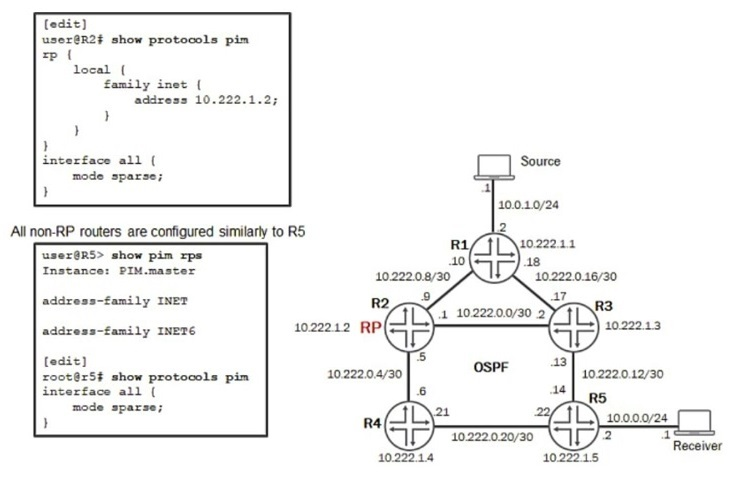
Click the Exhibit button.

You need to configure the non-RP routers in your network to dynamically learn the location of the RP using standard protocols only. You have already applied the configuration shown in the exhibit, but the routers have not learned the location of the RP.

Which additional step must you take to fulfill these requirements?

  1. A

    Configure MSDP.

  2. B

    Configure BSR.

  3. C

    Configure Anycast RP.

  4. D

    Configure Auto-RP.

Show answer and explanation

Correct answer: B

Question 7 Single choice

You configured MVRP in your Layer 2 network and you are adding two new interfaces to your distribution switch. You are asked to ensure that if a rogue device that uses MVRP is connected to these interfaces, that the MVRP PDUs are ignored.

In this scenario, what should you configure to accomplish this task?

  1. A

    Configure the join-timer to 500 ms.

  2. B

    Configure the no-dynamic-vlan feature under MVRP.

  3. C

    Configure the two new interfaces as point-to-point.

  4. D

    Configure the two new interfaces under MVRP using the forbidden registration mode.

Show answer and explanation

Correct answer: D

Question 8 Single choice

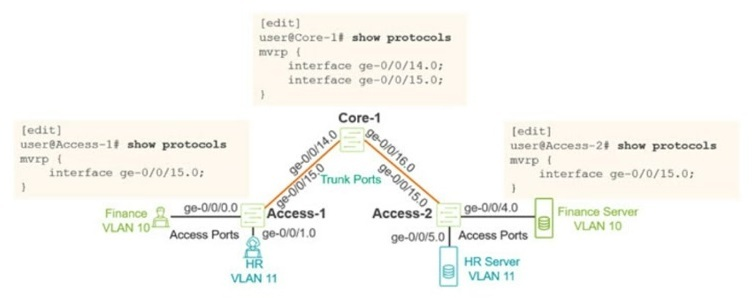
Click the Exhibit button.

You configured MVRP in your Layer 2 network using the configuration shown in the exhibit. You verified that the appropriate VLANs are configured and applied on the two access switches. You are using RSTP as your loop prevention mechanism. Unfortunately, the users are not able to communicate with their corresponding server attached to the Access-2 switch.

In this scenario, what should you do to solve this problem?

  1. A

    Configure VSTP instead of RSTP as your loop-prevention mechanism.

  2. B

    Configure the access interfaces on the Access-2 switch under MVRP.

  3. C

    Configure the ge-0/0/16.0 interface on the Core-1 switch under MVRP.

  4. D

    Configure the access interfaces on the Access-1 switch under MVRP.

Show answer and explanation

Correct answer: B

Question 9 Single choice

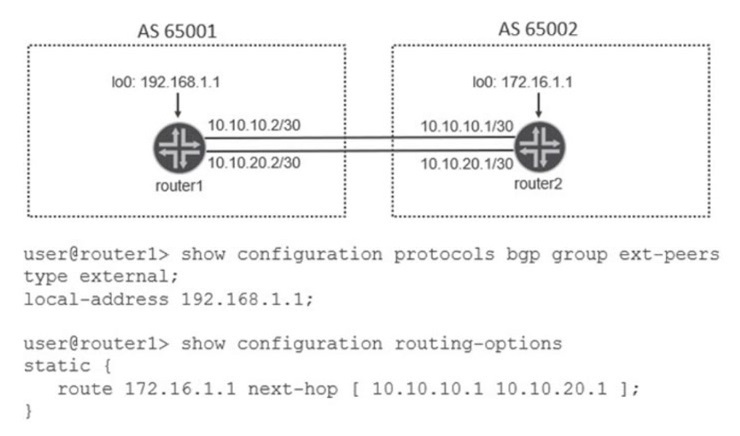
Click the Exhibit button.

Referring to the exhibit, what is required for the BGP peering to establish?

  1. A

    Configure neighbor 172.16.1.1 multipath under the ext-peers hierarchy.

  2. B

    Configure neighbor 10.10.20.1 multihop under the ext-peers hierarchy.

  3. C

    Configure neighbor 10.10.10.1 multihop under the ext-peers hierarchy.

  4. D

    Configure neighbor 172.16.1.1 multihop under the ext-peers hierarchy.

Show answer and explanation

Correct answer: D

Question 10 Single choice

You want to dynamically have devices discover VLANs and have enabled MVRP.

Which statement is correct in this scenario?

  1. A

    Dynamic VLAN creation is disabled by default.

  2. B

    BPDUs are used to synchronize membership between devices.

  3. C

    MVRP requires that GVRP be enabled.

  4. D

    When using VSTP on trunk interfaces, VLANs must be statically defined.

Show answer and explanation

Correct answer: A