JN0-643 Exam Details
-
Exam Code
:JN0-643 -
Exam Name
:Enterprise Routing and Switching, Professional (JNCIP-ENT) -
Certification
:Juniper Certifications -
Vendor
:Juniper -
Total Questions
:287 Q&As -
Last Updated
:Jul 11, 2026
Juniper JN0-643 Online Questions & Answers
-
Question 211:
-- Exhibit -
Mar 16 17:54:51.930726 OSPF periodic xmit from 172.14.10.1 to 224.0.0.5 (IFL 69 area 0.0.0.0) Mar 16 17:54:55.566920 ospf_trigger_build_telink_lsas : No peer found Mar 16 17:54:56.152585 ospf_trigger_build_telink_lsas : No peer found Mar 16 17:54:56.152721 ospf_set_lsdb_statE. Router LSA 192.168.2.1 adv-rtr 192.168.2.1 state QUIET>GEN_PENDING Mar 16 17:54:56.153271 OSPF trigger router LSA 0x156d0f0 build for area 0.0.0.0 lsa-id 192.168.2.1 Mar 16 17:54:56.157854 ospf_set_lsdb_statE. Router LSA 192.168.2.1 adv-rtr 192.168.2.1 state GEN_PENDING->QUIET Mar 16 17:54:56.157971 OSPF built router LSA, area 0.0.0.0, link count 2 Mar 16 17:54:56.158300 OSPF sent Hello 172.14.10.1 -> 224.0.0.5 (ge-0/0/1.0 IFL 69 area 0.0.0.0) Mar 16 17:54:56.158380 Version 2, length 44, ID 192.168.2.1, area 0.0.0.0 Mar 16 17:54:56.158435 mask 255.255.255.0, hello_ivl 10, opts 0x2, prio 128 Mar 16 17:54:56.158485 dead_ivl 40, DR 172.14.10.1, BDR 0.0.0.0 Mar 16 17:54:56.158949 OSPF DR is 192.168.2.1, BDR is 0.0.0.0 Mar 16 17:54:56.159276 OSPF sent Hello 172.14.10.1 -> 224.0.0.5 (ge-0/0/1.0 IFL 69 area 0.0.0.0) Mar 16 17:54:56.159331 Version 2, length 44, ID 192.168.2.1, area 0.0.0.0 Mar 16 17:54:56.159401 mask 255.255.255.0, hello_ivl 10, opts 0x2, prio 128 Mar 16 17:54:56.159563 dead_ivl 40, DR 172.14.10.1, BDR 0.0.0.0 Mar 16 17:54:56.168108 OSPF DR is 192.168.2.1, BDR is 0.0.0.0 Mar 16 17:54:58.237416 OSPF rcvd Hello 172.14.10.2 -> 224.0.0.5 (ge-0/0/1.0 IFL 69 area 0.0.0.0) Mar 16 17:54:58.237540 Version 2, length 44, ID 192.168.2.1, area 0.0.0.0 Mar 16 17:54:58.237623 checksum 0x0, authtype 0 Mar 16 17:54:58.237698 mask 255.255.255.0, hello_ivl 10, opts 0x2, prio 128 Mar 16 17:54:58.237751 dead_ivl 40, DR 172.14.10.2, BDR 0.0.0.0 -- Exhibit -
Click the Exhibit button.
Looking at the traceoptions output in the exhibit, why are the OSPF routers stuck in Init state?
A. There is an MTU mismatch.
B. There are duplicate router IDs.
C. The routers are in different areas.
D. No BDR has been elected. -
Question 212:
-- Exhibit -{master:0}[edit protocols dot1x]
user@switch# show
authenticator {
authentication-profile-name my-profile;
static {
00:21:cc:ba:c7:00/40 {
interface ge-0/0/12.0;
}
}
interface {
ge-0/0/12.0 {
supplicant multiple;
server-fail deny;
}
ge-1/0/14.0 {
reauthentication 120;
server-fail vlan-name local-only;
}
ge-1/0/15.0 {
supplicant multiple;
mac-radius {
restrict;
}
reauthentication 120;
server-fail vlan-name guest;
}
}
}
-- Exhibit -
Click the Exhibit button.
You just added a device on port ge-0/0/12 with the MAC address 00:21:cc:ba:c7:59. All access ports on this device are members of VLAN v20. The RADIUS server is currently not reachable.
Referring to the configuration shown in the exhibit, what happens to traffic sent from this device?
A. The traffic is denied.
B. The traffic is accepted and uses the guest VLAN.
C. The traffic is accepted and uses the local-only VLAN.
D. The traffic is accepted and uses the v20 VLAN. -
Question 213:
-- Exhibit -
user@router> show configuration routing-options
rib-groups {
foo {
import-rib [ inet.8 inet.2 inet.0 ];
}
}
user@router> show configuration protocols pim
rib-group inet foo;
interface all;
-- Exhibit -
Click the Exhibit button.
Based on the configuration in the exhibit, which routing table is used for IPv4 multicast RPF checks?
A. inet.0
B. inet.2
C. foo.inet.0
D. inet.8 -
Question 214:
When using PIM-SM in ASM mode, which two events trigger the creation of a shortest-path tree? (Choose two.)
A. Multicast traffic received at the receiver's designated router (DR).
B. PIM join received at the receiver's designated router (DR).
C. PIM join received at the source designated router (DR).
D. PIM registers received by the rendezvous point (RP). -
Question 215:
You are asked to configure OSPF for IPV4 and IPV6 route advertisement.Which two configuration accomplish the task? (Choose two)
A. [edit] user@switchl#show protocols ospf3{ export redistribute-ipv4; area 0.0.0.0 { interface al; } } [edit] user@switchl#show policy-options policy-statement redistribute-ipv4{ from family inet; to family inet6; then accept; }
B. [edit] protocols { ospf{ area 0.0.0.0 { interface all; } } ospf3 { area 0.0.0.0{
C. [edit] user@switch # show protocols Nospf { export redistribute-ipv6; area 0.0.0.0{ interface all; } } [edit] user@switch# show policy-options policy-statement redistribute-ipv6{ from family inet6; to family inet; then accept }
D. [edit] user@switch# show protocols ospf3 { relam ipv4-unicast { area 0.0.0.0 { interface all: } } area 0.0.0.0 interface all; -
Question 216:
-- Exhibit
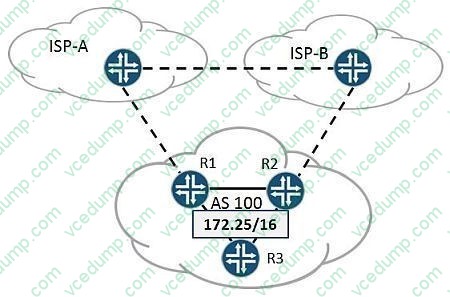
-- Exhibit -Click the Exhibit button.
Referring to the exhibit, your AS is connected to ISP-A and ISP-B using BGP. R1 and R2 are advertising your AS's 172.25/16 prefix upstream to both ISPs, and both ISPs are providing a full BGP route table. You want to influence traffic flow
so that traffic towards your network enters through R1.
Which action would meet the requirement?
Apply the following as an export policy towards ISP-B:
A. [edit policy-options] user@R2# show policy-statement prefer-for-inbound { term prepend { then { as-path-prepend "100 100"; accept; } } } Apply the following as an export policy towards ISP-A:
B. [edit policy-options] user@R1# show policy-statement prefer-for-inbound { term prepend { then { as-path-prepend "100 100"; accept; } } } Apply the following as an export policy towards R1 and R3:
C. [edit policy-options] user@R2# show policy-statement prefer-for-inbound { term local-pref { then { local-preference 110; accept; } } } Apply the following as an export policy towards R2 and R3:
D. [edit policy-options] user@R1# show policy-statement prefer-for-inbound { term local-pref { then { local-preference 110; accept; } } } -
Question 217:
You have been asked to implement 802.1X in your network and to ensure that all authorized users continue to be permitted should the RADIUS server fail. Which solution will satisfy this requirement?
A. Implement the persistent MAC feature with the override option.
B. Implement the server fail fallback feature with the use-cache option.
C. Implement the persistent MAC feature with the use-cache option.
D. Implement the server fail fallback feature with the override option. -
Question 218:
You are setting up a new switch in your network that is using MSTP. You have configured all access ports as edge ports, and you want to make sure that the access ports can never transition to nonedge ports. How can you meet this requirement?
A. Configure the interfaces as shared.
B. Configure the hello-time option as zero.
C. Configure the interfaces as a no-root-port.
D. Configure bpdu-block-on-edge. -
Question 219:
You configured IPv6 statics routes on the juniper routes and you want to OSPF to propagate these routes throughout your network. Which set of commands will accomplish these tracks?
A. Set policy-options statement exportatatic term IPV6 static from protocol ospf Set policy options statement exportatatic term IPV6 static than accept Set protocols ospf3 export exportstatic
B. set policy options statement exportatic term IPV6 static from protocol ospf Set policy options statement exportatic term IPV6 static than accept Set protocols ospf export exportstatic portexportstat
C. set policy options statement exportstatic term IPV6 static from protocol static Set policy options statement exportstatic term IPV6 static than accept Set protocol ospf export exportstatic
D. set policy options statement exportstatic term IPV6 static from protocol statie Set policy options statement exportstatic term IPV6 than accept Set protocol ospf3 export exportstatic -
Question 220:
-- Exhibit -
Interface State Area DR ID BDR ID Nbrs em2.0 DR 0.0.0.2 10.94.164.116 10.1.1.1 1 TypE. LAN, Address: 11.1.1.2, Mask: 255.255.255.252, MTU: 1500, Cost: 1 DR addr: 11.1.1.2, BDR addr: 11.1.1.1, Priority: 128 Adj count: 1 Hello: 10, DeaD. 40, ReXmit: 5, Stub Auth typE. None Protection typE. None Topology default (ID 0) -> Cost: 1 -- Exhibit -
Click the Exhibit button.
Referring to the exhibit, which statement is true?
A. The OSPF cost of the interface is 128.
B. The authentication type of the area is MD5.
C. This interface is part of a stub area.
D. This router is the BDR.
Related Exams:
-
JN0-102
Internet Associate, Junos(JNCIA-Junos) -
JN0-104
Junos, Associate (JNCIA-Junos) -
JN0-105
Junos, Associate (JNCIA-Junos) -
JN0-106
Junos - Associate (JNCIA-Junos) Junos OS 21.2 -
JN0-1101
Juniper Networks Certified Design Associate (JNCDA) -
JN0-1103
Design, Associate (JNCIA-Design) -
JN0-130
Juniper networks Certified internet specialist.e(jncis-e) -
JN0-1301
Data Center Design, Specialist (JNCDS-DC) -
JN0-1302
Data Center Design Specialist (JNCDS-DC) -
JN0-1331
Security Design, Specialist (JNCDS-SEC)
Tips on How to Prepare for the Exams
Nowadays, the certification exams become more and more important and required by more and more enterprises when applying for a job. But how to prepare for the exam effectively? How to prepare for the exam in a short time with less efforts? How to get a ideal result and how to find the most reliable resources? Here on Vcedump.com, you will find all the answers. Vcedump.com provide not only Juniper exam questions, answers and explanations but also complete assistance on your exam preparation and certification application. If you are confused on your JN0-643 exam preparations and Juniper certification application, do not hesitate to visit our Vcedump.com to find your solutions here.