JN0-643 Exam Details
-
Exam Code
:JN0-643 -
Exam Name
:Enterprise Routing and Switching, Professional (JNCIP-ENT) -
Certification
:Juniper Certifications -
Vendor
:Juniper -
Total Questions
:287 Q&As -
Last Updated
:Jul 11, 2026
Juniper JN0-643 Online Questions & Answers
-
Question 181:
-- Exhibit
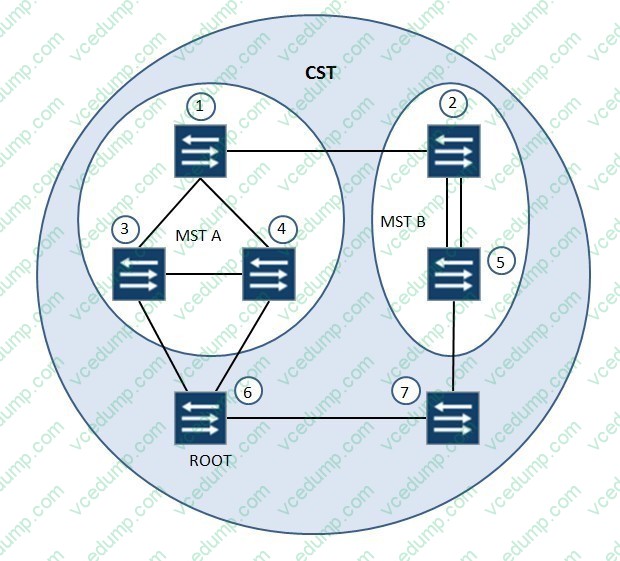
-- Exhibit -Click the Exhibit button.
Based on the exhibit, which statement about the Layer 2 topology is true?
A. A port on switch 3 or switch 4 towards the CST root (switch 6) is blocking traffic.
B. A total of 64 MST instances for MST region A and region B can be configured.
C. MSTI BPDUs are exchanged between MST regions and the CST root bridge.
D. IST BPDUs are exchanged only between switches 1 and 2, and between switches 6 and 7. -
Question 182:
What must you add to the configuration to allow a receiver connected to interface ge 0/0/6 to subscribe to group 232.0.0.1 from source 172.16.7.1?
A. Add sparse mode to PIM interface ge 0/0/6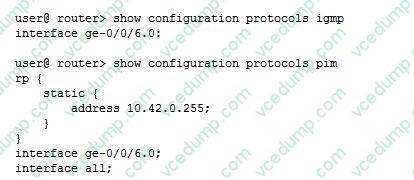
B. Add version 2 to the state RP configuration
C. Add version 3 to IGMP interface ge 0/0/6
D. Add version 2 to IGMP interface ge 0/0/6 -
Question 183:
-- Exhibit
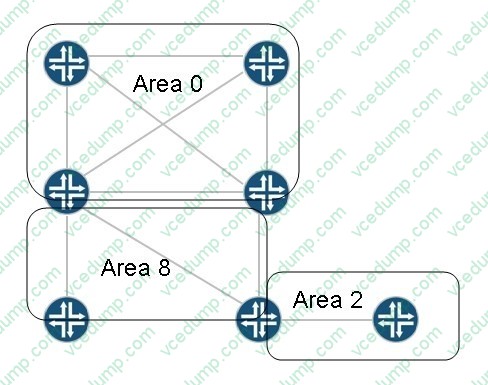
-- Exhibit -
Click the Exhibit button.
In the exhibit, which statement about the ABR between Area 8 and Area 2 is true?
A. The router has connectivity to all areas.
B. The router has connectivity to Area 8 only.
C. The router has connectivity to Area 2 only.
D. The router has connectivity to all routers in Area 8 and Area 2. -
Question 184:
You are troubleshooting a problem on interface ge-0/0/3. Which command shows statistics in real time?
A. show interfaces statistics
B. monitor interface statistics ge-0/0/3
C. monitor interface traffic
D. monitor traffic interface ge-0/0/3 -
Question 185:
-- Exhibit -user@R1> show pim join extensive InstancE. PIM.master Family: INET R = Rendezvous Point Tree, S = Sparse, W = Wildcard Group: 224.50.50.50 SourcE. * RP: 10.100.100.10 Flags: sparse,rptree,wildcard Upstream interfacE. ge-0/0/10.0 Upstream neighbor: 172.28.55.5 Upstream statE. Join to RP UptimE. 00:00:10 Downstream neighbors: InterfacE. ge-0/0/2.0
172.28.57.5 StatE. Join Flags: SRW Timeout: 209
Group: 224.50.50.50 SourcE. 10.100.10.10 Flags: sparse,spt Upstream interfacE. ge-0/0/6.0 Upstream neighbor: 172.28.56.5 Upstream statE. Join to Source, Prune to RP UptimE. 00:00:10 Keepalive timeout: 276 Downstream neighbors: InterfacE. ge-0/0/2.0
172.18.57.5 StatE. Join Flags: S Timeout: 209 -- Exhibit -
Click the Exhibit button.
Referring to the output shown in the exhibit, which three statements are true about the PIM implementation on R1? (Choose three.)
A. R1 is receiving multicast traffic over the RPT.
B. R1 is receiving multicast traffic over the SPT.
C. Interface ge-0/0/10 provides the shortest path to the source.
D. The multicast stream flows from 10.100.10.10 to 172.18.57.5.
E. Interface ge-0/0/6 provides the shortest path to the source. -
Question 186:
-- Exhibit -
[edit]
user@R1# show routing-options router-id
router-id 1.1.1.1;
[edit]
user@R1# show protocols ospf
area 0.0.0.0 {
interface ge-0/0/7.0;
}
[edit]
user@R2# show routing-options router-id
router-id 2.2.2.2;
[edit]
user@R2# show protocols ospf
area 0.0.0.0 {
interface ge-0/0/8.0 {
priority 200;
}
}
[edit]
user@R3# show routing-options router-id
router-id 222.255.255.255;
[edit]
user@R3# show protocols ospf
area 0.0.0.0 {
interface ge-0/0/8.0;
}
[edit]
user@R4# show routing-options router-id
router-id 239.255.255.255;
[edit]
user@R4# show protocols ospf
area 0.0.0.0 {
interface ge-0/0/6.0 {
priority 0;
}
}
-- Exhibit -
Click the Exhibit button.
All four routers in the exhibit are in the same broadcast domain. The routers were powered on at the same time.
Based on the configurations, which devices are the DR and the BDR
A. R4 is the DR and R2 is the BDR.
B. R2 is the DR and R3 is the BDR.
C. R2 is the DR and R1 is the BDR.
D. R3 is the DR and R2 is the BDR. -
Question 187:
-- Exhibit -
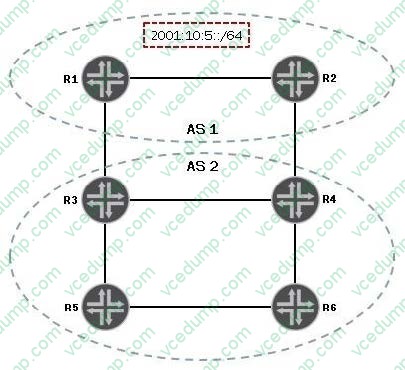
-- Exhibit -Click the Exhibit button.
Referring to the exhibit, you must ensure that traffic to the 2001:10:5::/64 network leaves AS 2 through R3.
Given that all BGP attributes are at their default, how would you accomplish this task?
A. On R1, configure a MED of 50 for the 2001:10:5::/64 route.
B. On R2, configure a MED of 50 for the 2001:10:5::/64 route.
C. On R3, configure a MED of 50 for the 2001:10:5::/64 route.
D. On R4, configure a MED of 50 for the 2001:10:5::/64 route. -
Question 188:
-- Exhibit -[edit protocols] user@switch# commit [edit protocols ] 'mstp' Another xSTP protocol is enabled error : Another xSTP protocol is enabled error: configuration check-out failed -- Exhibit -
Click the Exhibit button.
Referring to the exhibit, a customer is receiving an error while committing the operation on the switch.
What are two reasons for this problem? (Choose two.)
A. VSTP and RSTP are both configured.
B. MSTP and RSTP are both configured.
C. Only STP is configured.
D. MSTP and STP are both configured. -
Question 189:
When 802.1X, MAC-RADIUS, and Captive Portal are enabled on an interface, which authentication sequence occurs?
A. The authentication sequence is based on the order of the configuration.
B. If MAC-RADIUS is rejected, Captive Portal will start. If Captive portal is timed out, 802.1X will start.
C. If 802.1X times out, then MAC-RADIUS will start. If MAC-RADIUS is timed out by the RADIUS server, then Captive Portal will start.
D. If 802.1X times out, then MAC-RADIUS will start. If MAC-RADIUS is rejected by the RADIUS server, then Captive Portal will start. -
Question 190:
Which set of BGP attributes is preferred by the Junos OS?
A. MED. 100 AS path: 50 50 50 Local preferencE. 50 Origin: I
B. MED. 50 AS path: 50 50 50 Local preferencE. 1 Origin: E
C. MED. 100 AS path: 50 50 50 50 Local preferencE. 50 Origin: I
D. MED. 50 AS path: 50 50 50 Local preferencE. 50 Origin: E
Related Exams:
-
JN0-102
Internet Associate, Junos(JNCIA-Junos) -
JN0-104
Junos, Associate (JNCIA-Junos) -
JN0-105
Junos, Associate (JNCIA-Junos) -
JN0-106
Junos - Associate (JNCIA-Junos) Junos OS 21.2 -
JN0-1101
Juniper Networks Certified Design Associate (JNCDA) -
JN0-1103
Design, Associate (JNCIA-Design) -
JN0-130
Juniper networks Certified internet specialist.e(jncis-e) -
JN0-1301
Data Center Design, Specialist (JNCDS-DC) -
JN0-1302
Data Center Design Specialist (JNCDS-DC) -
JN0-1331
Security Design, Specialist (JNCDS-SEC)
Tips on How to Prepare for the Exams
Nowadays, the certification exams become more and more important and required by more and more enterprises when applying for a job. But how to prepare for the exam effectively? How to prepare for the exam in a short time with less efforts? How to get a ideal result and how to find the most reliable resources? Here on Vcedump.com, you will find all the answers. Vcedump.com provide not only Juniper exam questions, answers and explanations but also complete assistance on your exam preparation and certification application. If you are confused on your JN0-643 exam preparations and Juniper certification application, do not hesitate to visit our Vcedump.com to find your solutions here.